DAKAR: France on Thursday formally handed back its last two military bases in Senegal, leaving Paris with no permanent army camps in either west or central Africa.
Ending the French army’s 65 years in independent Senegal, the pull-out comes after similar withdrawals across the continent, with former colonies increasingly turning their backs on their former ruler.
The move comes as the Sahel region faces a growing jihadist conflict across Mali, Burkina Faso and Niger that is threatening the wider west African region.
A recent string of attacks this month in Mali included an assault on a town on the border with Senegal.
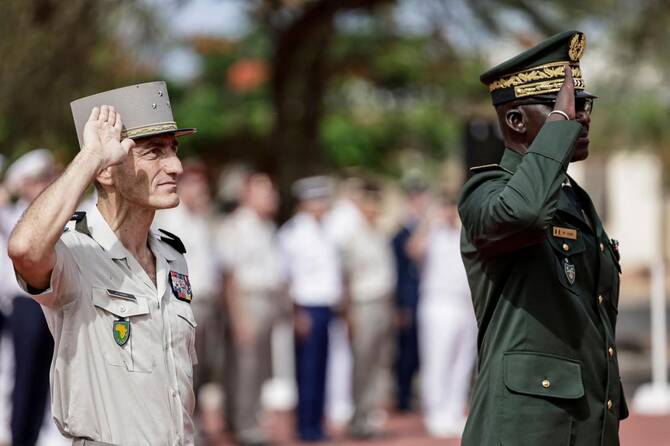
France returned Camp Geille, its largest base in the west African country, and its airfield at Dakar airport, in a ceremony attended by top French and Senegalese officials.
They included Senegalese chief of staff General Mbaye Cisse and General Pascal Ianni, the head of the French forces in Africa.
Cisse said the handover marked “an important turning point in the rich and long military journey of our two countries.”
He said the “new objectives” were aimed at “giving new content to the security partnership.”
Senegalese troops were working “to consolidate the numerous skills gained it its quest for strategic autonomy,” he added.
The general ended his speech with a quote from Antoine de Saint-Exupery, the French author of “The Little Prince,” who spent several months in Dakar: “For each ending there is always a new departure.”
Ianni said Paris was “reinventing partnerships in a dynamic Africa.”
“We have to do things differently, and we don’t need permanent bases to do so,” he said.
The French general however insisted that the pull-out “takes nothing away from the sacrifices made yesterday by our brothers-in-arms in Africa for our respective interests.”
Around 350 French soldiers, primarily tasked with conducting joint operations with the Senegalese army, are now leaving, marking the end of a three-month departure process that began in March.
After storming to victory in 2024 elections promising radical change, Senegal’s President Bassirou Diomaye Faye demanded France withdraw troops from the country by 2025.
Unlike the leaders of other former colonies such as junta-run Burkina Faso, Mali and Niger, however, Faye has insisted that Senegal will keep working with Paris.
Reinventing partnerships
Senegal was one of France’s first colonies in Africa.
After gaining independence in 1960, Senegal became one of France’s staunchest African allies, playing host to French troops throughout its modern history.
Faye’s predecessor, Macky Sall, continued that tradition.
However Faye, who ran on a ticket promising a clean break with the Sall era, has said that Senegal will treat France like any other foreign partner.
Pledging to make his country more self-sufficient, the president gave a deadline of the end of 2025 for all foreign armies to withdraw.
“Senegal is an independent country, it is a sovereign country, and sovereignty does not accept the presence of military bases in a sovereign country,” Faye said at the end of 2024.
He maintained nonetheless that France remained “an important partner for Senegal.”
Faye has also urged Paris to apologize for colonial atrocities, including the massacre on December 1, 1944, of dozens of African soldiers who had fought for France in World War II.
A lawmaker from the president’s ruling Pastef party, Guy Marius Sagna, hailed Thursday’s “end to the presence of the French occupying army.”
“Bravo to President Diomaye Faye!... Bravo to the patriots! Decolonization continues,” he told the press.
French former empire
With governments across Africa increasingly questioning the presence of French soldiers, Paris has closed or reduced numbers at bases across its former empire.
In February, Paris handed back its sole remaining base in Ivory Coast, ending decades of French presence at the site.
The month before, France turned over the Kossei base in Chad, its last military foothold in the unrest-hit Sahel region.
Coups in Burkina Faso, Niger and Mali between 2020 and 2023 have swept military strongmen to power.
All have cut ties with France and turned to Russia instead for help in fighting the Sahel’s decade-long jihadist insurgency.
The Central African Republic, also a former French colony to which the Kremlin has sent mercenaries, has likewise demanded a French pull-out.
Meanwhile, the army has turned its base in Gabon into a camp shared with the central African nation focused on training.
Only the tiny Horn of Africa nation of Djibouti will play host to a permanent French army base following Thursday’s withdrawal.
France intends to make its base in Djibouti, home to some 1,500 people, its military headquarters for Africa.


![]()

French army leaves Senegal, ending military presence in west Africa
Short Url
https://arab.news/mnm5n
French army leaves Senegal, ending military presence in west Africa
- France returned Camp Geille on Thursday, its largest base in the west African country, and its airfield at Dakar airport
- Senegalese chief of staff said handover marked “an important turning point” in the two countries’ military partnership


Latest updates


© 2026 SAUDI RESEARCH & PUBLISHING COMPANY, All Rights Reserved And subject to Terms of Use Agreement.