

UN experts demand probe into Belarus deaths in custody

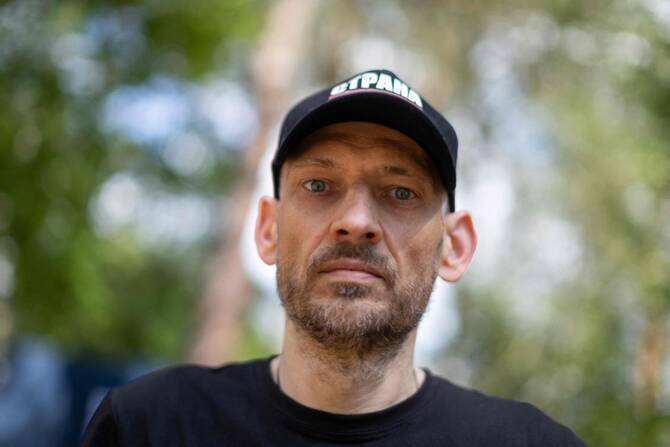
Belarusian opposition activist Sergei Tikhanovsky looks into the camera after an AFP interview, in a forest near Grodek, Poland, close to the Belarusian border, where he attends a festival organized by the Belarusian opposition on July 12, 2025. (AFP)
Short Url
Updated 16 July 2025
Follow

UN experts demand probe into Belarus deaths in custody

  • “Several individuals identified by human rights defenders as political prisoners have died in custody or shortly after being released,” the UN experts said
  • The dead included people who took part in protests surrounding the 2020 presidential elections

GENEVA: United Nations experts on Wednesday demanded transparent investigations into the deaths of people detained in Belarus for voicing political dissent.

Ruled by President Alexander Lukashenko since 1994, Belarus has outlawed all genuine opposition parties and faces accusations of persecuting dissidents.

“Over the past four years, several individuals identified by human rights defenders as political prisoners have died in custody or shortly after being released,” the UN experts said in a joint statement.

They said the dead included people who took part in protests surrounding the 2020 presidential elections, which rights groups and critics said Lukashenko had rigged.

The call for investigations came from Nils Muiznieks, special rapporteur on human rights in Belarus, plus the rapporteurs on freedom of expression, protecting rights while countering terrorism, and on extrajudicial executions.

UN special rapporteurs are independent figures appointed by the Human Rights Council to report in their field of expertise. They do not speak for the United Nations itself.

The experts raised the cases of three individuals who died in custody.

“It is of the utmost importance to thoroughly investigate the alleged instances of ill-treatment and
neglect that resulted in the deaths,” they said, while highlighting the deaths of others designated as political prisoners by human rights defenders.

“There are strong reasons to believe that these individuals lost their lives in retaliation for exercising their civil and political rights, including the rights to freedom of expression and peaceful assembly.”

Presenting an annual report to the Human Rights Council, last month Muiznieks said the rights picture in Belarus was “dire” and getting worse.

The eastern European country still holds more than 1,000 political prisoners in its jails, according to Belarusian human rights group Viasna.

“If these figures are even close to being accurate, Belarus probably has the most political prisoners per capita in the world,” said Muiznieks.


Arrivederci Milan Cortina. Italian organizers contemplating Rome bid for 2040 Summer Olympics

Updated 4 sec ago
Follow

Arrivederci Milan Cortina. Italian organizers contemplating Rome bid for 2040 Summer Olympics

  • The entire idea of the Milan Cortina Games was born out of the rejection of Rome’s bid for the 2024 Olympics by then-Mayor Virginia Raggi a decade ago
CORTINA D’AMPEZZO: Goodbye Milan Cortina. See you in Rome in 2040?
Now that the just-concluded Winter Olympics have been hailed for setting “a new, very high standard” by IOC President Kirsty Coventry, Italian organizers are contemplating a bid for the 2040 Summer Games.
“I think our country deserves another Summer Olympics,” Italian Olympic Committee (CONI) president Luciano Buonfiglio said over the weekend. “But let’s take it step by step. A candidacy has to be agreed on and shared with the government.”
The idea of the Milan Cortina Games was born out of the rejection of Rome’s bid for the 2024 Olympics by then-Mayor Virginia Raggi a decade ago. That came four years after then-Premier Mario Monti scrapped the city’s candidacy for the 2020 Games because of financial concerns; and after a Rome bid was narrowly defeated by Athens in the final round of voting for 2004.
“Scars help you remember” the defeats, said Giovanni Malagò, the head of the Milan Cortina organizing committee and former CONI president.
But Malagò, who is also an IOC member, suggested that Rome has a couple of key advantages in Olympic circles: its “unique” history of failed bids and the centerpiece venue for any Summer candidacy.
“Rome has a 70,000-seat stadium with an athletics track — which is huge in terms of sustainability,” Malagò said.
The existing Stadio Olimpico and surrounding Foro Italico complex would be a natural setting for athletics and swimming — the two biggest sports at the Summer Games.
Rome Mayor Roberto Gualtieri said during the Milan Cortina Games that he believes his city has “the conditions” for another bid — especially after welcoming more than 33 million people to the capital and Vatican for the 2025 Holy Year.
“If it’s considered a realistic goal, I’m open to collaborating with the IOC, government and CONI in order to create the most competitive bid possible,” Gualtieri said. “A capital like Rome should not be afraid of big challenges. The Jubilee showed off our organizational capacity for big events.”
With the 2028 Games coming up in Los Angeles and 2032 in Brisbane, Australia; and India and Qatar bidding for 2036; the 2040 Summer Games seem destined to return to Europe.
“Now is not the time to discuss this. It’s premature, wrong and even counterproductive,” Malagò said. “We need to understand the geopolitical landscape for post-2032.”
Malagò wouldn’t elaborate on speculation that he will run for Rome mayor after he finishes off his Milan Cortina duties, saying he would discuss “ideas that I have in mind” after next month’s Paralympics.
Andrea Abodi, Italy’s Minister for Sport and Youth, added: “It doesn’t necessarily require an announcement to build a winning bid.”