
DEIR AL-BALAH, Gaza Strip: Malnutrition rates among children in the Gaza Strip have doubled since Israel sharply restricted the entry of food in March, the UN said Tuesday. New Israeli strikes killed more than 90 Palestinians, including dozens of women and children, according to health officials.
Hunger has been rising among Gaza’s more than 2 million Palestinians since Israel broke a ceasefire in March to resume the war and banned all food and other supplies from entering Gaza, saying it aimed to pressure Hamas to release hostages. It slightly eased the blockade in late May, allowing in a trickle of aid.

Zainab Abu Haleeb, a five-month-old Palestinian girl diagnosed with malnutrition, according to medics, lies on a bed as she receives treatment at Nasser hospital in Khan Younis, in the southern Gaza Strip July 15, 2025. (REUTERS)
UNRWA, the main UN agency caring for Palestinians in Gaza, said it had screened nearly 16,000 children under age 5 at its clinics in June and found 10.2 percent of them were acutely malnourished. By comparison, in March, 5.5 percent of the nearly 15,000 children it screened were malnourished.
New airstrikes kill several families
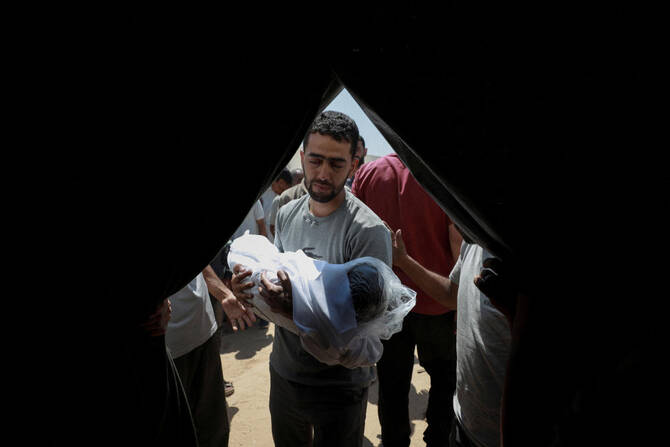
One strike in the northern Shati refugee camp killed a 68-year-old Hamas member of the Palestinian legislature, as well as a man and a woman and their six children who were sheltering in the same building, according to officials from the heavily damaged Shifa Hospital, where the casualties were taken.
One of the deadliest strikes hit a house in Gaza City’s Tel Al-Hawa district on Monday evening and killed 19 members of the family living inside, according to Shifa Hospital. The dead included eight women and six children. A strike on a tent housing displaced people in the same district killed a man and a woman and their two children.
The Israeli military did not comment on the strikes.
Gaza’s Health Ministry said in a daily report Tuesday afternoon that the bodies of 93 people killed by Israeli strikes had been brought to hospitals in Gaza over the past 24 hours, along with 278 wounded. It did not specify the total number of women and children among the dead.
The Hamas politician killed in a strike early Tuesday, Mohammed Faraj Al-Ghoul, was a member of the bloc of representatives from the group that won seats in the Palestinian Legislative Council in the last national elections, held in 2006.
The Israeli military says it only targets militants and tries to avoid harming civilians. It blames civilian deaths on Hamas because the militants operate in densely populated areas. But daily, it hits homes and shelters where people are living without warning or explanation of the target.
Malnutrition grows
UNICEF, which screens children separately from UNRWA, also reported a marked increase in malnutrition cases. It said this week its clinics had documented 5,870 cases of malnutrition among children in June, the fourth straight month of increases and more than double the around 2,000 cases it documented in February.
Experts have warned of famine since Israel tightened its lengthy blockade in March.
Israel has allowed an average of 69 trucks a day carrying supplies, including food, since it eased the blockade in May, according to the latest figures from COGAT, the Israeli military agency in charge of coordinating aid. That is far below the hundreds of trucks a day the UN says are needed to sustain Gaza’s population.
On Tuesday, COGAT blamed the UN for failing to distribute aid, saying in a post on X that thousands of pallets of supplies were inside Gaza waiting to be picked up by UN trucks. The UN says it has struggled to pick up and distribute aid because of Israeli military restrictions on its movements and the breakdown in law and order.
Israel has also let in food for distribution by an American contractor, the Gaza Humanitarian Foundation. GHF says it has distributed food boxes with the equivalent of more than 70 million meals since late May at the four centers it runs in the Rafah area of southern Gaza and in central Gaza.
More than 840 Palestinians have been killed and more than 5,600 others wounded in shootings as they walk for hours trying to reach the GHF centers, according to the Health Ministry. Witnesses say Israeli forces open fire with barrages of live ammunition to control crowds on the roads to the GHF centers, which are located in military-controlled zones.
The military says it has fired warning shots at people it says have approached its forces in a suspicious manner. GHF says no shootings have taken place in or immediately around its distribution sites.
No breakthrough in ceasefire efforts
The latest attacks came after US President Donald Trump and Israeli Prime Minister Benjamin Netanyahu held two days of talks last week that ended with no breakthrough in negotiations over a ceasefire and hostage release.
Israel has killed more than 58,400 Palestinians and wounded more than 139,000 others in its retaliation campaign since Hamas’ Oct. 7, 2023, attack, according to Gaza’s Health Ministry. Just over half the dead are women and children, according to the ministry, which does not distinguish between civilians and militants in its tally.
Israel has vowed to destroy Hamas after its attack 21 month ago, in which militants stormed into southern Israel and killed some 1,200 people, mostly civilians. They abducted 251 others, and the militants are still holding 50 hostages, less than half of them believed to be alive.
US calls for probe into killing of Palestinian-American
In a separate development, US Ambassador Mike Huckabee called on Israel to investigate the killing of a 20-year-old Palestinian-American whose family said was beaten to death by Jewish settlers over the weekend in the Israeli-occupied West Bank.
“There must be accountability for this criminal and terrorist act,” Huckabee wrote on X.
Seifeddin Musalat, born in Florida, and a local friend were killed Friday. Musalat was beaten to death by Israeli settlers on his family’s land, his cousin Diana Halum told reporters. The family had called on the US State Department to investigate his death and hold the settlers accountable.
The Israeli military said a confrontation erupted after Palestinians hurled stones at Israelis in the area earlier in the day, lightly wounding two people.
Huckabee, like many in the Trump administration, is a strong supporter of Israeli settlements, which are considered illegal by most of the international community and seen by the Palestinians as a major obstacle to peace.
Israel strikes Lebanon’s Bekaa Valley
Also on Tuesday, Israel launched a series of strikes in Lebanon’s eastern Bekaa Valley, targeting what the military said were compounds of the Hezbollah militant group.
Lebanon’s state-run National News Agency said that one of the strikes hit a Syrian refugee camp, killing seven Syrians. Altogether, the strikes killed 12 people and wounded eight, it said. Hezbollah said one of the strikes hit a rig used to drill water wells.
Israel has continued to carry out near-daily strikes in Lebanon since a US-brokered ceasefire agreement nominally brought an end to the latest Israel-Hezbollah war in November. Some 4,000 people were killed in Lebanon during the war and more than 250 since the ceasefire.