

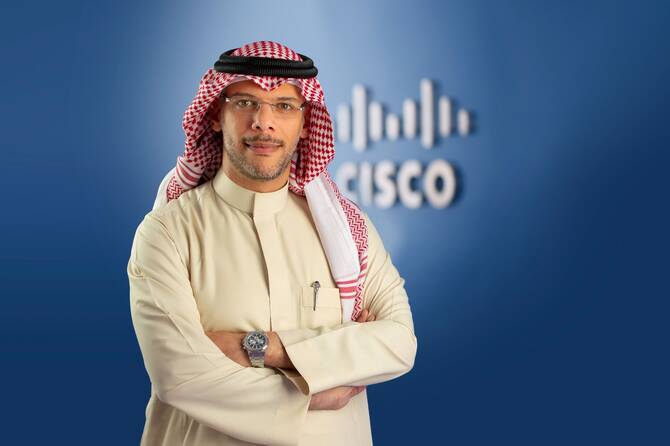

On the sidelines of Cisco Connect KSA, Salman Faqeeh, managing director of Cisco Saudi Arabia, discussed how the global technology leader is helping to accelerate the Kingdom’s digital transformation and build a future-ready economy. With nearly three decades of presence in Saudi Arabia, Cisco’s story is closely intertwined with the country’s ambitions under Vision 2030.
Powering the AI revolution in Saudi Arabia
As Saudi Arabia doubles down on its efforts to lead the AI revolution, Cisco is working hand-in-hand with government and enterprise partners to build the infrastructure of the future. Faqeeh highlighted Cisco’s groundbreaking initiative with HUMAIN, Saudi Arabia’s homegrown AI enterprise, to build one of the world’s most open and scalable AI infrastructures.
“Saudi Arabia is laying the foundation for a globally competitive AI ecosystem,” Faqeeh said. “With local data centers already operational for security cloud services and the Webex platform, and plans underway to bring the Meraki cloud to the Kingdom, Cisco is committed to enabling businesses to scale confidently in a cloud-first, AI-driven world.”
Upskilling the next generation
Beyond technology, Cisco is investing heavily in Saudi talent. Faqeeh announced the company’s plans to launch the Cisco AI Institute at King Abdullah University of Science and Technology, a center dedicated to driving AI innovation and preparing the next generation of Saudi talent.
Cisco is also scaling its efforts through digital upskilling, pledging free training for 500,000 learners over the next five years in critical areas such as AI, cybersecurity, and data science. This builds on the success of Cisco’s Networking Academy, which has already trained over 401,000 learners in the Kingdom — 36 percent of whom are women.
“Our goal is to prepare Saudi talent to thrive in an AI-powered world,” Faqeeh said. “Partnerships with institutions like King Abdulaziz City for Science and Technology are also helping expand the pool of Cisco Certified Internetwork Experts, ensuring the Kingdom has the skilled workforce it needs to manage complex networks that support the AI future.”
Driving local manufacturing
Cisco is also laying the groundwork for local manufacturing operations in Saudi Arabia, starting with wireless technologies. According to Faqeeh, this effort will evolve in response to market demand, supporting the Kingdom’s goal of building a sustainable and diversified economy.
A rapidly advancing digital landscape
Reflecting on the pace of digital transformation, Faqeeh praised Saudi Arabia’s vision and execution. Over the past six years, the government has invested more than $24.8 billion in digital infrastructure. Internet penetration has reached 99 percent, with mobile Internet speeds surpassing 215 Mbps. The Kingdom now ranks first regionally and fourth globally for government digital services.
“Saudi Arabia is no longer just a consumer of technology; it’s becoming a global leader,” Faqeeh said. “We see immense opportunities for Cisco to contribute, especially in building AI-ready data centers, driving digital resilience, and developing future-proof workplaces.”
Strengthening cybersecurity in the age of AI
With the Kingdom accelerating its adoption of emerging technologies, cybersecurity has become a top priority. Cisco’s recent Cybersecurity Readiness Index shows that 91 percent of Saudi organizations experienced AI-related cyber incidents last year, yet an impressive 93 percent of organizations already leverage AI in strengthening security strategies.
“Cybercriminals are using AI to automate and scale their attacks. Organizations can no longer rely solely on human-scale defenses,” Faqeeh explained. “Cisco is embedding AI across its security portfolio to help SecOps teams assist, automate, and augment their capabilities.”
Cisco’s AI Defense solution protects both the development and use of AI applications, safeguarding enterprises against misuse, data leakage, and sophisticated cyberthreats. Also Cisco’s cloud security data center in Saudi Arabia powers cloud-based security services such as Secure Service Edge, Cisco Secure Access, and Umbrella DNS, providing local organizations with flexible, AI-powered protection.
Preparing for the future of industry transformation
Looking ahead, Faqeeh highlighted several critical trends shaping Saudi Arabia’s industries. AI is transforming sectors from healthcare to finance, with organizations deploying secure, scalable infrastructures to harness practical AI use cases — such as predictive maintenance and automated onboarding.
The next leap, he said, will be agentic AI: autonomous AI tools capable of learning and acting independently. Supporting this evolution will require ultra-fast, low-latency, energy-efficient networks, as well as integrated security at every layer.
“We are on the verge of an AI-powered future that is difficult to fully comprehend today,” Faqeeh said. “The infrastructure we build now — whether in networking, compute, or cybersecurity — will determine how far we can go.”
Vision 2030: A blueprint for the digital economy
Saudi Arabia’s transformation is already bearing fruit. The digital economy contributes 15 percent to the GDP, equivalent to SR495 billion ($132 billion). The ICT market surpassed SR180 billion in 2024 and is projected to reach $43.5 billion by 2027. The AI sector alone is expected to add $135 billion to the Saudi economy by 2030, accounting for 12 percent of the GDP.
“Vision 2030 isn’t just a set of goals — it’s a blueprint for building a knowledge-based, innovation-driven economy,” Faqeeh added. “At Cisco, we are proud to partner with Saudi Arabia on this journey, helping turn bold ambitions into reality.”


