


LONDON: A Financial Times investigation, published on July 4, found that a consulting firm connected to the Gaza Humanitarian Foundation secured a multimillion-dollar contract to help shape the initiative and a proposal for the possible “relocation” of Palestinians from the Gaza Strip.
The Boston Consulting Group was found to have played a central role in designing and managing the US- and Israeli-backed project, which aimed to replace the UN as the primary coordinator of humanitarian aid in Gaza.
Amid growing criticism, BCG denied any ongoing involvement in the Gaza Humanitarian Foundation. In a June 7 statement, the firm said it initially provided “pro bono support” in October 2024 to help launch “an aid organization intended to operate alongside other relief efforts.”

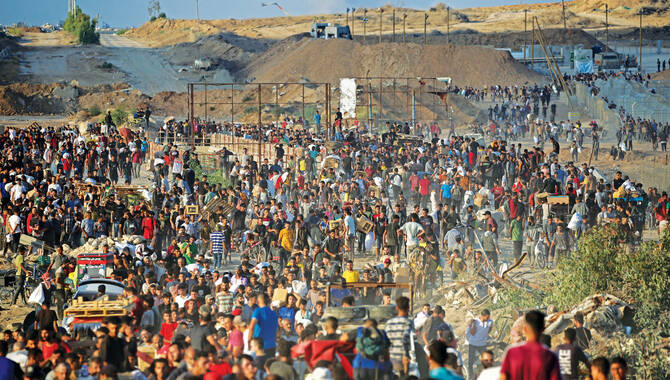
BCG has faced heavy scrutiny for its role in Gaza’s postwar reconstruction, mainly through its work with the controversial Gaza Humanitarian Foundation. (AFP file)
The firm said two senior US-based partners who led the initiative “failed to disclose the full nature of the work” and later engaged in “unauthorized” activities outside the firm’s oversight.
“Their actions reflected a serious failure of judgment and adherence to our standards,” the firm said. “We are shocked and outraged by the actions of these two partners. They have been exited from the firm.
“BCG disavows the work they undertook. It has been stopped, and BCG has not and will not be paid for any of their work.”
The company emphasized it is strengthening internal controls to prevent future breaches. “We deeply regret that in this situation we did not live up to our standards,” the statement said. “We are committed to accountability for our failures and humility in how we move forward.”
FAST FACTS:
• A Financial Times investigation examined BCG’s role in Gaza aid planning, including controversial proposals for Palestinian relocation.
• BCG disavowed the work and fired two senior partners, but documents suggest deeper involvement and lapses in internal oversight.
• The scandal underscores wider concerns about consulting firms’ ethics, with similar controversies involving PwC, KPMG, EY and McKinsey.
Following the FT story, BCG issued another statement on July 6 disputing aspects of the reporting. “Recent media reporting has misrepresented BCG’s role in post-war Gaza reconstruction,” the firm said.
BCG reiterated that the initiative was not an official company project and was carried out in secret. “Two former partners initiated this work, even though the lead partner was categorically told not to,” the statement read.
“This work was not a BCG project. It was orchestrated and run secretly outside any BCG scope or approvals. We fully disavow this work. BCG was not paid for any of this work.”

Buildings that were destroyed during the Israeli ground and air operations stand in northern of Gaza Strip as seen from southern Israel on July 10, 2025. (AP Photo)
However, individuals familiar with “Aurora” told the FT that BCG’s involvement ran deeper. The report revealed that BCG created a financial model for Gaza’s postwar reconstruction that included scenarios for mass displacement.
This revelation intensified scrutiny of the consulting industry’s ethical boundaries.
“Consulting companies… are held to a higher standard of professionalism and ethics than other lines of work,” Dr. Abdel Aziz Aluwaisheg, the Gulf Cooperation Council assistant secretary-general for political affairs and negotiation, wrote in an April opinion piece for Arab News.
He warned that without corrective action, major firms risk alienating clients.

Displaced Palestinians carrying relief supplies from the Gaza Humanitarian Foundation (GHF) return from aid distribution centers in Rafah to their tents in the southern Gaza Strip on May 29, 2025. (AFP)
ndeed, in recent years, top consulting firms like McKinsey, PwC, KPMG, and EY have faced growing scrutiny for putting profit over ethics, with scandals revealing conduct lapses worldwide.
McKinsey, for instance, faced heavy backlash for its role in the US opioid crisis. The firm was accused of helping Purdue Pharma and other manufacturers to aggressively market addictive painkillers, including OxyContin, The New York Times reported.
Aluwaisheg noted in his op-ed that some of these ethical lapses “are quite common throughout the consulting business.”
However, he added, “big firms are more likely to commit them,” citing sprawling operations that limit senior management oversight.
The industry’s core business model may be the issue: consulting firms adopted law firms’ high-fee model for expert advice — without their legal liability.
Despite this, demand for consulting services remains high. Aluwaisheg believes governments and businesses will continue to need outside expertise.

People walk by PricewaterhouseCoopers (PwC) New York headquarters. (AFP)
Still, accountability concerns have prompted some governments to take action. In February, Saudi Arabia’s Public Investment Fund banned PwC from taking on new advisory and consulting contracts for one year.
Some media outlets reported that the decision was related to an ethical violation tied to an alleged recruitment of a senior-level employee from the client’s side. The suspension did not impact PwC’s auditing work.
These events highlight ongoing concerns over consulting firms’ roles in controversial actions. In April 2024, KPMG’s Dutch arm was fined $25 million after over 500 staff cheated on internal training exams, Reuters reported.
Yet the BCG case may represent a new low for the industry.
The Gaza Humanitarian Foundation’s model bypassed traditional organizations like the UN, restricted aid distribution to limited sites under Israeli oversight and relied on private security contractors. This move has had deadly consequences.
According to Gaza’s health authority, at least 740 Palestinians have been killed and almost 4,900 injured while attempting to reach aid centers, drawing condemnation from humanitarian organizations and UN officials.

Displaced Palestinians look around on alert in the wake of gunfire shots as they receive food packages from a US-backed foundation pledging to distribute humanitarian aid in western Rafah in the southern Gaza Strip on May 27, 2025. (AFP)
UN aid chief Tom Fletcher called the initiative a “fig leaf for further violence and displacement” of Palestinians in the war-torn enclave.
In a July 10 letter to the FT editor, BCG’s CEO Christoph Schweizer pushed back against the allegations that his firm endorsed or profited from projects related to Gaza.
“None of that is true,” Schweizer wrote, adding that “a few people from BCG were involved in such work. They never should have been.”
Adding another layer to the controversy, FT reported on July 6 that staff from the Tony Blair Institute were also implicated in postwar planning that included scenarios for mass Palestinian displacement — despite being prominent advocates for peace in the Middle East.

Christoph Schweizer, CEO of Boston Consulting Group. (Supplied)
The plan, seen by the FT, imagined Gaza as a regional economic hub, complete with a “Trump Riviera” and “Elon Musk Smart Manufacturing Zone,” based on financial models developed by BCG.
While the Tony Blair Institute for Global Change denied authoring “The Great Trust” blueprint, it acknowledged two staff joined Gaza planning calls and chats. It also denied backing population relocation.
Arab News approached the TBI for comment, but did not receive a response by the time of publication.
Nevertheless, its involvement has triggered additional concerns about the ethics of postwar reconstruction planning and the role of consulting firms in shaping policies with far-reaching humanitarian consequences.


