
CAIRO/DOHA: Hamas and Israel on Saturday accused the other of blocking attempts to strike a Gaza ceasefire agreement, nearly a week into indirect talks between the two sides to halt 21 months of bitter fighting in the Palestinian territory.
A Palestinian source with knowledge of the discussions in Qatar told AFP that Israel’s proposals to keep its troops in the war-torn territory were holding up a deal for a 60-day pause.
But on the Israeli side, a senior political official, also speaking on condition of anonymity due to the sensitivities of the talks, accused the militant group of being inflexible and deliberately trying to scuttle efforts for an accord.
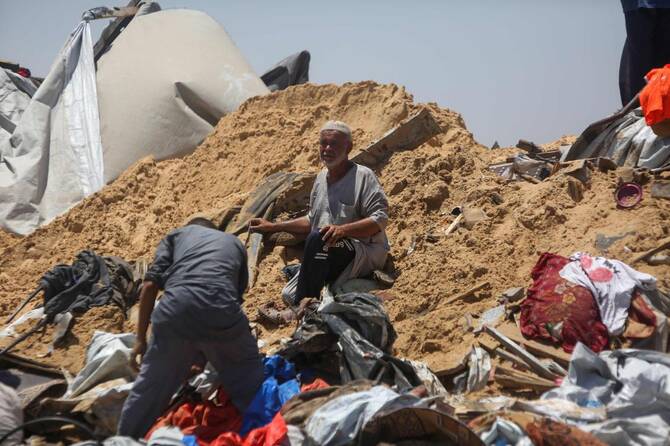
On the ground, Gaza’s civil defense agency said more than 20 people were killed across the territory on Saturday, including in an overnight air strike on an area sheltering the displaced.
“While we were sleeping, there was an explosion... where two boys, a girl and their mother were staying,” Bassam Hamdan told AFP after the attack in an area of Gaza City.
“We found them torn to pieces, their remains scattered,” he added.
In southern Gaza, bodies covered in white plastic sheets were brought to the Nasser hospital in Khan Yunis while wounded in Rafah were taken for treatment by donkey cart, on stretchers or carried.
Both Hamas and Israel have said that 10 hostages held since the militants’ October 7, 2023 attack that sparked the war would be released — if an agreement is reached.
Israeli Prime Minister Benjamin Netanyahu said he was prepared then to enter talks for a more permanent end to hostilities.
But one Palestinian source said Israel’s refusal to accept Hamas’s demand for a complete withdrawal of troops from Gaza was holding back progress in the talks.
A second source said mediators had asked both sides to postpone discussions until US President Donald Trump’s special envoy, Steve Witkoff, arrives in the Qatari capital.
“The negotiations in Doha are facing a setback and complex difficulties due to Israel’s insistence, as of Friday, on presenting a map of withdrawal, which is actually a map of redeployment and repositioning of the Israeli army rather than a genuine withdrawal,” the first source said.
They added that Israel was proposing to maintain military forces in more than 40 percent of the Palestinian territory, forcing hundreds of thousands of displaced Palestinians into a small area near the city of Rafah, on the border with Egypt.
“Hamas’s delegation will not accept the Israeli maps... as they essentially legitimize the reoccupation of approximately half of the Gaza Strip and turn Gaza into isolated zones with no crossings or freedom of movement,” they said.
A senior Israeli political official countered later that it was Hamas that rejected what was on the table, accusing the group of “creating obstacles” and “refusing to compromise” with the aim of “sabotaging the negotiations.”
“Israel has demonstrated a willingness to show flexibility in the negotiations, while Hamas remains intransigent, clinging to positions that prevent the mediators from advancing an agreement,” the official added in a statement sent to AFP.
The Hamas attacks on Israel in 2023 resulted in the deaths of at least 1,219 people, most of them civilians, according to an AFP tally based on Israeli figures.
Of the 251 hostages seized, 49 are still being held, including 27 the Israeli military says are dead.
At least 57,882 Palestinians, also mostly civilians, have been killed since the start of the war, according to the health ministry in Hamas-run Gaza.
The Israeli military said on Saturday it had attacked “approximately 250 terrorist targets throughout the Gaza Strip” in the previous 48 hours.
Targets included “terrorists, booby-trapped structures, weapons storage facilities, anti-tank missile launch posts, sniper posts, tunnels and additional terrorist infrastructure sites,” it added.
Two previous ceasefires — a week-long truce beginning in late November 2023 and a two-month one from mid-January this year — led to the release of 105 hostages in exchange for hundreds of Palestinian prisoners.
The second Palestinian source said “some progress” had been made in the latest talks on plans for releasing Palestinian prisoners held by Israel and getting more aid to Gaza.
Netanyahu, who is under domestic and international pressure to end the war, said this week that neutralising Hamas as a security threat was a prerequisite for any long-term ceasefire talks.
That included disarmament, he said, warning that failure to do so would mean Israel would have to do so by force.