

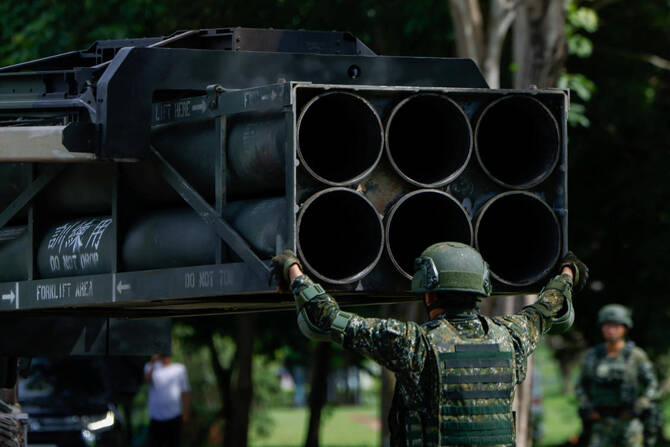
Taiwan deploys advanced US HIMARS rockets in annual drills

A High Mobility Artillery Rocket System (HIMARS) is on display at a park during Taiwan's annual Han Kuang military exercise in Taichung on July 12, 2025. (Reuters)
Short Url
Updated 12 July 2025
Follow

Taiwan deploys advanced US HIMARS rockets in annual drills

  • Two armored trucks with HIMARS were seen maneuvering around the city of Taichung
  • Deployment of weapons on fourth of 10 days of Taiwan’s most comprehensive annual exercises yet

TAICHUNG, Taiwan: Taiwan’s military began deploying one of its newest and most precise strike weapons on Saturday, ahead of live-fire drills meant to showcase the island’s determination to resist any Chinese invasion.

Two armored trucks with HIMARS – High Mobility Artillery Rocket Systems – were seen maneuvering around the city of Taichung near Taiwan’s central coast on the fourth of 10 days of its most comprehensive annual exercises yet.

The live-fire portion of the Han Kuang drills is expected next week.

In wartime, said Col. Chen Lian-jia, a military spokesperson, it would be vital to conceal HIMARS from enemy aerial reconnaissance, satellites “or even enemy operatives behind our lines” until the order to fire was given.

China views democratically governed Taiwan as its own and has intensified military pressure around the island over the last five years, staging a string of intense war games and daily naval and air force patrols around the territory.

Taiwan rejects China’s sovereignty claims, with President Lai Ching-te saying only Taiwan’s people can decide their future.

China’s defense ministry said this week the Han Kuang drills were “nothing but a bluff” while its foreign ministry said its opposition to US-Taiwan military ties was “consistent and very firm.”

Regional military attaches say the HIMARS deployment in a warlike exercise will be closely watched, given that they have been used extensively by Ukraine against Russian forces. Australia has also purchased the Lockheed Martin systems. Taiwan took delivery last year of the first 11 of 29 HIMARS units, testing them for the first time in May. With a range of about 300 kilometers, the weapons could strike coastal targets in China’s southern province of Fujian on the other side of the Taiwan Strait.

Taiwanese military analysts say the weapon would be used with its locally developed Thunderbolt 2000 launchers so Chinese forces could be targeted as they left port or attempted to land on Taiwan’s coast. A Thunderbolt unit was also seen in a park near the HIMARS units.

Senior Taiwanese military officials say the Han Kuang drills are unscripted and designed to replicate full combat conditions, starting with simulated enemy attacks on communications and command systems, leading to a full-blown invasion scenario.

The drills aim to show China and the international community, including Taiwan’s key weapons supplier the US, that Taiwan is determined to defend itself against any Chinese attack or invasion, the officials say.


Vietnam’s ruling Communist Party re-elects To Lam as general secretary

Updated 58 min 36 sec ago
Follow

Vietnam’s ruling Communist Party re-elects To Lam as general secretary

  • Lam, 68, was reappointed unanimously by the party’s 180-member Central Committee at the conclusion of the National Party Congress, the country’s most important political conclave

HANOI: Vietnam’s leader To Lam was re-elected Friday as the general secretary of its ruling Communist Party, securing a new five-year term in the country’s most powerful position and pledging to rev up economic growth in the export powerhouse.
Lam, 68, was reappointed unanimously by the party’s 180-member Central Committee at the conclusion of the National Party Congress, the country’s most important political conclave.
In a speech, he said he wanted to build a system grounded in “integrity, talent, courage, and competence,” with officials to be judged on merit rather than seniority or rhetoric.
No announcement was made about whether Lam will also become president. If he were to get both positions, he would be the country’s most powerful leader in decades, similar to Chinese leader Xi Jinping.
The Congress was framed by Vietnam’s defining national question: whether the country can transform itself into a high-income economy by 2045. During the meeting, Vietnam set a target of average annual GDP growth of 10 percent or more from 2026 to 2030.
The gathering brought together nearly 1,600 delegates to outline Vietnam’s political and economic direction through 2031. It also confirmed a slate of senior appointments, electing 19 members to the Politburo, the country’s top leadership body.
Beyond settling the question of who will lead Vietnam for the coming years, the Congress will also determine how the country’s single-party system responds to world grown increasingly turbulent as China and the United States wrangle over trade and Washington under President Donald Trump challenges a longstanding global order.
Vietnam’s transformation into a global manufacturing hub for electronics, textiles, and footwear has been striking. Poverty has declined and the middle class is growing quickly.
But challenges loom as the country tries to balance rapid growth with reforms, an aging population, climate risks, weak institutions and US pressure over its trade surplus. At the same time it must balance relations with major powers. Vietnam has overlapping territorial claims with China, its largest trading partner, in the South China Sea.
Lam has overseen Vietnam’s most ambitious bureaucratic and economic reforms since the late 1980s, when it liberalized its economy. Under his leadership, the government has cut tens of thousands of public-sector jobs, redrawn administrative boundaries to speed decision-making, and initiated dozens of major infrastructure projects.
Lam spent decades in the Ministry of Public Security before becoming its minister in 2016. He led an anti-corruption campaign championed by his predecessor, Nguyen Phu Trong. During his rise, Vietnam’s Politburo lost six of its 18 members during an anti-graft campaign, including two former presidents and Vietnam’s parliamentary head.