

At least 87 killed, 149 injured in rain-related incidents in Pakistan since June 26

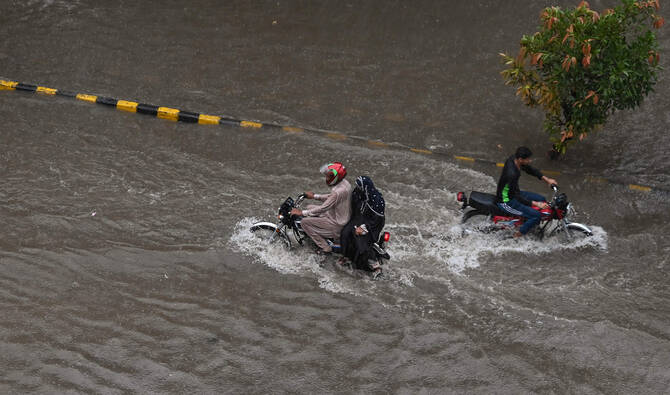
Commuters wade through a flooded street following heavy monsoon rains in Lahore on July 10, 2025. (AFP)
Short Url
Updated 10 July 2025
Follow

At least 87 killed, 149 injured in rain-related incidents in Pakistan since June 26

  • Those killed include 42 children, 29 men and 16 women, national disaster authority says in latest report
  • WHO, Pakistan government finalize contingency plan to maintain essential health services in high-risk districts

KARACHI: At least 87 people have been killed and 149 others injured in rain-related incidents across Pakistan since June 26, according to figures released Thursday by the country’s National Disaster Management Authority (NDMA).

Pakistan’s most populous province, Punjab, reported 29 deaths including 15 children, while the northwestern Khyber Pakhtunkhwa province recorded 30 deaths, 14 of them children. The southern province of Sindh reported 16 deaths, eight of them children, and the southwestern province of Balochistan saw 11 fatalities, five of them children. One man lost his life in Azad Jammu and Kashmir, the NDMA said.

“The total number of 87 deceased include 42 children, 29 men and 16 women,” the NDMA report said, adding that 149 people were injured, 61 children, 52 men and 36 women.

Heavy rains have also damaged at least 242 houses nationwide, including 71 that were completely destroyed and 171 that were partially damaged.

Flood relief operations have been underway since late June, with authorities distributing tents, ration bags, blankets, sandbags, quilts, gas cylinders, mattresses, kitchen sets, mosquito nets, plastic mats, hygiene kits and food packets to affected families.

A total of 24 relief camps have been set up in Punjab and two in Sindh, providing shelter to 176 people. According to the NDMA, around 245 people have been rescued in 21 operations carried out across the country.

Meanwhile, the World Health Organization (WHO), in partnership with the Pakistani government, has finalized its Monsoon Contingency Plan 2025 to ensure a coordinated emergency response and maintain essential health services in high-risk districts.

The plan will be implemented in 10 districts in Punjab and Sindh, nine in Balochistan and four in Khyber Pakhtunkhwa.

“WHO stands with Pakistan and partners to be ready to save lives by supporting rapid response, surveillance and the continuity of essential health services in the event of a natural disaster,” Pakistani state media quoted WHO Representative Dr. Dapeng Luo as saying.

“In a context marked by the impacts of climate change, which are exacerbating risks, it is crucial to be ready to protect the health of all, particularly the most vulnerable,” Luo added.

Pakistan has also rolled out a location-based SMS alert system to warn citizens living in flood-prone areas about imminent weather threats.


Pakistan reaffirms commitment to clamp down on informal sector to encourage investment

Updated 6 sec ago
Follow

Pakistan reaffirms commitment to clamp down on informal sector to encourage investment

  • Nestlé delegation briefs Finance Minister Muhammad Aurangzeb on localization, efficiency enhancements in Pakistan
  • Improved compliance, transparency, strengthened tax ecosystem central to economic recovery, stresses finance minister

KARACHI: Pakistan’s Finance Minister Muhammad Aurangzeb reaffirmed the government’s commitment to clamp down on the informal sector on Monday, the Finance Division said, citing transparency and a strengthened tax ecosystem as central to the country’s economic recovery. 

Pakistan’s government has cracked down on smuggled items and tightened enforcement in poorly taxed sectors, such as tobacco, in recent months as it pushes ahead with its efforts to maximize tax collection by discouraging the formal sector. Informal sector comprises businesses that operate outside the tax net, avoid registration and as a result, neglect regulatory oversight and violate quality, safety or labor standards. 

Aurangzeb met a delegation from Nestlé Pakistan at the Finance Division, where the two sides discussed the multinational’s efforts to strengthen its operations in the country through localization, portfolio adjustments and efficiency enhancements. 

“Emphasizing the government’s resolve to clamp down on the informal sector, an effort that has already begun yielding visible results in multiple industries, the finance minister noted that improved compliance, transparency and a strengthened tax ecosystem are central to Pakistan’s economic recovery,” the Finance Division said in a statement. 

Nestlé Pakistan Chief Executive Officer Jason Avancena provided an overview of the organization’s operations, claiming it had strengthened them through localization, portfolio adjustments, advanced automation, efficiency enhancements and continued innovation across product categories. 

Avancena said Nestlé is implementing solar and biomass energy systems, digital dashboards, environmentally improved packaging, and supply-chain automation in Pakistan. The delegation highlighted that Nestlé’s localization efforts have materially strengthened its resilience. 

“They noted that through sustained efforts to localize raw materials and reconfigure product portfolios, Nestlé Pakistan has reduced its import volumes by nearly half over the past three years from around $150 million to approximately $76–80 million, thereby minimizing exposure to foreign-exchange pressures and deepening integration with Pakistan’s agricultural and manufacturing base,” the Finance Division said. 

Aurangzeb commended the multinational for its efforts and underscored the government’s intention to facilitate greater formalization and enhanced tax equity across the food and beverages sector. He noted that informal players have “rapidly expanded” their market share by operating outside the tax net in sectors such as food and beverages. 

The delegation also discussed export performance, including the company’s presence in markets such as the United States, Canada, the Gulf, and the United Kingdom, sharing insights into challenges related to regional trade, particularly the Afghanistan corridor. 

Aurangzeb advised Nestlé to explore logistics partnerships to expand access to Central Asian markets, reiterating that Islamabad remains committed to enabling export-oriented industry growth.