Israeli army says intercepted missile launched from Yemen

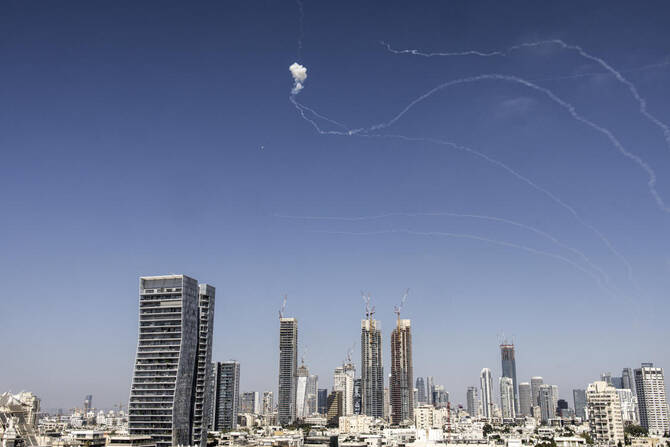
A missile is intercepted over Tel Aviv on June 20, 2025, after a Iran fired a fresh salvo of missiles. (File/AFP)
Short Url
Updated 10 July 2025
Follow

Israeli army says intercepted missile launched from Yemen

  • The Houthis carried out a military operation using a ballistic missile

JERUSALEM: Israel’s military said it intercepted a missile launched from Yemen on Thursday, with the Iran-backed Houthi rebels later claiming responsibility for the attack, which followed Israeli strikes on Houthi targets.
The Houthis “carried out a qualitative military operation” using a ballistic missile, military spokesman Yahya Saree said in a video statement.
The Israeli military said earlier in a post on X that a missile launched from Yemen had been intercepted following air raid sirens that sounded before dawn in several areas of Israel.
The Houthis began targeting Israel and ships in the Red Sea and Gulf of Aden they accuse of having links to the country after the start of the Gaza war in October 2023, claiming solidarity with Palestinians.
In response, Israel has carried out several strikes on Yemen, including attacks on Sunday on the port city of Hodeida.
The Houthis claimed responsibility this week for the sinking of two vessels, as they resumed their campaign against global shipping in the Red Sea.
Their fresh attacks mark the end of a months-long lull and threaten a May ceasefire with the United States that ended weeks of strikes on Houthi targets in Yemen.
Saree said the Eternity C bulk carrier, which was first attacked on Monday, was headed for the Israeli port of Eilat and was attacked in support of Palestinians in Gaza.
Saree warned companies dealing with Israeli ports that their ships would be targeted until Israel was forced to “lift the siege” on Gaza and end the war.
The Houthis said Monday that they had boarded and sank another vessel, the Magic Seas, a day earlier, because its owner had done business with Israel and used its ports.
Houthi attacks have prompted many shipping firms to make the time-consuming detour around the southern tip of Africa to avoid the Red Sea, which normally carries about 12 percent of global trade.


Tunisians revive protests in Gabes over pollution from state chemical plant

Updated 12 sec ago
Follow

Tunisians revive protests in Gabes over pollution from state chemical plant

  • People chanted mainly “Gabes wants to live“
  • The powerful UGTT union has called for a nationwide strike next month

TUNIS: Around 2,500 Tunisians marched through the coastal city of Gabes on Wednesday, reviving protests over pollution from a state-owned phosphate complex amid rising anger over perceived failures to protect public health.
People chanted mainly “Gabes wants to live,” on the 15th anniversary of the start of the 2011 pro-democracy uprising that sparked the Arab Spring movement against autocracy.
The protest added to the pressure on President Kais Saied’s government, which is grappling with a deep financial crisis and growing street unrest, protests by doctors, journalists, banks and public transport systems.
The powerful UGTT union has called for a nationwide strike next month, signalling great tension in the country. The recent protests are widely seen as one of the biggest challenges facing Saied since he began ruling by decree in 2021.
Protesters chanted slogans such as “We want to live” and “People want to dismantle polluting units,” as they marched toward Chatt Essalam, a coastal suburb north of the city where the Chemical Group’s industrial units are located.
“The chemical plant is a fully fledged crime... We refuse to pass on an environmental disaster to our children, and we are determined to stick to our demand,” said Safouan Kbibieh, a local environmental activist.
Residents say toxic emissions from the phosphate complex have led to higher rates of respiratory illnesses, osteoporosis and cancer, while industrial waste continues to be discharged into the sea, damaging marine life and livelihoods.
The protests in Gabes were reignited after hundreds of schoolchildren suffered breathing difficulties in recent months, allegedly caused by toxic fumes from a plant converting phosphates into phosphoric acid and fertilizers.
In October, Saied described the situation in Gabes as an “environmental assassination”, blaming policy choices made by previous governments, and has called for urgent maintenance to prevent toxic leaks.
The protesters reject the temporary measures and are demanding the permanent closure and relocation of the plant.