

EU chief von der Leyen faces no confidence vote

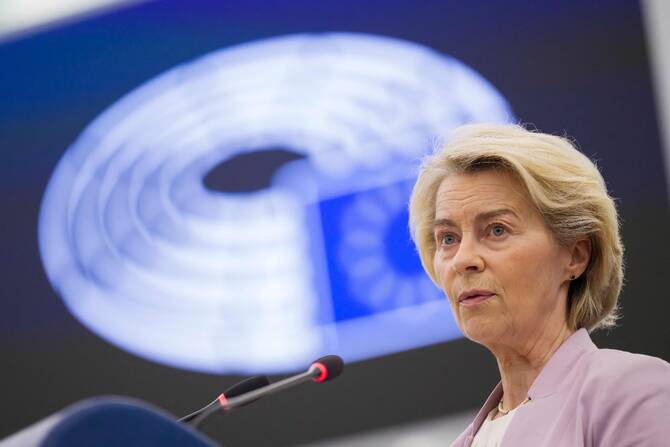
EU chief Ursula von der Leyen gives a speech during a plenary session at the European Parliament in Strasbourg, France. (AFP)
Short Url
Updated 10 July 2025
Follow

EU chief von der Leyen faces no confidence vote

  • A major complaint is that von der Leyen’s center-right camp has increasingly teamed up with the far-right to further its agenda, most notably to roll back environmental rules

STRATSBOURG: EU chief Ursula von der Leyen faces a confidence vote Thursday that has little chance of succeeding but has exposed frictions between her backers and complaints about her leadership style.
European lawmakers will vote on the rare challenge pushed by a far-right faction against the European Commission president at around midday (1000 GMT) in Strasbourg.
Addressing parliament this week, von der Leyen dismissed the no-confidence motion as a conspiracy theory-laden attempt to divide Europe, dismissing its supporters as “anti-vaxxers” and Russian President Vladimir “Putin apologists.”
She urged lawmakers to renew confidence in her commission arguing it was critical for Europe to show unity in the face of an array of challenges, from US trade talks to Russia’s war in Ukraine.
The no-confidence motion was initiated by Romanian far-right lawmaker Gheorghe Piperea.
He accuses von der Leyen of a lack of transparency over text messages she sent to the head of the Pfizer pharmaceutical giant when negotiating Covid vaccines.
The commission’s failure to release the messages — the focus of multiple court cases — has given weight to critics who accuse its boss of centralized and opaque decision-making.
That is also a growing refrain from the commission chief’s traditional allies on the left and center, who have used the vote to air their grievances.

A major complaint is that von der Leyen’s center-right camp has increasingly teamed up with the far-right to further its agenda — most notably to roll back environmental rules.
Centrist leader Valerie Hayer told parliament this week that von der Leyen’s commission was “too centralized and sclerotic” before warning that “nothing can be taken for granted.”
“Pfizergate” aside, Romania’s Piperea accuses the commission of interfering in his country’s recent presidential election, in which pro-European Nicusor Dan narrowly beat EU critic and nationalist George Simion.
That vote came after Romania’s constitutional court scrapped an initial ballot over allegations of Russian interference and massive social media promotion of the far-right frontrunner, who was barred from standing again.
Piperea’s challenge is unlikely to succeed.
It has support from some groups on the left and part of the far right — including the party of Hungary’s nationalist Prime Minister Viktor Orban.
“Time to go,” Orban tweeted on Wednesday alongside a photo of von der Leyen.
But Piperea’s own group, the ECR, is split. Its largest faction, the party of Italian Prime Minister Giorgia Meloni, said it would back the EU chief.
The two largest groups in parliament, the center-right EPP and the center-left Socialists and Democrats, have also flatly rejected the challenge, which needs two-thirds of votes cast, representing a majority of all lawmakers to pass.


Mystery of CIA’s lost nuclear device haunts Himalayan villagers 60 years on

Updated 56 min 44 sec ago
Follow

Mystery of CIA’s lost nuclear device haunts Himalayan villagers 60 years on

  • Plutonium-fueled spy system was meant to monitor China’s nuclear activity after 1964 atomic tests
  • Porter who took part in Nanda Devi mission warned family of ‘danger buried in snow’

NEW DELHI: Porters who helped American intelligence officers carry a nuclear spy system up the precarious slopes of Nanda Devi, India’s second-highest peak, returned home with stories that sent shockwaves through nearby villages, leaving many in fear that still holds six decades later.

A CIA team, working with India’s Intelligence Bureau, planned to install the device in the remote part of the Himalayas to monitor China, but a blizzard forced them to abandon the system before reaching the summit.

When they returned, the device was gone.

The spy system contained a large quantity of highly radioactive plutonium-238 — roughly a third of the amount used in the atomic bomb dropped by the US on the Japanese city of Nagasaki in the closing stages of the Second World War.

“The workers and porters who went with the CIA team in 1965 would tell the story of the nuclear device, and the villagers have been living in fear ever since,” said Narendra Rana from the Lata village near Nanda Devi’s peak.

His father, Dhan Singh Rana, was one of the porters who carried the device during the CIA’s mission in 1965.

“He told me there was a danger buried in the snow,” Rana said. “The villagers fear that as long as the device is buried in the snow, they are safe, but if it bursts, it will contaminate the air and water, and no one will be safe after that.”

During the Sino-Indian tensions in the 1960s, India cooperated with the US in surveillance after China conducted its first nuclear tests in 1964. The Nanda Devi mission was part of this cooperation and was classified for years. It only came under public scrutiny in 1978, when the story was broken by Outsider magazine.

The article caused an uproar in India, with lawmakers demanding the location of the nuclear device be revealed and calling for political accountability. The same year, then Prime Minister Morarji Desai set up a committee to assess whether nuclear material in the area near Nanda Devi could pollute the Ganges River, which originates there.

The Ganges is one of the world’s most crucial freshwater sources, with about 655 million people in India, Nepal, and Bangladesh depending on it for their essential needs.

The committee, chaired by prominent scientists, submitted its report a few months later, dismissing any cause for concerns, and establishing that even in the worst-case scenario of the device’s rupture, the river’s water would not be contaminated.

But for the villagers, the fear that the shell containing radioactive plutonium could break apart never goes away, and peace may only come once it is found.

Many believe the device, trapped within the glacier’s shifting ice, may have moved downhill over time.

Rana’s father told him that the device felt hot when it was carried, and he believed it might have melted its way into the glacier, remaining buried deep inside.

An imposing mass of rock and ice, Nanda Devi at 7,816 m is the second-highest mountain in India after Kangchenjunga. 

When a glacier near the mountain burst in 2021, claiming over 200 lives, scientists explained that the disaster was due to global warming, but in nearby villages the incident was initially blamed on a nuclear explosion.

“They feared the device had burst. Those rescuing people were afraid they might die from radiation,” Rana said. “If any noise is heard, if any smoke appears in the sky, we start fearing a leak from the nuclear device.”

The latent fear surfaces whenever natural disasters strike or media coverage puts the missing device back in the spotlight. Most recently, a New York Times article on the CIA mission’s 60th anniversary reignited the unease.

“The apprehensions are genuine. After 1965, Americans came twice to search for the device. The villagers accompanied them, but it could not be found, which remains a concern for the local community,” said Atul Soti, an environmentalist in Joshimath, Uttarakhand, about 50 km from Nanda Devi.

“People are worried. They have repeatedly sought answers from the government, but no clear response has been provided so far. Periodically, the villagers voice their concerns, and they need a definitive government statement on this issue.”

Despite repeated queries whenever media attention arises, Indian officials have not released detailed updates since the Desai-appointed committee submitted its findings.

“The government should issue a white paper to address people’s concerns. The white paper will make it clear about the status of the device, and whether leakage from the device could pollute the Ganges River,” Soti told Arab News.

“The government should be clear. If the government is not reacting, then it further reinforces the fear.”