

British explorer completes epic walk across Kingdom

1 / 4
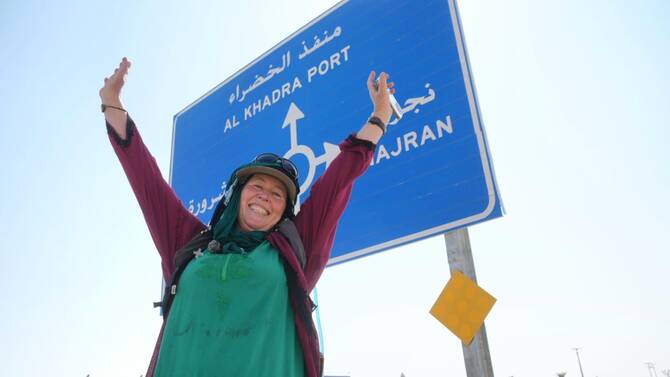
British explorer Alice Morrison has become the first person to walk the entire length of Saudi Arabia from north to south, completing a 2,200 km journey entirely on foot. (Supplied)
2 / 4
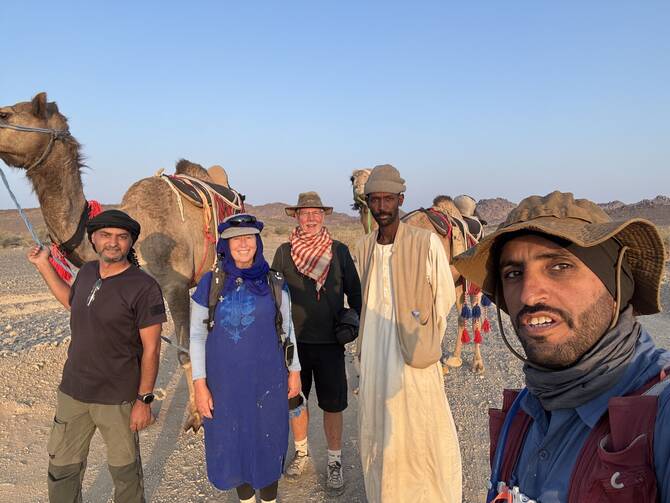
British explorer Alice Morrison has become the first person to walk the entire length of Saudi Arabia from north to south, completing a 2,200 km journey entirely on foot. (Supplied)
3 / 4
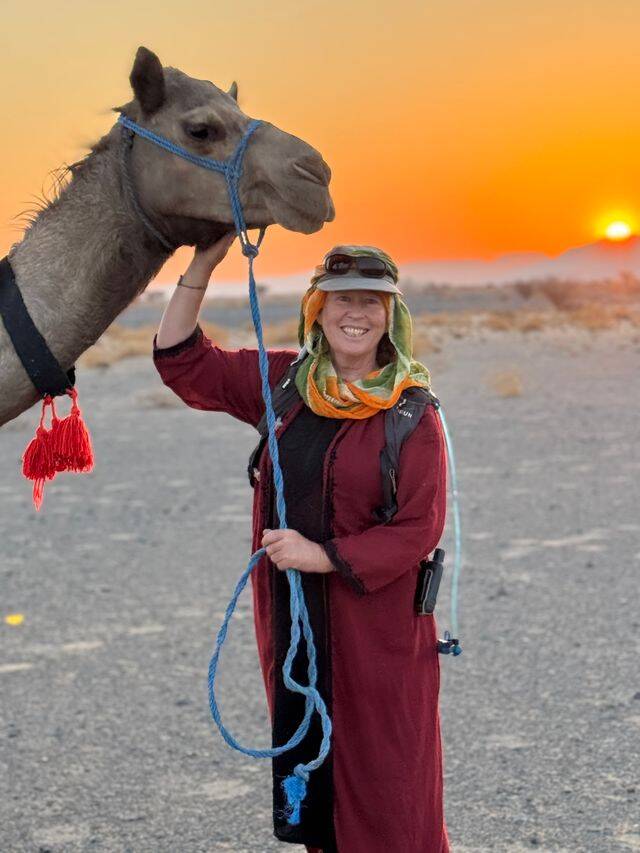
British explorer Alice Morrison has become the first person to walk the entire length of Saudi Arabia from north to south, completing a 2,200 km journey entirely on foot. (Supplied)
4 / 4
British explorer Alice Morrison has become the first person to walk the entire length of Saudi Arabia from north to south, completing a 2,200 km journey entirely on foot. (Supplied)
Short Url
Updated 20 December 2025
Follow

British explorer completes epic walk across Kingdom

  • Alice Morrison’s journey marks a historic first, while Saudi explorer Shaya Al-Shaya finishes close behind

JEDDAH: British explorer Alice Morrison has become the first person to walk the entire length of Saudi Arabia from north to south, completing a 2,200 km journey entirely on foot.

The 62-year-old from Edinburgh reached Najran on the Saudi-Yemen border at 10:30 a.m. on Dec. 15, concluding a 112-day expedition that began on Jan. 1. Accompanied by a specialist support team, Morrison crossed six provinces — Tabuk, Madinah, Makkah, Al-Baha, Aseer and Najran — passing through the UNESCO World Heritage sites of AlUla and Hima and traversing the Prince Mohammed bin Salman Royal Reserve.

The expedition was sponsored by the Royal Commission for AlUla, the Saudi Tourism Authority, and Gym Nation.

Speaking to Arab News, Morrison reflected on the moment she reached the border.

“When I reached the end point of our adventure, the border with Yemen, I felt an overwhelming sense of pride that I had accomplished this dream of mine. I was so full of happiness and also a feeling of achievement. One of the things I am proudest of is the way me and my support team from MAD Adventures worked together.”

Morrison said the idea for the journey was inspired by her father, who once gave her Wilfred Thesiger’s “Arabian Sands,”

While Morrison was the first to complete the crossing, Saudi explorer Shaya Al-Shaya, from Zulfi, finished close behind her, becoming the second person overall, the first Saudi, and the first man to walk the route. 

Morrison said Al-Shaya joined during the first stage of the expedition, missed three days due to illness, then returned to complete the full distance, including all of stage two.

Al-Shaya reportedly told Morrison: “They are so proud of what I’m doing. This is one of the great things in my life to become the first Arab to walk north to south of Saudi Arabia.”

Describing the physical toll of the journey, Morrison said: “This is definitely one of the hardest adventures I have ever done. It was 112 days and we faced heat, sand and headwinds. Also, I got blisters on the first stage which gave me a lot of pain.”

Knowing she had a goal to reach kept her going when she was “exhausted, in pain or just fed up,” she said.

“Walking is a way to see and feel every detail of the path you travel. An exploration but also a meditation,” Morrison explained. “This expedition has exceeded my expectations in every way.”

She noted that the journey challenged her mentally and physically, and shattered her “preconceptions” of Saudi Arabia.

“I’ve walked across a country full of wild landscapes, history ready to be discovered and the most hospitable people in the world. One of the revelations has been the women I've met who are instigating a quiet cultural revolution,” she said.

Accompanied by camels Juicy and Lulu who brought “endless entertainment” in their search for snacks, and supported by a multinational specialist team, Morrison highlighted the generosity she encountered along the way. 

“The Saudis I met on the way have been overwhelmingly kind and hospitable. Everyone wanted to help.”

Despite the challenges, Morrison found the journey shaped just as much by the warmth of the people she met on the way. 

In every village and wild-camp stop, the first question offered was always the same: “How can I help you?”  

Saudi hospitality, given freely and without hesitation, became an essential part of the expedition’s rhythm: navigation advice, weather warnings from shepherds, shared tea, the gift of two live sheep, and even a marriage proposal.

The expedition also recorded archeological observations, including ancient rock carvings, ancient tombs and tools, as well as remnants of the Hejaz Railway, all documented by the team.

Her route followed some of the Kingdom’s earliest pathways of trade, pilgrimage and settlement. 

Stage one ended in AlUla, an ancient crossroads of civilization, and stage two passed through Hima and the old caravan trails of the Elephant’s Road, and intersected with Darb Zubayda, the Abbasid-era pilgrimage route once travelled by thousands.

After months on the trail, Morrison said: “I am going to encourage my relatives and friends to visit to experience it for themselves and if there is a new project offered, I will come back definitely.”


Healthcare must be ‘proactive’ says Hevolution exec

Updated 20 December 2025
Follow

Healthcare must be ‘proactive’ says Hevolution exec

  • Princess Dr. Haya bint Khaled bin Bandar Al-Saud spoke to Arab News at a presentation of its second Global Healthspan Report

RIYADH: Healthcare needs to shift to a global model that targets preventing disease rather than treating it, a senior executive from the Saudi-funded Hevolution Foundation told Arab News.

The senior vice president of research of Hevolution, Princess Dr. Haya bint Khaled bin Bandar Al-Saud, spoke to Arab News at a presentation of its second Global Healthspan Report at the nonprofit’s headquarters in Riyadh’s KAFD on Wednesday.

“People have to be aware, healthcare has to change its way of thinking, because it’s a must,” she said. “We cannot be reactive anymore, we have to be proactive.

“And this has to start earlier in the education of health professionals, and third, someone needs to take this to the global agenda. The general public needs to know that this is a reality.” 

Launching its report, Hevolution called for urgent global action to treat healthy aging as an economic imperative, where prevention, not disease, drives prosperity.

The organization focuses on healthspan research, or extending the healthy human lifespan.

The findings of the report centered around five main areas; rising awareness and public demand, breakthrough science and new therapies, AI and data revolution, investment momentum and gaps and economic and policy imperatives.

The report detailed the momentum of a new healthspan era where science, technology and public awareness are converging, but momentum alone is not enough.

Al-Saud explained that achieving equitable and evidence-based progress would require coordinated leadership from scientists, policymakers and investors alike.

“Today, science and societal cause has to be integrated, meaning the public needs to know that everything that we are investing in is for the general population, not just on a local level but on a global level,” she said.

The report surveyed 23 countries on the awareness of healthspan, which found that two-thirds of healthcare professionals now receive patient inquiries about healthspan interventions at least once a month, with one-third reporting them weekly.

Al-Saud highlighted that the report also found that 80 per cent of citizens believed governments should fund preventive care programs, while 39 per cent expressed concern about inequality in access.

“Awareness is the most important thing. This subject touches every single one of us, every single one of us has a story that this relates to, whether a grandparent, sick parent, or us,” she said.

Under artificial intelligence the report found that 74 per cent of experts believe AI will transform healthspan R&D and healthcare delivery, yet 26–30 per cent remain opposed to AI in diagnostics, reflecting an ongoing trust and ethics gap.

The report detailed that 59 per cent of investors cite lack of awareness as the top barrier while 46 per cent point to limited experts, unclear evidence and weak regulatory frameworks.

“Between 2022 and 2024 the investments in healthspan has doubled, it’s estimated to be $7 billion invested in finding interventions in healthspan globally,” Al-Saud said.

Investment in healthspan reached $7.33 billion in 2024, up from $3.48 billion the previous year. The average deal size has grown 77 per cent since 2020, signaling maturing confidence in the sector.

“Hevolution Foundation remains the world’s largest philanthropic backer of aging biology and healthspan science, with $400 million allocated in over 230 grants, 25 partnerships, and four biotech ventures,” Al-Saud said.

According to a report from Hevolution, expanding could deliver up to $220 billion annually in productivity gains, and every $1 invested in prevention could yield $16 in returns.

“We always want to support scientists but the end-consumer is the general public,” Al-Saud said.

Hevolution has remained true to its mission since its foundation; to extend healthy human lifespan for all, mobilizing the science, innovation and investment needed to make healthier longer lives a shared global reality.

Established by royal decree in 2018 and launched in 2021, Hevolution Foundation is a non-profit organization that focuses on accelerating independent research and entrepreneurship in the emerging field of healthspan science.

Headquartered in Riyadh, Saudi Arabia, with a North American hub in Boston, the foundation says it has plans for further international expansion, and has set key goals and targets to advance its vision and mission.