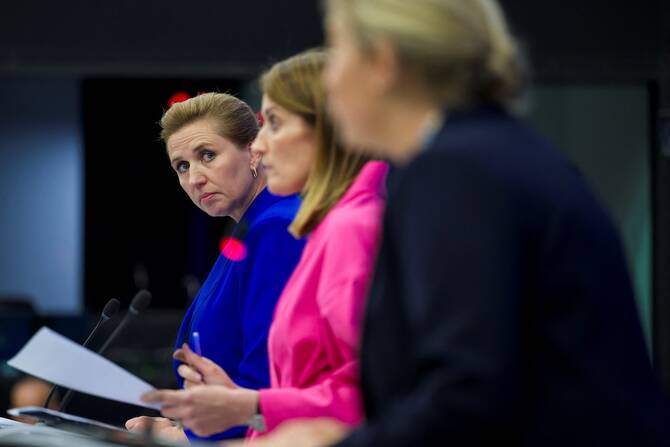
BRUSSELS: Russia could pose a credible security threat to the European Union by the end of the decade and defense industries in Europe and Ukraine must be ramped up within five years in preparation, Danish Prime Minister Mette Frederiksen warned on Tuesday.
In a speech to the European Parliament marking the launch of Denmark’s six-month term as holder of the EU presidency, Frederiksen lamented that “cutting our defense spending in the past 30 years was a huge mistake.”
European officials have warned that President Vladimir Putin could soon try to test NATO’s Article 5 security guarantee — the pledge that an attack on any one ally would be met with a collective response from all 32. Most of the allies are EU countries.
Russia has been accused of acts of sabotage, cyberattacks and fake news campaigns – largely to weaken European support for Ukraine – and while Europe is not at war, it is not at peace either, NATO Secretary-General Mark Rutte has said.
“Strengthening Europe’s defense industry is an absolute top priority, and we have to be able to defend ourselves by 2030 at the latest,” Frederiksen told EU lawmakers in Strasbourg, France. “Never, ever should we allow Europe to be put in a position again where we cannot defend ourselves.”
Many European leaders insist they have heard the Trump administration’s warning that American security priorities now lie elsewhere – in the Middle East and the Indo-Pacific – but Europe’s effort to arm is moving only slowly.
When NATO’s ambitions are not enough
At a key summit last month, NATO leaders endorsed a statement saying: “Allies commit to invest 5% of GDP annually on core defense requirements as well as defense- and security-related spending by 2035 to ensure our individual and collective obligations.”
That historic pledge will require them to spend tens of billions of euros (dollars) more over the coming decade, not five years. Spain – NATO’s lowest spender with 1.28% of GDP last year – quickly branded the target “unreasonable.”
Belgium has cast doubt over whether it will make the grade. Slovenia is considering a referendum. Heavyweights France and Italy are mired in economic woes and will struggle to get there too.
Money spent on military support to Ukraine can now be included in NATO’s defense calculations, but even that will not hike the GDP military spend by much.
The EU’s Readiness 2030 plan
With the threat of Russian aggression in mind, the EU’s executive branch has come up with a security plan. It hinges on a 150-billion-euro ($176 billion) loan program that member countries, Ukraine and outsiders like Britain could dip into.
It aims to fill gaps that the U.S. might leave. Spending priorities for joint purchase include air and missile defense systems, artillery, ammunition, drones, equipment for use in cyber and electronic warfare, and “strategic enablers” like air-to-air refueling and transport.
On Tuesday, 15 EU countries were permitted to take advantage of another measure — a “national escape clause” — to allow them to spend more on defense without breaking the bloc’s debt rules.
Beefing up Ukraine ’s defense industry is also a pillar. The country produces arms and ammunition faster and more cheaply than its EU partners. Kyiv estimates that 40% more of its industrial capacity could be exploited if Europe were to invest.
Still, ambition is one thing, and the reality another.
“Things are not moving fast enough to be able to defend ourselves in 5 years,” Danish Defense Minister Troels Lund Poulsen told reporters last week. “It’s a huge, huge challenge to reach that goal.”
On the need to take risks
A big part of the problem is that governments and the defense industry are stuck in old ways of thinking and neither wants to take a risk, even with Europe’s biggest land war in many decades still raging in its fourth year.
“You cannot expect industry to invest in production capacity if you don’t have long-term orders,” said Joachim Finkielman, the director of Danish Defense and Security Industries.
“If you need to build new factories, if you need to engage a larger workforce, you need to make sure that you have that,” he told The Associated Press on Friday.
Demand for 155mm artillery shells is a typical example, Finkielman said. “When you see the kinds of orders that have been placed around Europe, it is two to three years out in time,” he said, while industry needs five to 10 years’ worth of orders to take a chance.
Finkielman said that if governments and industries in Britain, France, Germany and Italy start to move, “the rest will follow.”


The EU presidency says Europe must rearm within 5 years
https://arab.news/996ch
The EU presidency says Europe must rearm within 5 years

- Russia has been accused of acts of sabotage, cyberattacks and fake news campaigns – largely to weaken European support for Ukraine


India accelerates free trade agreements against backdrop of US tariffs
- India signed a CEPA with Oman on Thursday and a CETA with the UK in July
- Delhi is also in advanced talks for trade pacts with the EU, New Zealand, Chile
NEW DELHI: India has accelerated discussions to finalize free trade agreements with several nations, as New Delhi seeks to offset the impact of steep US import tariffs and widen export destinations amid uncertainties in global trade.
India signed a Comprehensive Economic Partnership Agreement with Oman on Thursday, which allows India to export most of its goods without paying tariffs, covering 98 percent of the total value of India’s exports to the Gulf nation.
The deal comes less than five months after a multibillion-dollar trade agreement with the UK, which cut tariffs on goods from cars to alcohol, and as Indian trade negotiators are in advanced talks with New Zealand, the EU and Chile for similar partnerships.
They are part of India’s “ongoing efforts to expand its trade network and liberalize its trade,” said Anupam Manur, professor of economics at the Takshashila Institution.
“The renewed efforts to sign bilateral FTAs are partly an after-effect of New Delhi realizing the importance of diversifying trade partners, especially after India’s biggest export market, the US, levied tariff rates of up to 50 percent on India.”
Indian exporters have been hit hard by the hefty tariffs that went into effect in August.
Months of negotiations with Washington have not clarified when a trade deal to bring down the tariffs would be signed, while the levies have weighed on sectors such as textiles, auto components, metals and labor-intensive manufacturing.
The FTAs with other nations will “help partially in mitigating the effects of US tariffs,” Manur said.
In particular, Oman can “act as a gateway to other Gulf countries and even parts of Eastern Europe, Central Asia, and Africa,” and the free trade deal will most likely benefit “labor-intensive sectors in India,” he added.
The chances of concluding a deal with Washington “will prove to be difficult,” said Arun Kumar, a retired economics professor at the Jawaharlal Nehru University.
“With the US, the chances of coming to (an agreement) are a bit difficult, because they want to get our agriculture market open, which we cannot do. They want us to reduce trade with Russia. That’s also difficult for India to do,” he told Arab News.
US President Donald Trump has threatened sanctions over India’s historic ties with Moscow and its imports of Russian oil, which Washington says help fund Moscow’s ongoing war with Ukraine.
“President Trump is constantly creating new problems, like with H-1B visa and so on now. So some difficulty or the other is expected. That’s why India is trying to build relationships with other nations,” Kumar said, referring to increased vetting and delays under the Trump administration for foreign workers, who include a large number of Indian nationals.
“Substituting for the US market is going to be tough. So certainly, I think India should do what it can do in terms of promoting trade with other countries.”
India has free trade agreements with more than 10 countries, including comprehensive economic partnership agreements with South Korea, Japan, and the UAE.
It is in talks with the EU to conclude an FTA, amid new negotiations launched this year for trade agreements, including with New Zealand and Chile.
India’s approach to trade partnerships has been “totally transformed,” Commerce and Industry Minister Piyush Goyal said in a press briefing following the signing of the CEPA with Oman, which Indian officials aim to enter into force in three months.
“Now we don’t do FTAs with other developing nations; our focus is on the developed world, with whom we don’t compete,” he said. “We complement and therefore open up huge opportunities for our industry, for our manufactured goods, for our services.”