Pakistan pitches digital finance reforms to foreign fintech investors

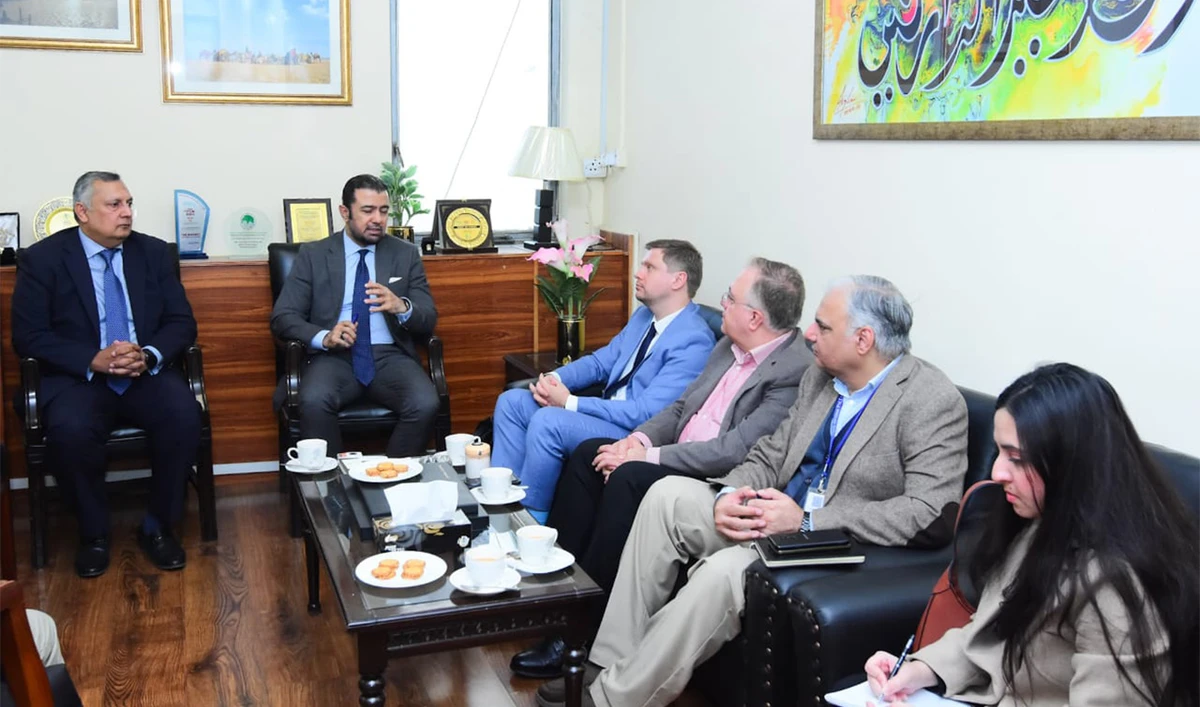
Advisor to Finance Minister, Khurram Schehzad meeting with a high-level delegation of leading international fintech investors from the Middle East led by Dr. John Sfakianakis, Chairman Fintech Solutions Holding, in Islamabad on December 20, 2025. (Finance ministry)
Short Url
Updated 20 December 2025
Follow

Pakistan pitches digital finance reforms to foreign fintech investors

  • Khurram Schehzad highlights progress on digital banking and plans for regulating blockchain and virtual assets
  • Visiting delegation welcomes policy clarity, sees scope for long-term investment and partnerships in Pakistan

KARACHI: Pakistan on Saturday pitched its digital finance and fintech reforms to foreign investors as part of a broader effort to attract capital after macroeconomic stabilization, with a senior official highlighting progress on digital banking, payments infrastructure and regulatory overhaul.

The outreach came as Islamabad seeks to sustain reform momentum following a period of economic stress, positioning technology-led financial inclusion as a pillar of its recovery and growth strategy while courting international investors.

Khurram Schehzad, adviser to the finance minister, briefed a delegation of international fintech investors on Pakistan’s reform agenda and digital growth plans at a meeting in federal capital, according to a statement from the finance ministry.

“Consistent policy implementation and structural reforms have strengthened macroeconomic fundamentals and improved Pakistan’s investment outlook,” he said, highlighting the “renewed global confidence” in the economy.

Officials said the discussions focused on the government’s Digital Pakistan Vision, including efforts to expand digital payments, build public digital infrastructure and digitize government transactions to widen financial inclusion and formalize the economy.

Schehzad cited the role of Raast, Pakistan’s instant payment system, which enables real-time, low-cost and interoperable digital payments nationwide, as well as regulatory reforms introduced by the State Bank of Pakistan to modernize retail digital banking.

Under the new framework, easypaisa Digital Bank has been operational for nearly a year, while Mashreq Digital Bank has also begun operations, with several other digital banks moving toward launch, the statement said.

The adviser also outlined Pakistan’s plans to develop a regulatory framework for blockchain, Web3.0 and virtual assets, saying authorities were engaging with global platforms to support innovation while ensuring compliance and investor protection.

The investor delegation was led by John Sfakianakis, chairman of Fintech Solutions Holding, alongside the company’s chief executive Kirill Smolin, and was facilitated by local technology firm Tech Avenue.

The investors welcomed the “clarity of reforms and policy direction,” saying Pakistan’s combination of macroeconomic stabilization, digital infrastructure and emerging technologies offered opportunities for long-term investment and strategic partnerships, the finance ministry said.


Pakistan says petroleum stocks at ‘comfortable levels’ despite Middle East crisis

Updated 9 sec ago
Follow

Pakistan says petroleum stocks at ‘comfortable levels’ despite Middle East crisis

  • US-Israeli strikes on Iran and Tehran’s counterattacks in Gulf have disrupted global supplies, with oil surging past $119 a barrel
  • Pakistan’s government assures it is undertaking continuous planning to safeguard domestic energy security, economic stability

KARACHI: Pakistan has “comfortable levels” of petroleum stocks and the supply chains are functioning smoothly, the finance ministry said on Monday, amid an ongoing Middle East conflict that has disrupted global fuel supplies.

Global fuel supply chains have been affected by disruptions in the Strait of Hormuz, a strategic waterway between Iran and Oman and a key transit route, that has been blocked by Tehran amid ongoing United States-Israeli strikes on Iran and its counter attacks against several Gulf states.

Oil prices surged more than 25 percent past globally on Monday to $119.50 a barrel, the highest levels since mid-2022, as some major producers cut supplies and fears of prolonged shipping disruptions gripped the market due to the expanding US-Israeli war with Iran.

Finance Minister Muhammad Aurangzeb on Tuesday presided a meeting of the Cabinet Committee to Monitor Petrol Prices to review developments in the energy sector and assess national preparedness measures in light of the evolving regional situation.

“The Committee deliberated on the evolving regional and global energy situation and undertook a detailed review of petroleum product stock positions across the country,” the finance ministry said.

“The Committee noted with satisfaction that petroleum product stocks remain at comfortable levels and supply chains are functioning smoothly, with multiple cargoes and import arrangements in place to ensure continuity of supply in the coming weeks.”

The statement came days after the intensifying conflict in Middle East and subsequent disruptions last week forced Pakistan to increase petrol and diesel prices by Rs55 ($0.20) per liter.

Separately, the Federation of Pakistan Chambers of Commerce and Industry (FPCCI) has urged the government to declare an “energy emergency” and implement reliable contingency measures to insulate Pakistan’s fragile economic recovery and its exports from the severe fallout of the ongoing conflict in the Middle East.

Officials also briefed participants of Monday’s meeting on recent trends in global crude and refined petroleum product prices, which have witnessed significant volatility due to geopolitical developments in the region.

“The Committee reviewed international market indicators, including benchmark crude movements and refined product price trends, and assessed possible scenarios for global energy markets,” the finance ministry said.

“It was noted that the Government is closely monitoring international price developments and undertaking continuous scenario planning to safeguard domestic energy security and economic stability.”