

Pakistan kicks off investor roadshow in China for inaugural panda bond

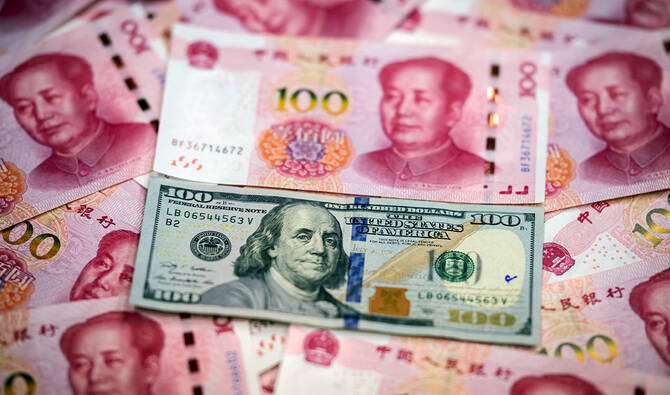
This photo illustration shows a Chinese 100 yuan notes (red color) and US 100 note (C) in Beijing on January 14, 2020. (AFP/File)
Short Url
Updated 09 July 2025
Follow

Pakistan kicks off investor roadshow in China for inaugural panda bond

  • Pre-marketing meetings in Beijing draw strong investor interest in debut Panda Bond
  • Finance Ministry says move will help diversify funding through China’s onshore market

KARACHI: Pakistan has launched a series of investor meetings in Beijing this week as it prepares to issue its first-ever panda bond, the finance ministry said on Wednesday, marking a significant step in the country’s strategy to diversify its funding sources through China’s onshore capital market.

Representatives from the Pakistani ministry of finance are holding the non-deal investor roadshow (NDR) in China from July 7 to 11, 2025. The delegation has engaged in technical discussions with potential investors, underwriters, prospective guarantors, the Chinese Rating Agency, and Chinese legal counsel as part of the pre-marketing process for the debut issuance.

The investor meetings focus on Pakistan’s macroeconomic outlook, ongoing debt management reforms and the proposed bond’s structure. The initiative reflects Pakistan’s push to broaden its investor base and strengthen its credibility in international capital markets.

A panda bond is a Renminbi-denominated bond issued by a foreign government, multilateral institution, or company in China’s onshore bond market, allowing overseas issuers to raise funds from Chinese investors while diversifying their investor base and gaining access to China’s deep capital pool.

“The visit reflects the Government’s commitment to proactive investor engagement and diversification of funding sources through access to China’s onshore capital market,” the finance ministry said in a statement.

According to the ministry, the inaugural panda bond is expected to be launched later this year after the completion of documentation and regulatory approvals, including credit guarantees from multilateral development partners.

Officials said the roadshow has drawn strong initial interest, signalling investor confidence in Pakistan’s reform trajectory. The ministry described the move as a milestone that would help Pakistan tap China’s deep and diversified onshore bond market while using local currency instruments backed by multilateral partners.

“The successful NDR so far reflects the Government’s commitment to innovative and forward-looking financial diplomacy — and sends a clear message: Pakistan is ready to enter new capital frontiers with confidence and credibility,” the statement added.


Pakistan moves to digitize payments for 10 million women under flagship poverty initiative

Updated 5 sec ago
Follow

Pakistan moves to digitize payments for 10 million women under flagship poverty initiative

  • BISP Official says accounts will be linked to phones to boost financial inclusion and curb payment deductions
  • Over 1.9 million SIMs issued as the nationwide rollout continues across provinces ahead of the March deadline

ISLAMABAD: Pakistan’s flagship poverty alleviation initiative, the Benazir Income Support Program (BISP), plans to equip 10 million women with digital bank accounts linked to their phone numbers within four months in one of the largest such exercises in the world, one of its top officials said on Wednesday.

Launched in 2008, the initiative is named after the late former prime minister Benazir Bhutto and has a budget of Rs716 billion ($2.5 billion) during the current fiscal year. Through its Benazir Kafaalat — or financial assistance — program, BISP provides quarterly stipends of Rs13,500 ($48) to around 10 million women.

In an exclusive interview with Arab News, BISP Secretary Amir Ali Ahmed said the opening of digital bank accounts for the beneficiaries was part of Prime Minister Shehbaz Sharif’s initiative related to a cashless economy and digital transformation of the country.

“I’m glad to share that 10 million bank accounts, wallet accounts were created,” he said. “This is a follow-up of the same exercise whereby now 10 million SIMs are being distributed.

“It is significant to share that the entire beneficiary network that we have is female-centric,” he continued. “So these are 10 million female accounts that have been created.”

Ahmed said the process of issuing mobile phone SIM cards to BISP beneficiaries had started on November 17 and would be completed by March next year.

“Let me share that this is one of the largest such exercises to be conducted in the world which is female-centric, linked with financial inclusion and financial empowerment.”

The BISP official added that out of the more than 10 million beneficiaries, only five to 10 percent had bank accounts, but nearly 90 to 95 percent were excluded from the system.

He said they were being linked to the banking system with cellphone SIMs that are being distributed with the help of the IT ministry, Pakistan Telecommunication Authority, National Database and Registration Authority and telecom companies across the country.

“We feel that this initiative of the government of Pakistan will not only result in financial empowerment of our beneficiaries, it will also result in financial inclusion of a segment which was not part of the banking sector in Pakistan,” he said, adding that the move will also lead to transparency.

In the past, there have been complaints of women not getting their full payment from bank officials in the absence of their own accounts, but Ahmed said this was going to change.

“They will be free from any exploitation at the agent networks, the queues that one would witness, the complaints of corruption or deductions that would emerge,” he continued.

According to official data, more than 1.9 million SIMs have so far been issued for BISP beneficiaries across the country.

The province of Punjab leads the rollout with 810,597 SIMs, followed by Sindh with 523,629 and Khyber Pakhtunkhwa with 371,427 SIMs.

In other regions, Azad Jammu and Kashmir has received 59,617, Balochistan 82,826, Gilgit-Baltistan 45,184, and Islamabad 4,508 SIMs.