LONDON: It began with an incident of the type that has become all too familiar in the West Bank, and yet has lately been overlooked by global media coverage distracted by the wars in Gaza and Iran.
On June 25, a force of about 100 of Israeli settlers, many of them masked, descended on the Palestinian West Bank town of Kafr Malik, 17 kilometers northeast of Ramallah.
It wasn’t the first time the town had been attacked, but this time was different.
Emboldened by right-wing ministers in Israel’s coalition government, settlers across the West Bank have become increasingly aggressive toward their Arab neighbors.
Kafr Malik, which sits close to an illegal settlement established in 2019, has been attacked again and again. But this time, the consequences went beyond harassment, beatings, and the destruction of property.
Accounts of what happened vary, but the basic facts are clear. In what The Times of Israel described as “a settler rampage,” the attackers threw stones at residents and set fire to homes and cars.

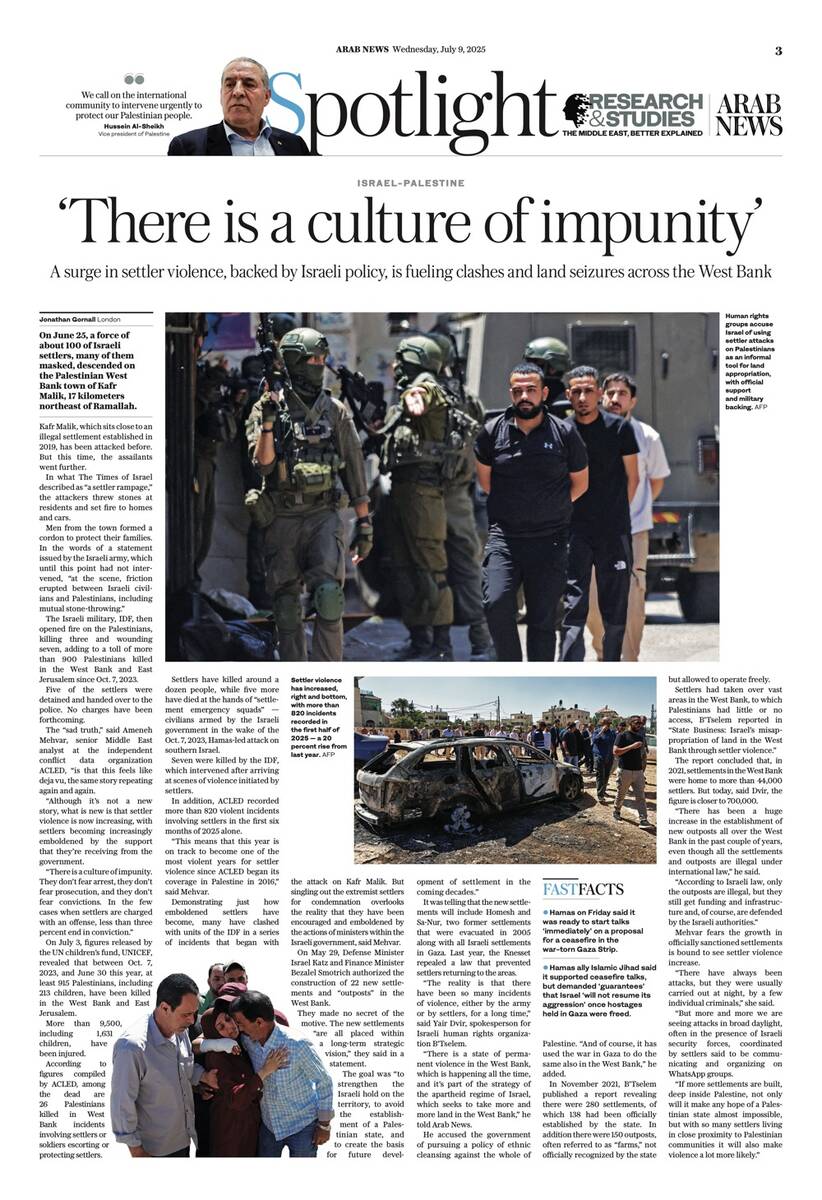
Settlers had taken over vast areas in the West Bank. (AFP)
Men from the town formed a cordon to protect their families. In the words of a statement issued by the Israeli army, which until this point had not intervened, “at the scene, friction erupted between Israeli civilians and Palestinians, including mutual stone-throwing.”
The Israel Defense Forces then opened fire on the Palestinians, killing three men and wounding seven more, adding to a toll of more than 900 Palestinians killed in the West Bank and East Jerusalem since Oct. 7, 2023.
Five of the settlers were detained and handed over to the police. No charges have been forthcoming.
Daylight attacks like these have become increasingly commonplace in the West Bank, and routinely go unnoticed by the international community.
Attention was drawn to this one in part thanks to Saudi Arabia’s Foreign Ministry, which issued a statement denouncing “the continued violence perpetrated by Israeli settlers, under the protection of the occupation forces, against Palestinian civilians, including the attacks in the village of Kafr Malik.”
A statement released by Israeli human rights organization Yesh Din, which monitors settler violence in the West Bank, also condemned the latest violence.
“Under the auspices of (the) government and (with) military backing, settler violence in the West Bank continues and becomes more deadly by the day,” it said.
“This is what ethnic cleansing looks like.”
In the wake of the attack on Kafr Malik, Hussein Al-Sheikh, deputy to Palestinian Authority President Mahmoud Abbas, also laid the blame for settler violence on the Israeli government.
“The government of Israel, with its behavior and decisions, is pushing the region to explode,” he posted on X. “We call on the international community to intervene urgently to protect our Palestinian people.”
The “sad truth,” said Ameneh Mehvar, senior Middle East analyst at the independent conflict data organization ACLED, “is that this feels like deja vu, the same story repeating again and again.
“Although it’s not a new story, what is new is that settler violence is now increasing, with settlers becoming increasingly emboldened by the support that they’re receiving from the government.
“There is a culture of impunity. They don’t fear arrest, they don’t fear prosecution, and they don’t fear convictions. In the few cases when settlers are charged with an offense, less than three percent end in conviction.”
In November, Israel’s new defense minister, Israel Katz, announced that settlers would no longer be subject to military “administrative detention orders,” under which suspects can be held indefinitely without trial.
The orders remain in force for Palestinians, of whom, according to the Palestinian Prisoners’ Society, more than 1,000 remain detained, without charge or trial.

Daylight attacks have become increasingly commonplace in the West Bank, and routinely go unnoticed by the international community. (AFP)
On July 3, figures released by the UN children’s fund, UNICEF, revealed that between Oct. 7, 2023, and June 30 this year, at least 915 Palestinians, including 213 children, have been killed in the West Bank and East Jerusalem.
More than 9,500, including 1,631 children, have been injured.
Reflecting the recent Israeli military activity in the area, 77 percent of child killings in 2025 have been in the northern governorates of the West Bank, with the highest number of fatalities — 35 percent of the total — in Jenin.
According to figures compiled by ACLED, among the dead are 26 Palestinians killed in West Bank incidents involving settlers or soldiers escorting or protecting settlers.
Settlers have killed around a dozen people, while five more have died at the hands of “settlement emergency squads” — civilians armed by the Israeli government in the wake of the Oct. 7, 2023, Hamas-led attack on southern Israel.
Seven were killed by the IDF, which intervened after arriving at scenes of violence initiated by settlers — exactly what happened at Kafr Malik.
that this year is on track to become one of the most violent years for settler violence since ACLED began its coverage in Palestine in 2016,” said Mehvar.
FASTFACTS
• Hamas on Friday said it was ready to start talks “immediately” on a proposal for a ceasefire in the war-torn Gaza Strip.
• Hamas ally Islamic Jihad said it supported ceasefire talks, but demanded “guarantees” that Israel “will not resume its aggression” once hostages held in Gaza were freed.
In addition, ACLED recorded more than 820 violent incidents involving settlers in the first six months of 2025 alone — a more than 20 percent increase compared to the same period last year.
“This means
Demonstrating just how emboldened settlers have become, many have clashed with units of the IDF in a series of incidents that began with the attack on Kafr Malik.
The settlers, who had been trying to establish an illegal outpost on Palestinian land near the village, turned on the soldiers, accusing the commander of being “a traitor.”
According to the IDF, they beat, choked, and hurled rocks at the troops, and slashed the tyres of a police vehicle.
Later that same evening, an army patrol vehicle in the vicinity was ambushed and stoned. The soldiers, who at first didn’t realize that their attackers were fellow Israelis, fired warning shots, one of which wounded a teenager, prompting further settler violence.
According to IDF reports, gangs of settlers tried to break into a military base in the central West Bank, throwing rocks and spraying pepper spray at troops, while in the Ramallah area an IDF security installation was torched.
These events have come as a shock to Israeli public opinion. In an editorial published on July 1, The Jerusalem Post condemned “the growing cancer of lawbreakers in (the) West Bank,” which “must be cut out, before it’s too late.”

Settler violence has increased with more than 820 incidents recorded in the first half of 2025 — a 20 percent rise from last year. (AFP)
It added that the “aggression by certain Jewish residents of Samaria (the Jewish name for the central region of the West Bank) against Palestinians” had been “overlooked during the past 20 months amid the hyperfocus on the Israel-Hamas war and the plight of hostages and then the lightning war with Iran,” but “it can’t be ignored — or swept under the rug — any longer.
“These fringe elements within the Jewish population … are not just terrorizing Palestinians — itself an affront — but they have no qualms about directing their violence against their fellow Israelis serving in the IDF.”
But singling out the extremist settlers for condemnation overlooks the reality that they have been encouraged and emboldened by the actions of ministers within the Israeli government, said Mehvar.
On May 29, defense minister Katz and finance minister Bezalel Smotrich authorized the construction of 22 new settlements and “outposts” in the West Bank.
They made no secret of the motive. The new settlements “are all placed within a long-term strategic vision,” they said in a statement.
The goal was “to strengthen the Israeli hold on the territory, to avoid the establishment of a Palestinian state, and to create the basis for future development of settlement in the coming decades.”
It was telling that the new settlements will include Homesh and Sa-Nur, two former settlements that were evacuated in 2005 along with all Israeli settlements in Gaza. Last year, the Knesset repealed a law that prevented settlers returning to the areas.

“The reality is that there have been so many incidents of violence, either by the army or by settlers, for a long time,” said Yair Dvir, spokesperson for Israeli human rights organization B’Tselem, the Israeli Information Center for Human Rights in the Occupied Territories.
“There is a state of permanent violence in the West Bank, which is happening all the time, and it’s part of the strategy of the apartheid regime of Israel, which seeks to take more and more land in the West Bank,” he told Arab News.
He accused the government of pursuing a policy of ethnic cleansing against the whole of Palestine. “And of course, it has used the war in Gaza to do the same also in the West Bank,” he added.
Keeping up with the unchecked proliferation of illegal outposts and settlements in the West Bank is extremely difficult because of the sheer pace and number of developments.
In November 2021, B’Tselem published a report revealing there were 280 settlements, of which 138 had been officially established by the state. In addition there were 150 outposts, often referred to as “farms,” not officially recognized by the state but allowed to operate freely.
Settlers had taken over vast areas in the West Bank, to which Palestinians had little or no access, B’Tselem reported in “State Business: Israel’s misappropriation of land in the West Bank through settler violence.”

“This is what ethnic cleansing looks like.” (AFP)
Some land had been “officially” seized by the state through military orders declaring an area “state land,” a “firing zone,” or a “nature reserve.” Other areas had been taken over by settlers “through daily acts of violence, including attacks on Palestinians and their property.”
The two methods of land seizure are often directly linked. “Settler violence against Palestinians serves as a major informal tool at the hands of the state to take over more and more West Bank land,” said the report.
“The state fully supports and assists these acts of violence, and its agents sometimes participate in them directly. As such, settler violence is a form of government policy, aided and abetted by official state authorities with their active participation.”
The report concluded that, in 2021, settlements in the West Bank were home to more than 44,000 settlers. But today, said Dvir, the figure is closer to 700,000.
“There has been a huge increase in the establishment of new outposts all over the West Bank in the past couple of years, even though all the settlements and outposts are illegal under international law,” he said.
“According to Israeli law, only the outposts are illegal, but they still get funding and infrastructure and, of course, are defended by the Israeli authorities.”
Mehvar fears the growth in officially sanctioned settlements is bound to see settler violence increase.

A surge in settler violence, backed by Israeli policy, is fueling clashes and land seizures across the West Bank. (AFP)
“There have always been attacks, but they were usually carried out at night, by a few individual criminals,” she said.
“But more and more we are seeing attacks in broad daylight, often in the presence of Israeli security forces, coordinated by settlers said to be communicating and organizing on WhatsApp groups.
“If more settlements are built, deep inside Palestine, not only will it make any hope of a Palestinian state almost impossible, but with so many settlers living in close proximity to Palestinian communities it will also make violence a lot more likely.”