Bangladesh’s garment industry eying GCC growth as exports to Saudi Arabia rise

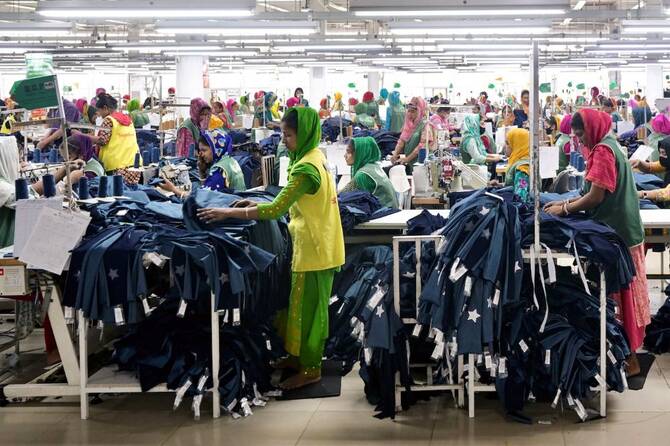
Bangladeshi garment workers tailor clothes at their sewing stations in a factory in Tongi, on the outskirts of Dhaka on July 6, 2025. (AFP)
Short Url
Updated 08 July 2025
Follow

Bangladesh’s garment industry eying GCC growth as exports to Saudi Arabia rise

  • Garment exports to the Kingdom surged 7.3% YOY in 2024-25
  • Apparel producers see untapped potential for high-end fashion exports

DHAKA: Bangladesh’s ready-made garment industry is seeing growing demand in Saudi Arabia, industry leaders say, as they look to the Kingdom as a key market for expansion in the Gulf region.

The garment sector is a key driver of the Bangladeshi economy. The country is one of the largest garment exporters in the world, second only to China. The industry accounts for more than 80 percent of Bangladesh’s total foreign sales revenue.

The newest data from the Export Promotion Bureau shows that garment exports to Saudi Arabia were valued at $152 million in the fiscal year 2024–25, up by 7.3 percent year-on-year.

The upward trend reflects growing interest from Saudi buyers in Bangladeshi apparel, particularly items such as T-shirts and jeans, according to Akhter Hossain Apurbo, vice president of the Bangladesh Knitwear Manufacturers and Exporters Association.

“We have strong potential for increasing exports to the GCC region, with Saudi Arabia and the UAE being the most significant markets,” he told Arab News.

Major European brands with retail outlets in Saudi Arabia place orders with Bangladeshi producers who deliver products directly to Saudi ports.

“We export to wholesale buyers and later on retailers sell these goods across the region,” Apurbo said. “Mostly Saudi locals are buying these Bangladeshi-made garments.”

Garment exports to Saudi Arabia have been growing consistently over the past few years. In the 2022–23 fiscal year, they were valued at $130 million — a major increase from the $84 million recorded in 2020-21, when production was stalled by the COVID-19 pandemic.

“Saudi Arabia is a growing and potential market for our garment exporters as there is a captive market of about 3 million Bangladeshi migrants,” said Mohiuddin Rubel, former director of the Bangladesh Garment Manufacturers and Exporters Association.

“Saudi citizens are also our target customers. Bangladesh makes world-class garment products and Saudis have good taste in clothing and they can afford it ... most of these buyers choose renowned European and American brands.”

Rubel sees significant untapped potential for high-end garment products and local Bangladeshi brands to enter the Saudi market.

“We have to focus on increasing exports to Saudi Arabia and other Middle Eastern countries, aiming to reduce our dependency on the EU and US markets. It’s the need of the hour,” he said.

“We need to focus on building our own brands (for the Middle Eastern market) besides producing clothes for internationally renowned brands. We have some competitive advantages as the goods will reach their destinations in a shorter time, with lower freight costs ... it will also help us increase product diversity.”


Gaza student evacuated to UK with her family after government climbdown

Updated 9 sec ago
Follow

Gaza student evacuated to UK with her family after government climbdown

  • Manar Al-Houbi was initially denied permission to bring her husband and children after changes to UK rules on foreign scholarship recipients
  • Several students still stranded in Gaza as relocation deadline looms, after refusing to abandon family members

LONDON: A student from Gaza granted permission to live and study in the UK has been evacuated from the Palestinian territory, with her family, by the British government.

Manar Al-Houbi won a full scholarship to study for a doctorate at the University of Glasgow. It also allowed her to bring her husband and children with her, and they applied for the required visas. But shortly before her studies were due to start, UK authorities told her the rules for international students and their dependents had changed and her family could no longer accompany her.

Shortly after her story was reported in October, however, the government backed down as said it would consider evacuation of international students’ dependents on a “case-by-case basis.”

Al-Houbi and her family are now in Jordan, on their way to the UK, The Guardian newspaper reported on Friday. The British scheme for the evacuation of students from Gaza is due to expire on Dec. 31. People who have attempted to use it have described it as being riddled with issues, as a result of which some students with scholarships have been left stranded in the Palestinian territory.

Several told the Guardian they had decided not to travel to the UK because they had felt pressured into leaving loved ones behind, including children.

Wahhaj Mohammed, 32, said he was told by the Foreign, Commonwealth and Development Office to travel to the UK alone, and his wife and children would be allowed to join him later. Two months after he arrived in Glasgow, his family are still in Gaza with no time frame for them to follow him.

“The uncertainty affects every aspect of my life here,” he told The Guardian. “It’s difficult to settle, to feel present or to engage academically when the people you love most remain living under constant threat.”

The Guardian said UK officials were “hopeful” his family would be evacuated in 2026 but could offer no guarantee about when this might happen.

Another student, Amany Shaher, said she refused to leave her family behind in Gaza and as a result was denied permission to travel to the UK this week. She does not know whether she will be permitted to defer her scholarship to study at the University of Bristol.

The 34-year-old, who has three children, said: “How can I even consider leaving my children behind in Gaza? Nowhere else in the world would a mother be expected to part so easily from her children. It’s dehumanizing. We have a right to stick together as a family and not be forced to separate — that should not be too much to ask.

“None of us know if the UK’s student evacuation scheme will be extended or not. We haven’t been given any clear guidance or timelines and have no idea what 2026 will bring.”

Mohammed Aldalou also refused to leave behind his family, including his 5-year-old autistic and non-verbal son, to take up a scholarship for postgraduate studies at the London School of Economics.

He said the Foreign Office had suggested to him he travel separately from them, as they did with Mohammed.

“They should ask themselves what they would do if they were in my shoes,” he said. “It’s heartbreaking that after everything we’ve been through, we’re being asked to make this impossible decision.”

Sources told The Guardian it was unlikely the Foreign Office would extend the scheme to allow students to travel from Gaza to the UK later, but that a meeting took place last week with the Department for Education to discuss whether students could begin their studies online.