

Ten men arrested at Mexico drug cartel ranch found guilty of murder

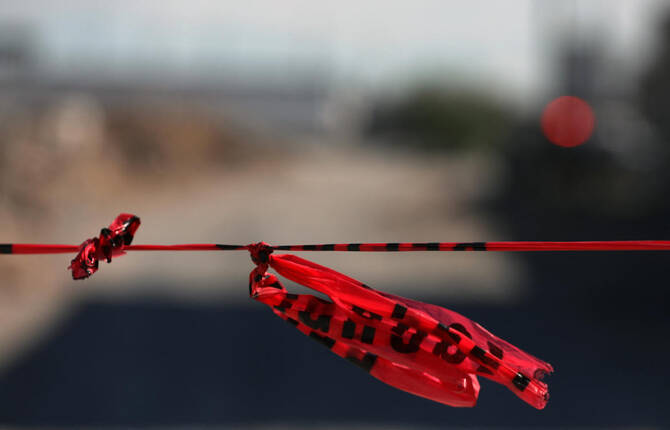
Since March, about 15 other people, including a mayor and police officers, have been arrested in connection with this site. (File/AFP)
Short Url
Updated 08 July 2025
Follow

Ten men arrested at Mexico drug cartel ranch found guilty of murder

  • The men were arrested last September when they exchanged gunfire with police and National Guard officers

GUADALAJARA: Ten men arrested at a farm linked to a drug cartel in the Mexican state of Jalisco were found guilty of murder and kidnapping in a high-profile trial that concluded Monday, the prosecutor’s office said.

The Izaguirre ranch allegedly served as a forced recruitment center for the Jalisco New Generation Cartel (CJNG), one of the most powerful criminal gangs in the country.

The men were found guilty of “disappearance committed by private individuals” and “qualified homicide,” according to a statement from the Jalisco prosecutor’s office.

The men were arrested last September when they exchanged gunfire with police and National Guard officers.

The Guerreros Buscadores collective, a group dedicated to locating missing relatives, reported in March that hundreds of objects and items of clothing had been found on the same property, allegedly belonging to missing people who had been forced to join the cartel.

The group also stated that they found probable charred human remains and that the site had been a sort of “extermination center” for the CJNG.

But the Attorney General’s Office, which carried out the investigation, stated that it did not find evidence to confirm these allegations, although it said the farm served as a criminal training center.

Since March, about 15 other people, including a mayor and police officers, have been arrested in connection with this site.

The case has received significant press coverage in a country where more than 100,000 people have gone missing, most of them since 2006 when the federal government launched a widely criticized anti-drug military operation.


Russia says talks on US peace plan for Ukraine ‘are proceeding constructively’

Updated 2 sec ago
Follow

Russia says talks on US peace plan for Ukraine ‘are proceeding constructively’

  • The talks are part of the Trump administration’s push for peace, which included meetings with Ukrainian and European officials in Berlin earlier this week
  • Ukrainian President Volodymyr Zelensky said much depends on the US posture after discussions with the Russians
A Kremlin envoy says peace talks on a US-proposed plan to end the nearly four-year war in Ukraine were pressing on “constructively” in Florida.
The talks are part of the Trump administration’s monthslong push for peace that also included meetings with Ukrainian and European officials in Berlin earlier this week.
“The discussions are proceeding constructively. They began earlier and will continue today, and will also continue tomorrow,” Kirill Dmitriev told reporters Saturday, according to Russian state news agency RIA Novosti.
Dmitriev met with US President Donald Trump’s envoy Steve Witkoff and Trump’s son-in-law Jared Kushner in Miami, the agency reported.
Ukrainian President Volodymyr Zelensky said Saturday that much will depend on the US posture after discussions with the Russians. This came a day after Ukraine’s chief negotiator said his delegation had completed separate meetings in the United States with American and European partners.
Trump has unleashed an extensive diplomatic push to end the war, but his efforts have run into sharply conflicting demands by Moscow and Kyiv. Russian President Vladimir Putin has recently signaled he is digging in on his maximalist demands on Ukraine, as Moscow’s troops inch forward on the battlefield despite huge losses.
On Friday, Putin expressed confidence that the Kremlin would achieve its military goals if Kyiv didn’t agree to Russia’s conditions in peace talks.
European Union leaders agreed on Friday to provide 90 billion euros ($106 billion) to Ukraine to meet its military and economic needs for the next two years, although they failed to bridge differences with Belgium that would have allowed them to use frozen Russian assets to raise the funds. Instead, they were borrowed from capital markets.