MEXICO CITY: A fierce protest in Mexico City railing against gentrification and mass tourism was fueled by government failures and active promotion to attract digital nomads, according to experts, who said tension had been mounting for years.
The criticism comes after Mexican President Claudia Sheinbaum alleged that Friday’s protest was marked by xenophobia, reviving a debate over an influx of Americans in the city.
Many Mexicans say they’ve been priced out of their neighborhoods — in part because of a move made by Sheinbaum in 2022, when she was the Mexico City mayor and signed an agreement with Airbnb and UNESCO to boost tourism and attract digital nomads despite concern over the impact short-term rentals could have.
‘Gringo: Stop stealing our home’
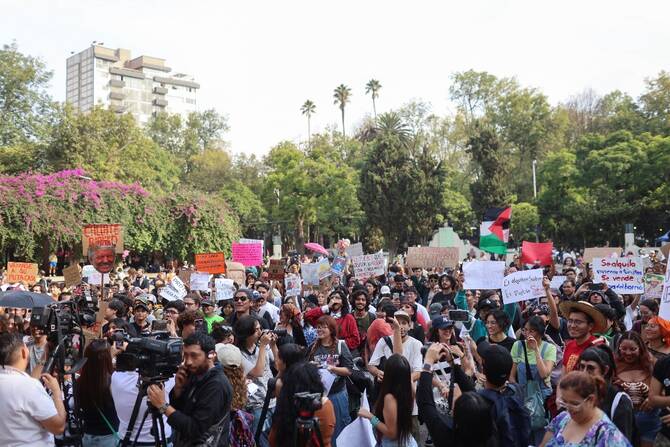
On Friday, that came to a head. A largely peaceful protest of hundreds of demonstrators marched through tourism centers of the city with signs reading “Gringo: Stop stealing our home” and “Housing regulations now!”
Near the end of the march, a group of protesters turned violent, breaking the windows of storefronts and looting a number of businesses. In one case, a protester slammed a butter knife against the window of a restaurant where people were hiding, and another person painted “kill a gringo” on a nearby wall.
“The xenophobic displays seen at that protest have to be condemned. No one should be able to say ‘any nationality get out of our country’ even over a legitimate problem like gentrification,” Sheinbaum said Monday. “We’ve always been open, fraternal.”
The frustrations were built upon years of mass tourism and rising rent prices in large swathes of the city. The influx of foreigners began around 2020, when Americans flooded into the Mexico City to work remotely, dodge coronavirus restrictions and take advantage of cheaper living costs.
In the years since, choice neighborhoods like Roma and Condesa, lush central areas dotted with cafes and markets, have grown increasingly populated by foreign tourists and the remote workers known as digital nomads, and there are more temporary housing units rented through companies like Airbnb that cater to tourists.
As they have, rent and living prices have soared and English has been increasingly common on the streets of those areas. Some groups have described the phenomenon as a sort of “neo-colonialism.”
Mounting tensions
The Mexico City Anti-Gentrification Front, one of the organizations behind the protest, it was “completely against” any acts of physical violence and denied that the protests were xenophobic. Instead, the organization said the protest was a result of years of failures by the local government to address the root of the problems.
“Gentrification isn’t just foreigners’ fault, it’s the fault of the government and these companies that prioritize the money foreigners bring,” the organization said in a statement. Meanwhile “young people and the working class can’t afford to live here.”
In its list of demands, the organization called for greater rent controls, mandates that locals have a voice in larger development projects in their area, stricter laws making it harder for landlords to throw out residents and prioritizing Mexican renters over foreigners.
Mexico’s protest comes on the back of a wave of similar protests across Europe railing against mass tourism. Tensions in Mexico have also been compounded by wider inequalities and the Trump administration targeting Latino communities in the US as it ramps up deportations.
The US Department of Homeland Security took a jab at protesters Sunday, writing in a post on the social media platform X: “If you are in the United States illegally and wish to join the next protest in Mexico City, use the CBP Home app to facilitate your departure.”
Government failures
Protesters’ cries against government failures were echoed by experts, who said that surging gentrification is a product of both shortage of affordable housing in the city and longtime government failures to regulate the housing market.
Antonio Azuela, lawyer and sociologist and others said that they do see the protest as a xenophobic backlash, and around 2020 the core of the problem was the influx of “digital nomads” in the city, but it grew out of hand because of lax housing laws.
“What has made this explode is lack of regulation in the market,” Azuela said.
Mexico City’s government over the course of decades has made a few efforts to control development and create affordable housing.
Legislators estimated there are about 2.7 million houses and apartments in the city, but it needs about 800,000 more. But such affordable housing developments that have popped up often are pushed off to the fringes of the city, said Luis Salinas, a researcher at National Autonomous University of Mexico who has studied gentrification in Mexico City for years.
Taking advantage of ‘insufficient’ laws
Controls, meanwhile, have been marked by lack of enforcement, which developers travel services companies like Airbnb take advantage of, he said.
Today, more than 26,000 properties in Mexico City are currently listed on Airbnb, according to the Inside Airbnb, an advocacy organization that tracks the company’s impact on residential communities through data. That’s compared to 36,000 properties in New York City and 19,000 in Barcelona, where protests have also broken out.
“The government has treated housing like it’s merchandise,” Salinas said. The actions the government is taking “are completely insufficient. The federal government needs to be intervening far more nowadays.”
Airbnb said it helped contribute more than a billion dollars in “economic impact” to Mexico City last year and that spending by guests has supported 46,000 jobs in the city. “What’s needed is regulation based not on prohibitions, but on respect for rights and transparency of obligations,” it said in a statement.
Last year, Mexico City’s government approved the most ambitious rent control law since the 1940s in an effort to control prices and also set caps on short-term rentals to 180 nights a year, but Salinas said that enforcement of short-term rental legislation has been put on pause until after the 2026 FIFA World Cup.
And even then, the country’s government will have to take far greater actions to get the situation under control, said Azuela.
“This isn’t going to end by just reigning in Airbnb,” he said. “They’re going to have to do a whole lot more.”


![]()

Mexico’s president calls march against mass tourism ‘xenophobic.’ Critics blame government failures
Short Url
https://arab.news/vusyu
Mexico’s president calls march against mass tourism ‘xenophobic.’ Critics blame government failures
- The Mexico City Anti Gentrification Front, one of the organizations behind the protest said said this was a result of years of failures by the local government to address the root of the problems


Latest updates


© 2026 SAUDI RESEARCH & PUBLISHING COMPANY, All Rights Reserved And subject to Terms of Use Agreement.