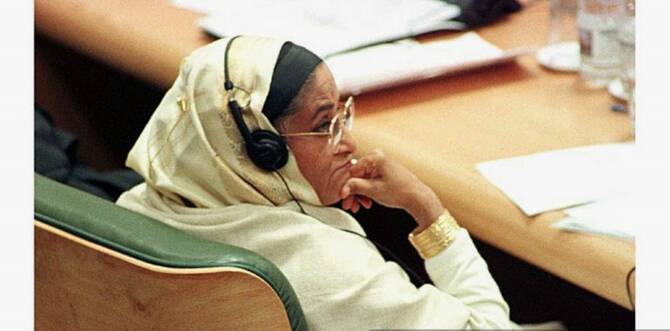
DHAKA: State-appointed defense lawyers sought on Monday to throw out the charges against Bangladesh’s convicted ex-prime minister Sheikh Hasina in her crimes against humanity trial.
Up to 1,400 people were killed between July and August last year, according to the United Nations, when Hasina’s government ordered a crackdown on protesters in a failed bid to cling to power.
Hasina, 77, fled to India at the culmination of the student-led uprising in August and has defied orders to return to Dhaka, where her trial in absentia opened on June 1.
“I sought discharge from all the allegations... as they appear false, fabricated and politically motivated,” Md Amir Hossain told reporters. He added that he had not been able to speak to Hasina directly.
Prosecutors say that Hasina held overall command responsibility for the violence.
Prosecutors have filed five charges against her — including failure to prevent mass murder — which amount to crimes against humanity under Bangladeshi law.
The trial resumes on July 10.
Hasina was already convicted of contempt of court in a separate case on July 2, receiving a six-month sentence.


Bangladesh lawyers seek to quash ex PM’s murder trial
https://arab.news/vbdqk
Bangladesh lawyers seek to quash ex PM’s murder trial

- According to the United Nations, up to 1,400 people were killed between July and August last year when ex PM Hasina’s government ordered a crackdown on protesters in a failed bid to cling to power


Britain needs to step up defense spending faster, says Starmer
- Britain’s budget watchdog, the Office for Budget Responsibility, said last year that raising defense spending to 3 percent of the GDP would cost an additional £17.3 billion a year ($24 billion) in 2029-30
LONDON: Britain should step up and accelerate its defense spending, Prime Minister Keir Starmer said on Monday, following a report that the government was considering bringing forward its target to spend 3 percent of economic output on defense.
Britain, which has warned of the risks posed by Russia, said in February 2025 that it would lift annual defense spending to 2.5 percent of the GDP by 2027 and aim for 3 percent in the next Parliament, which is expected to begin after an election due in 2029.
The BBC reported that the government was now exploring ways to reach the 3 percent target by 2029. It said no decision had been taken but the government recognized current plans would not cover rising defense costs.
HIGHLIGHT
The BBC reported that the government is now exploring ways to reach the 3 percent target by 2029.
Asked whether he would bring the target forward to 2029, Starmer echoed comments he made at the Munich Security Conference, where he said Europe had united to support Ukraine with the supply of weapons and munitions and to strengthen military readiness.
“We need to step up. That means on defense spending, we need to go faster,” Starmer told reporters on Monday. “We’ve obviously made commitments already in relation to that, but it goes beyond just how much you spend.”
Latest NATO estimates show that Britain spent 2.3 percent of the GDP on defense in 2024, above the alliance’s 2 percent guideline. But like other European countries, it has faced US pressure to spend more to protect the continent. Struggling with high debt and spending commitments, the government last year cut its international aid budget to fund the hike in defense spending to 2.5 percent of GDP but is yet to publish an investment plan with spending priorities, something that has frustrated the defense industry.
Britain’s budget watchdog, the Office for Budget Responsibility, said last year that raising defense spending to 3 percent of the GDP would cost an additional £17.3 billion a year ($24 billion) in 2029-30.
Finance Minister Rachel Reeves has struggled to stay on track with her plans to repair the public finances. The BBC said the Finance Ministry was believed to be cautious about the new defense spending proposals.
A government spokesperson said Britain was “delivering the largest sustained increase in defense spending since the Cold War.”


