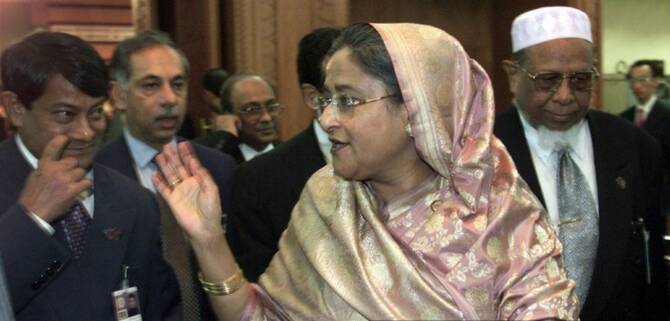
DHAKA: A Bangladesh government-appointed commission investigating hundreds of disappearances by the security forces under ousted premier Sheikh Hasina on Monday warned that the same “culture of impunity” continues.
The Commission of Inquiry into Enforced Disappearances is probing abuses during the rule of Hasina, whose government was accused of widespread human rights abuses.
That includes the extrajudicial killing of hundreds of political opponents and the unlawful abduction and disappearance of hundreds more.
The commission was established by interim leader, Nobel Peace Prize winner Muhammad Yunus, 84, who is facing intense political pressure as parties jostle for power ahead of elections expected early next year.
Bangladesh has a long history of military coups and the army retains a powerful role.
“Enforced disappearances in Bangladesh were not isolated acts of wrongdoing, but the result of a politicized institutional machinery that condoned, normalized, and often rewarded such crimes,” the commission said, in a section of a report released by the interim government on Monday.
“Alarmingly, this culture of impunity continues even after the regime change on August 5, 2024.”
The commission has verified more than 250 cases of enforced disappearances spanning the 15 years that Hasina’s Awami League was in power.
Commission chief Moyeenul Islam Chowdhury said earlier this month that responsibility lay with individual officers, who were “involved in conducting enforced disappearances,” but not the armed forces as an institution.
Earlier this month, a joint statement by rights groups — including Amnesty International and Human Rights Watch — called on the security forces to “fully cooperate with the commission by guaranteeing unfettered and ongoing access to all detention centers... and providing free access to records regarding those seized or detained.”
Hasina,77, remains in self-imposed exile in India, where she fled after she was ousted last year.
She has defied orders to return to Dhaka to face charges amounting to crimes against humanity. Her trial in absentia continues.


![]()


Bangladesh probe into Hasina-era abuses warns ‘impunity’ remains
Short Url
https://arab.news/vhrty
Bangladesh probe into Hasina-era abuses warns ‘impunity’ remains
- The Commission of Inquiry into Enforced Disappearances is probing abuses during the rule of Hasina, whose government was accused of widespread human rights abuses


Moderate candidate wins emphatically over a populist in Portugal’s presidential runoff
LISBON: Center-left Socialist candidate António José Seguro recorded a thumping victory over hard-right populist André Ventura in Portugal’s runoff presidential election Sunday, according to official results with 99 percent of votes counted.
Seguro won a five-year term in Lisbon’s riverside “pink palace” with 66.7 percent of votes, compared with 33.3 percent for Ventura.
The ballot was an opportunity to test the depth of support for Ventura’s brash style, which has struck a chord with voters and helped make his Chega (Enough) party the second-biggest in the Portuguese parliament, as well as gauge the public appetite for Europe’s increasing shift to the right in recent years.
European Commission President Ursula von der Leyen congratulated Seguro and said on social media that “Portugal’s voice for our shared European values remains strong.”
Seguro, a longstanding Socialist politician, positioned himself as a moderate candidate who will cooperate with Portugal’s center-right minority government, repudiating Ventura’s anti-establishment and anti-immigrant tirades.
He won the backing of other mainstream politicians on the left and right who want to halt the rising populist tide.
In Portugal, the president is largely a figurehead with no executive power. Traditionally, the head of state stands above the political fray, mediating disputes and defusing tensions.
However, the president is an influential voice and possesses some powerful tools, being able to veto legislation from parliament, although the veto can be overturned. The head of state also possesses what in Portuguese political jargon is called an “atomic bomb,” the power to dissolve parliament and call early elections.
In May, Portugal held its third general election in three years in the country’s worst bout of political instability for decades, and steadying the ship is a key challenge for the next president.
Ventura, an eloquent and theatrical politician, rejected political accommodation in favor of a more combative stance.
Ventura said he will keep working to bring about a political “transformation” in Portugal.
“I tried to show there’s a different way … that we needed a different kind of president,” he told reporters.
Making it through to the runoff was already a milestone for Ventura and his party, which have recalibrated Portuguese politics.
One of Ventura’s main targets has been what he calls excessive immigration, as foreign workers have become more conspicuous in Portugal in recent years.
“Portugal is ours,” he said.
During the campaign, Ventura put up billboards across the country saying, “This isn’t Bangladesh” and “Immigrants shouldn’t be allowed to live on welfare.”
Although he founded his party less than seven years ago, its surge in public support made it the second-largest party in Portugal’s parliament in the May 18 general election.
Seguro will next month replace center-right President Marcelo Rebelo de Sousa, who has served the constitutional limit of two five-year terms.
Seguro won a five-year term in Lisbon’s riverside “pink palace” with 66.7 percent of votes, compared with 33.3 percent for Ventura.
The ballot was an opportunity to test the depth of support for Ventura’s brash style, which has struck a chord with voters and helped make his Chega (Enough) party the second-biggest in the Portuguese parliament, as well as gauge the public appetite for Europe’s increasing shift to the right in recent years.
European Commission President Ursula von der Leyen congratulated Seguro and said on social media that “Portugal’s voice for our shared European values remains strong.”
Seguro, a longstanding Socialist politician, positioned himself as a moderate candidate who will cooperate with Portugal’s center-right minority government, repudiating Ventura’s anti-establishment and anti-immigrant tirades.
He won the backing of other mainstream politicians on the left and right who want to halt the rising populist tide.
In Portugal, the president is largely a figurehead with no executive power. Traditionally, the head of state stands above the political fray, mediating disputes and defusing tensions.
However, the president is an influential voice and possesses some powerful tools, being able to veto legislation from parliament, although the veto can be overturned. The head of state also possesses what in Portuguese political jargon is called an “atomic bomb,” the power to dissolve parliament and call early elections.
In May, Portugal held its third general election in three years in the country’s worst bout of political instability for decades, and steadying the ship is a key challenge for the next president.
Ventura, an eloquent and theatrical politician, rejected political accommodation in favor of a more combative stance.
Ventura said he will keep working to bring about a political “transformation” in Portugal.
“I tried to show there’s a different way … that we needed a different kind of president,” he told reporters.
Making it through to the runoff was already a milestone for Ventura and his party, which have recalibrated Portuguese politics.
One of Ventura’s main targets has been what he calls excessive immigration, as foreign workers have become more conspicuous in Portugal in recent years.
“Portugal is ours,” he said.
During the campaign, Ventura put up billboards across the country saying, “This isn’t Bangladesh” and “Immigrants shouldn’t be allowed to live on welfare.”
Although he founded his party less than seven years ago, its surge in public support made it the second-largest party in Portugal’s parliament in the May 18 general election.
Seguro will next month replace center-right President Marcelo Rebelo de Sousa, who has served the constitutional limit of two five-year terms.
Latest updates


Recommended


© 2026 SAUDI RESEARCH & PUBLISHING COMPANY, All Rights Reserved And subject to Terms of Use Agreement.