DAMASCUS: Syrian authorities said some 100 square kilometers (40 square miles) of forest had “turned to ash” in wildfires as firefighters from neighboring Jordan arrived Sunday to battle a fourth day of blazes in the province of Latakia.
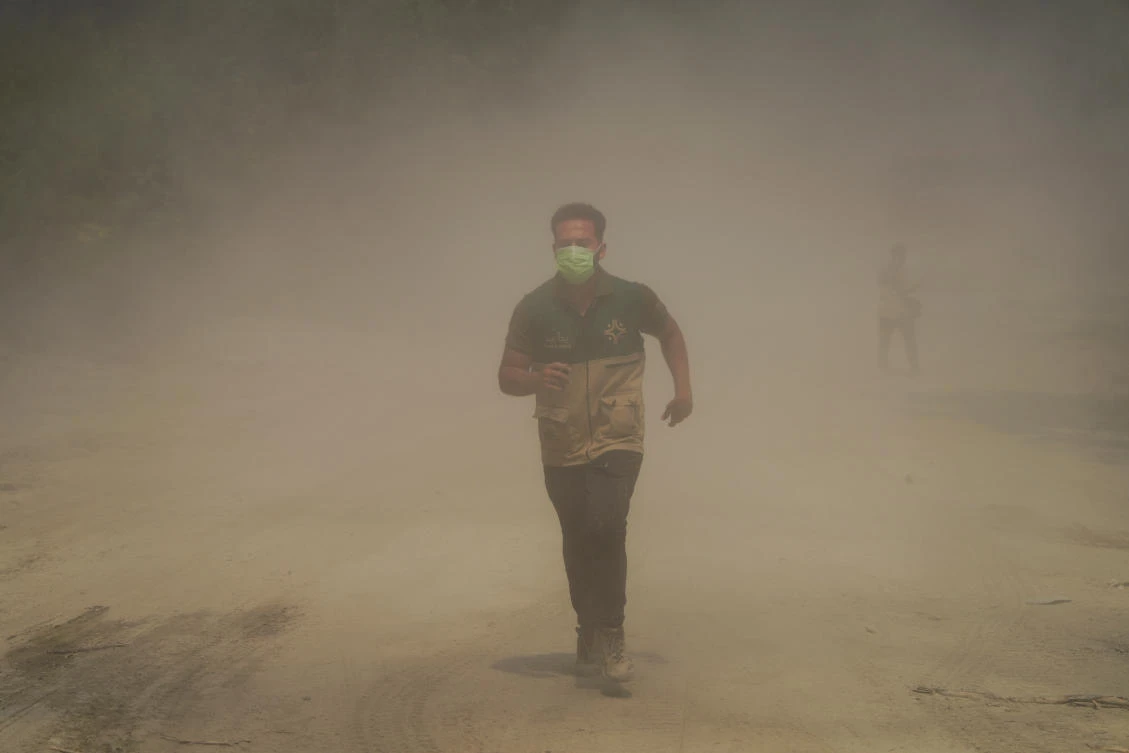
Syrian emergency workers have faced tough conditions including high temperatures, strong winds, rugged mountainous terrain in the coastal province and the danger of explosive war remnants, in a country worn down by years of conflict and economic crisis.
An AFP correspondent in Latakia’s Rabiaa region saw emergency workers battling a blaze near homes, while vast swathes of forest and olive groves were burnt and smoke filled the air over a long distance.
Jordanian civil defense teams crossed into Syria on Sunday morning, the Syrian ministry for emergencies and disaster management said, after Turkiye sent assistance a day earlier.
Minister Raed Al-Saleh said on X that “hundreds of thousands of forest trees over an estimated area of around 10,000 hectares (25,000 acres) in 28 locations have turned to ash.”
He later decried “a real environmental disaster” at a press conference in the province.
More than 80 teams including civil defense personnel have been helping battle the blaze, he said, noting local organizations and residents were also providing assistance, in addition to teams and firefighting aircraft from neighboring Jordan and Turkiye.
Saleh said it would take days to declare the blazes completely extinguished once the fire was brought under control, calling them “catastrophic.”
Syria’s defense ministry said the air force was assisting, publishing images of a helicopter collecting and dropping water.
Jordan’s public security directorate said in a statement that the “specialized firefighting teams from the civil defense... have been provided with all the modern equipment and machinery necessary to carry out their duties to the fullest extent.”
Swathes of forested area and farmland have burnt and some villages evacuated as the fires raged including near the Turkish border.
The United Nations deputy envoy to Syria Najat Rochdi said in a statement Sunday on X that Damascus “needs more international assistance” to face the fires.
A statement from the UN resident and humanitarian coordinator for Syria Adam Abdelmoula said that “UN teams are on the ground conducting urgent assessments to determine the scale of the disaster and to identify the most immediate humanitarian needs.”
Nearly seven months after the ousting of longtime ruler Bashar Assad, Syria is still reeling from more than a decade of civil war that ravaged the country’s economy, infrastructure and public services.
With man-made climate change increasing the likelihood and intensity of droughts and wildfires worldwide, Syria has also been battered by heatwaves and low rainfall.
In June, the United Nations Food and Agriculture Organization told AFP that Syria had “not seen such bad climate conditions in 60 years.”
Syria fights ‘catastrophic’ fires for fourth day
https://arab.news/2q4dx
Syria fights ‘catastrophic’ fires for fourth day
- Syrian emergency workers have faced tough conditions including high temperatures, strong winds, rugged mountainous terrain in the coastal province
A year after Assad fled, his victims struggle to heal
- A year ago, Mohammad Marwan found himself stumbling, barefoot and dazed, out of Syria’s notorious Saydnaya prison on the outskirts of Damascus as opposition forces pushing toward the capital threw open its doors to release the prisoners
- ‘We were in something like a state of death in Saydnaya ... Now we’ve come back to life’
HOMS, Syria: A year ago, Mohammad Marwan found himself stumbling, barefoot and dazed, out of Syria’s notorious Saydnaya prison on the outskirts of Damascus as opposition forces pushing toward the capital threw open its doors to release the prisoners.
Arrested in 2018 for fleeing compulsory military service, the father of three had cycled through four other lockups before landing in Saydnaya, a sprawling complex just north of Damascus that became synonymous with some of the worst atrocities committed under the rule of now-ousted President Bashar Assad.
He recalled guards waiting to welcome new prisoners with a gauntlet of beatings and electric shocks. “They said, ‘You have no rights here, and we’re not calling an ambulance unless we have a dead body,’” Marwan said.
His Dec. 8, 2024, homecoming to a house full of relatives and friends in his village in Homs province was joyful.
But in the year since then, he has struggled to overcome the physical and psychological effects of his six-year imprisonment. He suffered from chest pain and difficulty breathing that turned out to be the result of tuberculosis. He was beset by crippling anxiety and difficulty sleeping.
He’s now undergoing treatment for tuberculosis and attending therapy sessions at a center in Homs focused on rehabilitating former prisoners, and Marwan said his physical and mental situations have gradually improved.
“We were in something like a state of death” in Saydnaya, he said. “Now we’ve come back to life.”
Like Marwan, the country is struggling to heal a year after the Assad dynasty’s repressive 50-year reign came to an end following 14 years of civil war that left an estimated half a million people dead, millions more displaced, and the country battered and divided.
Hassan Abdul Ghani, spokesperson for the Syrian Ministry of Defense, said the opposition and its allies had launched a major organizational overhaul after Assad’s forces regained control of a number of areas in 2019 and 2020.
The offensive in November 2024 was not initially aimed at seizing Damascus but was meant to preempt an expected major offensive by Assad’s forces in opposition-held Idlib intending to “finish the Idlib file,” Abdul Ghani said.
Launching an attack on Aleppo “was a military solution to expand the radius of the battle and thus safeguard the liberated interior areas,” he said.
When the Syrian army’s defenses collapsed, the opposition pressed on, “taking advantage of every golden opportunity,” Abdul Ghani said.
Remnants of the civil war are everywhere. The Mines Advisory Group has reported that at least 590 people have been killed by land mines in Syria since Assad’s fall, including 167 children, putting the country on track to record the world’s highest land mine casualty rate in 2025.
The rebuilding that has taken place has largely been individual owners paying to fix their own damaged houses and businesses.
On the outskirts of Damascus, the once-vibrant Yarmouk Palestinian camp today largely resembles a moonscape. Taken over by a series of militant groups then bombarded by government planes, the camp was all but abandoned after 2018.
Since Assad’s fall, a steady stream of former residents have come back.
The most damaged areas remain largely deserted but on the main street leading into the camp, bit by bit, blasted-out walls have been replaced in the buildings that remain structurally sound. Shops have reopened and families have come back to their apartments. But any larger reconstruction initiative appears to still be far off.
“It’s been a year since the regime fell. I would hope they could remove the old destroyed houses and build towers,” said Maher Al-Homsi, who is fixing his damaged home to move back, although the area doesn’t even have a water connection.
His neighbor, Etab Al-Hawari, was willing to cut the new authorities some slack.
“They inherited an empty country — the banks are empty, the infrastructure was robbed, the homes were robbed,” she said.
Bassam Dimashqi, a dentist from Damascus, said of the country after Assad’s fall, “Of course it’s better, there’s freedom of some sort.”
He added: “The job of the state is to impose security, and once you impose security, everything else will come. The security situation is what encourages investors to come and do projects.”
The UN refugee agency reports that more than 1 million refugees and nearly 2 million internally displaced Syrians have returned to their homes since Assad’s fall.
Among them is Marwan, the former prisoner, who says the post-Assad situation in Syria is “far better” than before. But he is struggling economically.
Sometimes he picks up labor that pays only 50,000 or 60,000 Syrian pounds daily, the equivalent of about $5.
Once he finishes his tuberculosis treatment, he said, he plans to leave for Lebanon in search of better-paid work.