

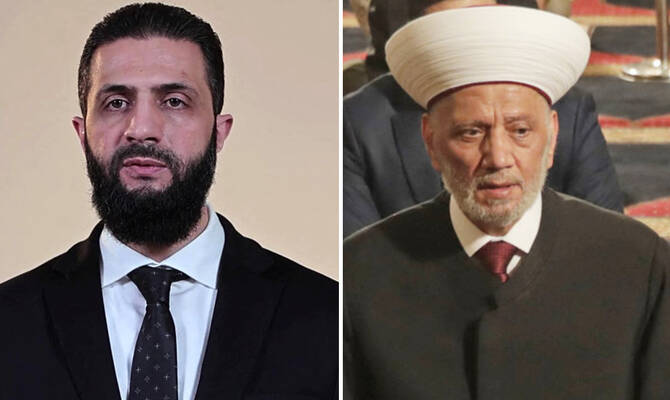

BEIRUT: Syrian President Ahmad Al-Sharaa and Lebanon’s Grand Mufti Sheikh Abdel Latif Derian had an hour-long meeting at the People’s Palace in Damascus on Saturday.
Derian’s visit was the first by a Lebanese Sunni religious leader to Syria in more than 20 years, signaling a thaw in relations between the two nations that had been strained since the 2005 assassination of former Lebanese Prime Minister Rafik Hariri and the start of the Syrian war in 2011.
Described as “frank,” the meeting addressed past estrangements and shared aspirations for renewal.
Derian, accompanied by a delegation of religious leaders, including Sheikh Mohammed Assaf, head of the Sunni Shariah courts, emphasized the importance of reconciliation and cooperation.
“After a long absence we come to reform the present and build a prosperous future,” he said, acknowledging the suffering of millions of Syrians and praising their resilience in the face of extremism and displacement.
He lauded the Syrian Arab Republic’s path toward free elections under Al-Sharaa — the first for more than 60 years — and expressed hope for its revival as a pillar of the Arab world and ability to overcome challenges like the recent Damascus church bombing, which he cited as evidence of ongoing conspiracies.
“Syrians will not be defeated by terrorism,” he said, praising Al-Sharaa’s navigation of a “difficult and arduous” road.
Derian underscored a renewed Lebanese-Syrian partnership founded on mutual support and Arab unity, and highlighted the promise of Lebanon’s own trajectory under a new government committed to the Taif Agreement.
“The hopes of the Lebanese are pinned on what was contained in the ministerial statement and the presidential oath, which are the beginning of the road to rebuilding a strong and just state, striving to serve all the Lebanese,” he said.
“Lebanon’s rise can only be achieved through the efforts of its best and loyal sons, both residents and expatriates, and the support of his Arab brothers and friends.”
He said there could be no salvation for Lebanon except through “sincere and constructive cooperation” with other Arab nations, which he described as the “guarantee of Lebanon’s security, stability, sovereignty, national unity and civilized Arabism which believes in the commitment to the Taif Agreement document … sponsored by Saudi Arabia.”
As a symbol of the strong ties between Lebanon and Syria, Derian presented Al-Sharaa with the Dar Al-Fatwa Gold Medal.
“We will stand with you in every calamity and joy,” he said.
The visit, coordinated with Lebanese President Joseph Aoun and Prime Minister Nawaf Salam, began with prayers at the Umayyad Mosque and a stop at Mount Qasioun.
In a separate meeting with Syrian Minister of Endowments Mohammed Abu Al-Khair, Derian emphasized Dar Al-Fatwa’s role in promoting moderate Islam, citizenship and coexistence amid regional challenges.
A Lebanese political observer framed the visit as a pivotal shift, not just religious but political, signaling Lebanese Sunnis’ readiness to forge a “new and normal” relationship with Syria’s emerging leadership.
The visit underscores Lebanon’s reaffirmation of its Arab identity and commitment to moderation, moving beyond decades of tension marked by assassinations and conflict.
Hezbollah, through its activists on social media, reacted cautiously to Derian’s visit to Damascus and his meeting with Al-Sharaa, with some accusing him of “stabbing the party in the back.”


