

Japan to export used destroyers to Philippines to deter China, Yomiuri reports

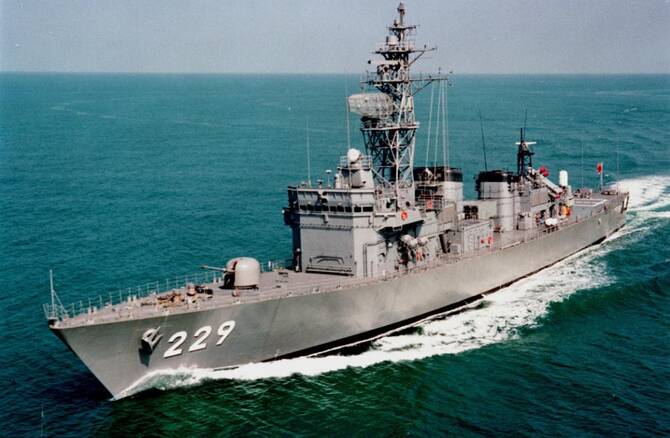
The Abukuma-class destroyer escort is operated by a crew of about 120 and is armed with anti-submarine and anti-ship missiles, torpedo tubes and guns, according to a Japanese navy website. (www.mod.go.jp)
Short Url
Updated 06 July 2025
Follow

Japan to export used destroyers to Philippines to deter China, Yomiuri reports

  • Tokyo and Manila say they face challenges from Beijing’s increasingly assertive moves in disputed waters
  • The Abukuma-class destroyer escort is a relatively small type of destroyer with a 2,000-tonne standard displacement

TOKYO: Japan will export used navy destroyers to the Philippines to strengthen its deterrence against China’s maritime expansion, the Yomiuri newspaper reported on Sunday, as the two US allies increase cooperation to counter Beijing.

The export plan involves six Abukuma-class destroyer escorts in service by the Japan Maritime Self-Defense Force for more than three decades, the Japanese daily said, citing multiple unnamed government sources.

Defense ministers Gen Nakatani and Gilberto Teodoro agreed to the destroyer export when they met in Singapore last month, the Yomiuri said, adding the Philippine military is set to inspect the destroyers this summer as part of the final preparations.

A Japanese defense ministry spokesperson declined to comment on the report. A Philippine military spokesperson and China’s foreign ministry did not immediately respond to Reuters requests for comment.

Tokyo and Manila say they face challenges from Beijing’s increasingly assertive moves in waters including the South China Sea for the Philippines and the East China Sea for Japan.

Bilateral military cooperation has included joint exercises, a Japanese radar aid package and a high-level strategic dialogue. Last year they signed a reciprocal access agreement, the first such for Japan in Asia, allowing deployment of forces on each other’s soil.

To clear military equipment export restrictions for the destroyers under Japan’s pacifist mandates, Tokyo will treat the installation of equipment and communication systems requested by Manila as a joint development project, the Yomiuri said.

The Abukuma-class destroyer escort, a relatively small type of destroyer with a 2,000-tonne standard displacement, is operated by a crew of about 120 and is armed with anti-submarine and anti-ship missiles, torpedo tubes and guns, according to a Japanese navy website.

The Philippine Navy does not have destroyers, only frigates and corvettes, which are typically smaller and lighter-armed vessels.


EU, India successfully conclude major trade deal: New Delhi

Updated 3 sec ago
Follow

EU, India successfully conclude major trade deal: New Delhi

  • Indian government officials say the pact, which was two decades in the making, will be unveiled Tuesday
  • European Commission President Ursula von der Leyen and European Council president Antonio Costa appear as guests of honor at India’s Republic Day parade
NEW DELHI: India and the European Union have finalized a massive free trade deal, Indian government officials said on Monday, about two decades after negotiations were first launched.
Facing challenges from China and the United States, Brussels and New Delhi have sought closer ties, producing a pact that is to be unveiled in the Indian capital on Tuesday.
Feted Monday as guests of honor at India’s Republic Day parade, European Commission President Ursula von der Leyen and European Council president Antonio Costa are to meet Indian Prime Minister Narendra Modi for a summit.
“Official level negotiations are being concluded and both sides are all set to announce the successful conclusion” of talks at the Tuesday summit, Indian commerce secretary Rajesh Agrawal told AFP.
The EU has eyed India — the world’s most populous nation — as an important market for the future, while New Delhi sees the European bloc as an important source of much-needed technology and investment to rapidly upscale its infrastructure and create millions of new jobs.

’Mother of all deals’

Bilateral trade in goods reached 120 billion euros ($139 billion) in 2024, an increase of nearly 90 percent over the past decade, according to EU figures, with a further 60 billion euros ($69 billion) in trade in services.
India’s Commerce Minister Piyush Goyal has described the new pact as “the mother of all deals.”
“Final negotiations have been focused and fruitful, and we are now very optimistic that we will land this historic trade deal,” an EU official said Monday speaking on condition of anonymity.
Under the agreement, India is expected to ease market access for key European products, including cars and wine, in return for easier exports of textiles and pharmaceuticals, among other things.
“The EU stands to gain the highest level of access ever granted to a trade partner in the traditionally protected Indian market,” von der Leyen said on Sunday, adding that she expected exports to India to double.
“We will gain a significant competitive advantage in key industrial and agri-good sectors.”
Talks went down to the wire on Monday, focusing on a few sticking points, including the impact of the EU’s carbon border tax on steel, according to sources familiar with the discussions.
The accord comes as both Brussels and New Delhi have sought to open up new markets in the face of US tariffs and Chinese export controls.
India and the EU were also expected to conclude an accord to facilitate movement for seasonal workers, students, researchers and highly skilled professionals, and a security and defense pact.
“India and Europe have made a clear choice. The choice of strategic partnership, dialogue and openness,” von der Leyen wrote on social media. “We are showing a fractured world that another way is possible.”
New Delhi, which has relied on Moscow for key military hardware for decades, has tried to cut its dependence on Russia in recent years by diversifying imports and pushing its own domestic manufacturing base.
Europe is doing the same with regard to the United States.