

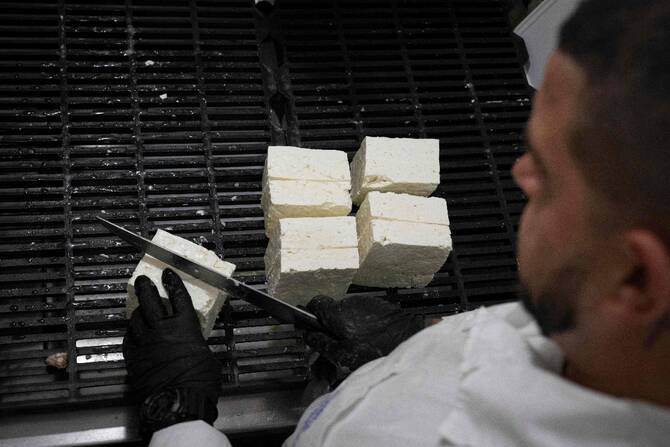

SMOLYAN: At a prison nestled deep in Bulgaria’s southern Rhodope mountains, Georgi Filyanov stirs a large tank of curdling milk to make traditional feta-like cheese in the facility’s dairy operation.
Filyanov is the latest success story to emerge from the dairy located inside Smolyan prison, where about 15 selected inmates produce some of Bulgaria’s highly sought-after cheese and yogurt.
“Work is interesting — not too hard, not too easy,” said 30-year-old Filyanov, who was handed a two-and-a-half-year jail sentence for drug dealing. He has since been released early after having his sentence reduced by prison labor.
The “Gerzovitsa” dairy is the brainchild of former prison director Hristo Solakov, who was looking for ways to produce everything in-house while helping inmates to prepare for life outside jail.
From tending to herds of goats and cows, to making white cheese, prisoners are involved throughout the entire process.
Coveted by cheese lovers and often sold out at specialty stores outside prison, production has not been able to keep up with demand.
The prison is located about 20 minutes from the nearest town of the same name, in a narrow gorge surrounded by conifer-covered hills.
Once the headquarters of several Communist-run uranium mines, which were shuttered after 1989, the building is now home to around 100 inmates, who serve time in the semi-open prison for drink-driving, theft but also murder.
Prisons are not overflowing in Bulgaria, the poorest country in the European Union, which has seen a considerable exodus by those seeking a better life abroad. According to Eurostat figures, the country has only 86 prisoners per 100,000 inhabitants, trailing far behind France (111).
Nonetheless, poor conditions in Bulgaria’s prisons that have been exacerbated by dilapidated facilities and chronic staff shortages repeatedly drew criticism from the Council of Europe.
Smolyan, however, stands out — not least because of its dairy that opened in 2010.
To date it is Bulgaria’s only such rehabilitation project that enables prisoners to earn early release and a small salary of several hundred euros per month they can spend while they are inside or access upon their release.
“At first, we only kept cows, sheep, and goats — but it wasn’t profitable: the milk sold for less than the costs we had,” said Solakov, who came up with the idea of setting up a dairy in a bid “to close the circle.”
“It’s a job with responsibilities,” prisoner Ivan Patazov, 31, told AFP.
Tasked with cutting, packaging and labelling the cheese, he hopes to continue in this line of work after he gets out.
“He won’t be the first,” said Solakov, 62, adding that a former inmate successfully opened his own dairy after being released.
He praised the prison’s “high-quality” dairy products, which do without “any artificial preservatives or additives.”
With demand soaring and production capacity limited, the dairy products are sold at a higher price than comparable items.
While about half of the production is destined for other Bulgarian jails, the rest is sold at markets and grocery shops.
A few specialty stores across Bulgaria also sell various types of cheese and yogurt from Smolyan prison.
A few kilometers outside the prison, a herd of about 100 goats are grazing on a mountain meadow, where the air is thick with the scent of thyme.
Another prisoner called Pavel, who declined to give his surname, looks after the herd. Even though the meadow is close to the border with Greece, running away has never crossed his mind.
“In the old days, we used to raid dairies — now the dairy is in prison,” Solakov quipped, referring to Bulgarian partisans, who infamously robbed farmers during World War II.
But he hopes to secure funding for a new project to expand the dairy and start producing kashkaval cheese.


