BRICS nations to denounce Trump tariffs for causing economic uncertainty

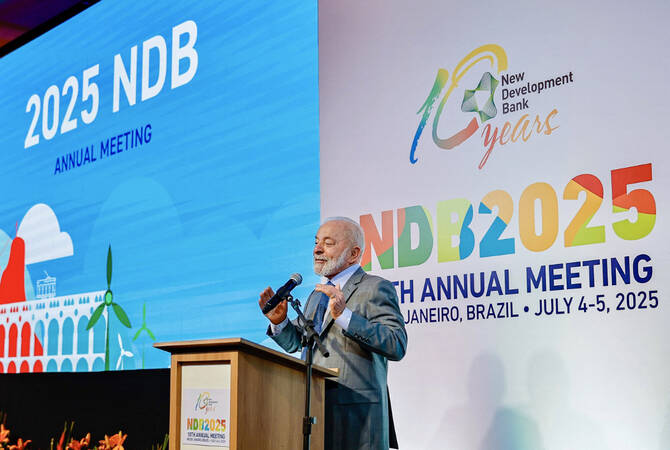
Brazil's President Luiz Inacio Lula da Silva delivers a speech during the 10th Annual Meeting of the New Development Bank (NDB), within the BRICS summit in Rio de Janeiro on July 4, 2025. (Brazilian Presidency handout/ via AFP)
Short Url
Updated 05 July 2025
Follow

BRICS nations to denounce Trump tariffs for causing economic uncertainty

  • Emerging nations representing about half the world’s population and 40 percent of global economic output are set to unite over what they see as unfair US import tariffs
  • Since coming to office in January, Trump has threatened allies and rivals alike with a slew of punitive tariffs

RIO DE JANEIRO, Brazil: BRICS leaders meeting in Rio de Janeiro from Sunday are expected to decry Donald Trump’s hard-line trade policies, but are struggling to bridge divides over crises roiling the Middle East.
Emerging nations representing about half the world’s population and 40 percent of global economic output are set to unite over what they see as unfair US import tariffs, according to sources familiar with summit negotiations.
Since coming to office in January, Trump has threatened allies and rivals alike with a slew of punitive tariffs.
His latest salvo comes in the form of letters due to be sent starting Friday informing trading partners of new tariff rates expected next week on July 9.
Diplomats from 11 emerging nations, including Brazil, Russia, India, China and South Africa, have been busy drafting a statement condemning the economic uncertainty.
Any final summit declaration is not expected to mention the United States or its president by name. But it is expected to be a clear political shot directed at Washington.
“We’re anticipating a summit with a cautious tone: it will be difficult to mention the United States by name in the final declaration,” Marta Fernandez, director of the BRICS Policy Center at Rio’s Pontifical Catholic University said.
This is particularly the case for China, which has only recently negotiated with the US to lower steep tit-for-tat levies.
“This doesn’t seem to be the right time to provoke further friction” between the world’s two leading economies, Fernandez said.

China leader to skip annual meeting

Conceived two decades ago as a forum for fast-growing economies, the BRICS have come to be seen as a Chinese-driven counterbalance to Western power.
But the summit’s political punch will be depleted by the absence of China’s Xi Jinping, who is skipping the annual meeting for the first time in his 12 years as president.
“I expect there will be speculation about the reasons for Xi’s absence,” said Ryan Hass, a former China director at the US National Security Council who is now with the Brookings Institution think tank.
“The simplest explanation may hold the most explanatory power. Xi recently hosted Lula in Beijing,” said Hass.
The Chinese leader will not be the only notable absentee. War crime-indicted Russian President Vladimir Putin is also opting to stay away, but will participate via video link, according to the Kremlin.
Hass said Putin’s non-attendance and the fact that India’s prime minister will be a guest of honor in Brazil could also be factors in Xi’s absence.
“Xi does not want to appear upstaged by Modi,” who will receive a state lunch, he said.
“I expect Xi’s decision to delegate attendance to Premier Li (Qiang) rests amidst these factors.”
Still, the Xi no-show is a blow to host President Luiz Inacio Lula da Silva, who wants Brazil to play a bigger role on the world stage.
In the year to November 2025, Brazil will have hosted a G20 summit, a BRICS summit, and COP30 international climate talks, all before heading into fiercely contested presidential elections next year, in which he is expected to run.

No consensus on response to Gaza, Iran wars
Iran’s President Masoud Pezeshkian, whose nation is still reeling from a 12-day conflict with Israel is also skipping the meeting.
A source familiar with the negotiations said the BRICS countries were still in disagreement over how to respond to the wars in Gaza and between Iran and Israel.
Iranian negotiators are pushing for a tougher collective stance that goes beyond referencing the need for the creation of a Palestinian state and for disputes to be resolved peacefully.
Artificial intelligence and health will also be on the agenda at the summit.
Original members of the bloc Brazil, Russia, India, and China have been joined by South Africa and, more recently, by Iran, the United Arab Emirates, Egypt, Ethiopia and Indonesia.
Analysts say that it has given the grouping more potential international punch.
But it has also opened many new fault lines.
Brazil hopes that countries can take a common stand at the summit, including on the most sensitive issues.
“BRICS (countries), throughout their history, have managed to speak with one voice on major international issues, and there’s no reason why that shouldn’t be the case this time on the subject of the Middle East,” Brazil’s Foreign Minister Mauro Vieira told AFP.


Zelensky hails ‘real progress’ in Berlin talks with Trump envoys

Updated 7 sec ago
Follow

Zelensky hails ‘real progress’ in Berlin talks with Trump envoys

BERLIN: Ukrainian President Volodymyr Zelensky said Monday that talks in Berlin with US President Donald Trump’s envoys on ending the war with Russia were “not easy” but brought “real progress” on the question of security guarantees.
Zelensky met for a second day with Trump’s special envoy Steve Witkoff and the president’s son-in-law Jared Kushner for talks aimed at ending the war that started with Russia’s 2022 full-scale invasion, building on a proposal initially put forward by Trump.
He hailed new security guarantees offered by Washington but also said differences remained on the question of what territories Ukraine would have to cede to battlefield enemy Russia.
“There has been sufficient dialogue on the territory, and I think that, frankly speaking, we still have different positions,” Zelensky told reporters.
An upbeat German Chancellor Friedrich Merz said the talks had created the “chance for a real peace process” and praised the US for offering “substantial” security guarantees.
From Washington, Trump said he would hold a phone call later Monday with Zelensky and a group of European leaders set to meet in Berlin, among them UK Prime Minister Keir Starmer and French President Emmanuel Macron.
Also expected were Italian Prime Minister Giorgia Meloni, Polish premier Donald Tusk and Finland’s President Alexander Stubb and other leaders, as well as NATO chief Mark Rutte and European Commission head Ursula von der Leyen.
The United States said it had offered strong, NATO-like security guarantees to Ukraine and voiced confidence that Russia would accept, in what Washington said would be a breakthrough in ending the war.

- ‘Very strong deterrence’ -

US officials described the hours of talks in Berlin as positive and said Trump in his call would seek to push forward the deal.
The US officials warned Ukraine must accept the deal, which they said would provide security guarantees in line with NATO’s Article Five — which calls an attack on one ally an attack on all.
“The basis of that agreement is basically to have really, really strong guarantees — Article Five-like — also a very, very strong deterrence” in the size of Ukraine’s military, a US official said on condition of anonymity.
“Those guarantees will not be on the table forever. Those guarantees are on the table right now if there’s a conclusion that’s reached in a good way,” he said.
Trump has previously ruled out a formal entry of Ukraine into NATO and sided with Russia in calling Kyiv’s aspirations to the alliance a reason for the full-scale invasion by Moscow.
Merz said any ceasefire must be “secured by substantial legal and material security guarantees from the United States and Europe, which the United States has put on the table here in Berlin in terms of legal and material guarantees.”
“This is truly remarkable. This is a very important step forward, which I very much welcome,” he said.

- ‘Criminal attack’ -

Zelensky said about the talks with the US side that “these conversations are always not easy” but that it had been “a productive conversation.”
An official briefed on the US-Ukrainian talks earlier told AFP that US negotiators still want Ukraine to cede control of the eastern Donbas — made up of the Donetsk and Lugansk regions.
Moscow controls almost all of Lugansk and about 80 percent of the Donetsk region, according to the US-based Institute for the Study of War.
Russian President Vladimir Putin “wants territory,” said the official, adding that the United States was demanding that Ukraine “withdraw” from the regions and that Kyiv was refusing.
One of the US officials acknowledged that there was no agreement on territory.
Trump has called it inevitable that Ukraine would need to surrender territory to Russia, an outcome anathematic to Zelensky after his country’s defense of nearly four years.
Russia, meanwhile, has signalled it will insist on its core demands, including on territory and on Ukraine never joining NATO.
Kremlin spokesman Dmitry Peskov said on Monday that Russia was expecting the United States to “provide us with the concept that is being discussed in Berlin today.”
Merz vowed sustained support for Ukraine as it fights back against what he labelled “Putin’s criminal attack.”
“We will only be able to achieve lasting peace in Europe together, with a free and sovereign Ukraine, a strong Ukraine that can defend itself against Russian attacks now and in the future,” he said.
“The fate of Ukraine is the fate of all Europe.”