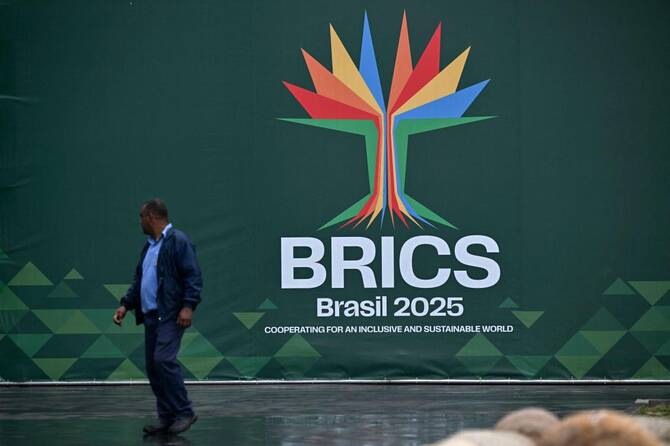
Rio to host BRICS summit wary of Trump

BRICS members did not issue a strong statement on the Iran-Israel conflict and subsequent US military strikes due to their ‘diverging’ interests, an expert said. (AFP)
Short Url
Updated 04 July 2025
Follow

Rio to host BRICS summit wary of Trump

  • The city, with beefed-up security, will play host to leaders and diplomats from 11 emerging economies
  • Tensions in the Middle East, including Israel’s ongoing war in Gaza, will weigh on the summit

RIO DE JANEIRO, Brazil: A summit of BRICS nations will convene in Rio de Janeiro on Sunday and Monday, with members hoping to weigh in on global crises while tiptoeing around US President Donald Trump’s policies.

The city, with beefed-up security, will play host to leaders and diplomats from 11 emerging economies including China, India, Russia and South Africa, which represent nearly half of the world’s population and 40 percent of its GDP.

Brazil’s left-wing President Luiz Inacio Lula da Silva will have to navigate the absence of Chinese President Xi Jinping, who will miss the summit for the first time.

Beijing will instead be represented by its Prime Minister Li Qiang.

Russian leader Vladimir Putin, who is facing a pending International Criminal Court (ICC) arrest warrant, will not travel to Brazil, but is set to participate via video link, according to the Kremlin.

Iran’s President Masoud Pezeshkian, fresh from a 12-day conflict with Israel and a skirmish with the United States, will also be absent, as will his Egyptian counterpart Abdel Fattah El-Sisi, a Brazilian government source said.

Tensions in the Middle East, including Israel’s ongoing war in Gaza, will weigh on the summit, as well as the grim anticipation of tariffs threatened by Trump due next week.

“We’re anticipating a summit with a cautious tone: it will be difficult to mention the United States by name in the final declaration,” Marta Fernandez, director of the BRICS Policy Center at Rio’s Pontifical Catholic University said.

China, for example, “is trying to adopt a restrained position on the Middle East,” Fernandez said, pointing out that Beijing was also in tricky tariff negotiations with Washington.

“This doesn’t seem to be the right time to provoke further friction” between the world’s two leading economies, the researcher said.

BRICS members did not issue a strong statement on the Iran-Israel conflict and subsequent US military strikes due to their “diverging” interests, according to Oliver Stuenkel, an international relations professor at the Getulio Vargas Foundation.

Brazil nevertheless hopes that countries can take a common stand at the summit, including on the most sensitive issues.

“BRICS (countries), throughout their history, have managed to speak with one voice on major international issues, and there’s no reason why that shouldn’t be the case this time on the subject of the Middle East,” Brazil’s Foreign Minister Mauro Vieira said.

However, talks on finding an alternative to the dollar for trade between BRICS members are likely dead in the water.

For Fernandez, it is almost “forbidden” to mention the idea within the group since Trump threatened to impose 100 percent tariffs on countries that challenge the dollar’s international dominance.

Brazil, which in 2030 will host the COP30 UN climate conference, also hopes to find unity on the fight against climate change.

Artificial intelligence and global governance reform will also be on the menu.

“The escalation of the Middle East conflict reinforces the urgency of the debate on the need to reform global governance and strengthen multilateralism,” said foreign minister Vieira.

Since 2023, Egypt, the United Arab Emirates, Ethiopia, Iran and Indonesia have joined the BRICS, formed in 2009 as a counter-balance to leading Western economies.

But, as Fernandez points out, this expansion “makes it all the more difficult to build a strong consensus.”


India rolls out strictest anti-pollution curbs as toxic smog engulfs Delhi

Demonstrator wearing an oxygen mask and holding oxygen tanks takes part in protest.
Updated 14 December 2025
Follow

India rolls out strictest anti-pollution curbs as toxic smog engulfs Delhi

  • Private monitors in several parts of northern Delhi recorded AQI spikes between 550 and 700s
  • Authorities invoked stage four of the capital region’s emergency pollution-control framework

NEW DELHI: India’s capital choked under a thick blanket of smog on Sunday, with the government imposing anti-pollution curbs after monitoring stations in some areas recorded extremely hazardous air quality.

Home to 30 million people, Delhi has not recorded a single “clean air” day in 2025, with Air Quality Index readings hitting high above the 50 score throughout the year.

On the AQI scale from 0 to 500, good air quality is represented by levels below 50, while levels above 300 are dangerous.

Worsening since late October, official records over the weekend were in the severe to severe-plus range of 400–500, but as 24-hour averages, they did not capture the peaks. Private monitors in several parts of North and North West Delhi recorded AQI spikes above 550 and even into the 700s in real-time.

On Saturday evening, the Ministry of Environment’s Commission for Air Quality Management invoked stage four — the highest level — of the Graded Response Action Plan for Delhi and surrounding areas.

To “prevent further deterioration of air quality in the region,” the commission suspended all non-essential construction, shut stone crushers and mining operations, stopped entry of trucks into the capital region, and ordered schools to shift to hybrid classes or online, where possible.

While authorities blamed the pollution on “adverse meteorological conditions,” residents have been demanding more government action.

“The situation is so bad in Delhi that we don’t have any option but to force kids to do online classes. The government has failed us; it has not done anything to address the issue,” said Nabanita Nayak, who decided for her teenage children to attend school online only, despite concerns over their screen addiction.

“If the kids are too much in front of laptops, that’s also an issue. As a mother, I am worried.” 

Delhi’s pollution has been worsening since Diwali in late October, when the average AQI has been above 370, or “very poor.” Since mid-November, it has been over 400, which means “severe” air quality, with certain areas recording 500 and above, which is classified as a “hazardous” level.

“I don’t feel proud living in Delhi. It’s the capital city of the country … We talk about being a developed nation by 2047 — we have deadlines,” said Jagriti Arora, who is keeping her 7-year-old daughter at home to prevent allergy flare-ups caused by air pollution.

“The government has to do something … China had a big problem with pollution, but now they’ve managed to bring it down.”

Delhi’s air quality deteriorates in winter due to local emissions and seasonal weather conditions. Cold temperatures and low wind speeds result in a temperature inversion, which traps pollutants close to the ground instead of letting them disperse. This allows emissions from millions of vehicles, ongoing construction, and nearby industrial activity to accumulate in the air. Urban waste burning and dust from construction sites further add to it.

“This is not a new thing. This has been happening now for over 10 years,” Arora said. “You can see it. You don’t need to actually look at an AQI meter to see how bad the pollution is these days.”