



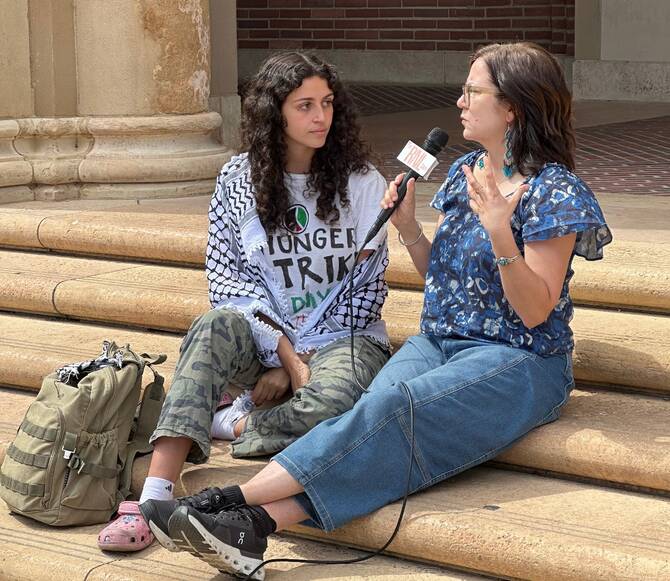

DUBAI: Maya Abdallah’s message is clear: she will not eat until her university — the University of California, Los Angeles — hears her out on her cause, the crisis in Gaza.
The 23-year-old film student is Palestinian-Lebanese and is on hunger strike, protesting against her university’s funding of Israeli businesses that allegedly invest in manufacturing weapons being used by Israeli forces on the people of Gaza.
“I want to open a renegotiation for divestment … billions of dollars are spent on things like the gas that’s going into the Israeli tanks, to the manufacturers of the weapons used against the people of Gaza,” Abdallah said.
UC Chief Investment Officer Jagdeep Singh Bachher said in an official statement in 2024 that the university had $32 billion in assets in various companies, $3.3 billion of that in groups with ties to weapons manufacturers and $163 million in the investment firm BlackRock.
Abdallah is not alone. Although she is currently the only student at UCLA on hunger strike, students at other universities in California are also striking, including California State University Dominguez Hills and California State University Long Beach.
Hoping to be heard by policymakers and officials at their institutions, these students are now on Day 21 of their strikes.
So far, San Francisco State University and University of San Francisco have announced in official statements their divestment from companies such as Palantir and GE Aerospace who allegedly supply weapon systems and technology to the Israeli military.
“I didn’t just come up with the idea of a hunger strike. I saw students across California do it, and I wanted to contribute, even if I was the only one at UCLA,” Abdallah said.
Her strike began on May 9. Abdullah, who is subsisting only on liquids, said it has been harder than she anticipated, but she is willing to push herself.
“This isn’t easy. I’m exhausted, I’m hungry, and sometimes I’m scared. But none of that compares to what Palestinians in Gaza are facing right now. I remind myself of that every single day,” she said.
Abdallah said the hardest part of the strike is the mental strain of starving herself.
“More than the toll starvation takes on your body, it’s what it does to your brain. I can’t imagine the people who’ve suffered the loss of family members, left their homes, and felt abandoned in every way; now also going without food and dealing with that added stress. For me, there’s food around me. I could end my strike and eat. That’s not an option for them,” she said.
In addition to studying film, Abdallah is a social media entertainer turned activist, with more than two million followers on various platforms.
“I’ve tried protesting and raising awareness, but this was one of the things I hadn’t tried yet … when you’re fighting for such a cause, you have to try literally everything in your toolbox,” she said.
On the ninth day of her strike, Abdallah collapsed during a protest on campus and was rushed to the emergency room in an ambulance.
In a video she posted on her social media accounts, Abdallah said that first responders discovered her heart rate was 40 percent higher than the average person.
Since then, Abdallah is back home resting and is still actively fighting for her cause on campus and on social media.
The UN in 2024 reported that more than 80 percent of educational institutes in Gaza were damaged or destroyed.
“There are no universities left in Gaza, and yet our university is helping fund that destruction. It’s disgusting hypocrisy,” she added.
Abdallah said her university was aware of her strike, and that campus police as well as social workers are in contact with her, yet no official acknowledgement of her strike has been made. Even after she was admitted to hospital, Abdallah said no one from the university responded to check on her.
A UCLA spokesperson told Arab News the university supports freedom of expression of different points of view.
“We strongly urge all Bruins to peacefully express themselves and exercise their first amendment rights in ways that are safe. We will continue to make support available to all students through UCLA’s Student Health Services and other campus offices,” the spokesperson said.
Many people online have criticized Abdallah for her decision to strike, claiming that it will not lead to any meaningful outcome. But she said she does not care.
“An ‘indefinite hunger strike’ is ridiculous. She’s only harming herself. Ridiculous actions,” said a commenter on Instagram. Another said she was “A spoiled rich girl doing spoiled rich girl stuff. Your university owes you nothing but an overpriced gender studies degree. Grow up girl.” Another said “you go girl! Starve yourself. That’ll free Gaza.”
After a surge of student protests and encampments on university campuses in April 2024 to raise awareness about the crisis in Gaza after the Israeli military aggression on Gaza intensified in 2023, UCLA released a statement saying it would not divest from Israel.
“The University of California has consistently opposed calls for boycott against and divestment from Israel. While the University affirms the right of our community members to express diverse viewpoints, a boycott of this sort impinges on the academic freedom of our students and faculty and the unfettered exchange of ideas on our campuses,” according to the statement on UCLA’s official website.
Abdallah, who was on campus during the 2024 protests and encampments, described the situation as brutal but she felt motivated to see so many people fight for her cause.
“I felt pure joy that I have literally never felt at any other time in my life. To see so many people care about the thing that I’ve been begging people to care about my entire life,” she said.
But that feeling soon turned to sadness after experiencing brutality and pressure to stop. Abdallah recalled being attacked by a group of counter-strikers who she said got very aggressive and released mice into the encampments and set off fireworks.
Abdallah said it took a long time for law enforcement officers and police to arrive on the scene and the violence escalated.
“I was there the night the cops stormed and broke it up. They came in with rubber bullets and the batons. I was so traumatized,” she said.
At the time of the encampments, The Guardian reported that demonstrators told local media that police were “creating chaos” as they tried to peacefully demonstrate with “hands up”, and video footage showed chaotic scenes of baton-carrying police used flash-bang stun grenades to disperse protesters.
Abdallah said police were called several times during the violent night raids led by counter-protesters on the encampments but no one showed up.
A spokesperson for California Governor Gavin Newsom last year criticized the “limited and delayed campus law enforcement response”" to the unrest as “unacceptable.”
Arab News asked UCLA officials for a statement regarding the alleged police brutality that occurred on campus, but they have yet to reply.


