

Egypt says Ethiopia’s power-generating dam lacks a legally binding agreement

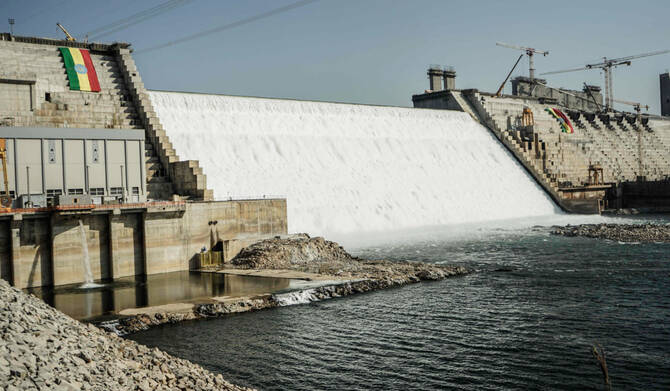
This general view shows the site of the Grand Ethiopian Renaissance Dam (GERD) in Guba, Ethiopia, on February 19, 2022. (AFP)
Short Url
Updated 04 July 2025
Follow

Egypt says Ethiopia’s power-generating dam lacks a legally binding agreement

  • Egypt firmly rejects Ethiopia’s continued policy of imposing a fait accompli through unilateral actions concerning the Nile River, which is an international shared watercourse

CAIRO: Egypt said on Friday that Ethiopia has consistently lacked the political will to reach a binding agreement on its now-complete dam, an issue that involves Nile River water rights and the interests of Egypt and Sudan.
Ethiopia’s prime minister said Thursday that the country’s power-generating dam, known as the Grand Ethiopian Renaissance Dam, on the Nile is now complete and that the government is “preparing for its official inauguration” in September.
Egypt has long opposed the construction of the dam because it would reduce the country’s share of Nile River waters, which it almost entirely relies on for agriculture and to serve its more than 100 million people.
The more than $4 billion dam on the Blue Nile near the Sudan border began producing power in 2022. 
It is expected to eventually produce more than 6,000 MW of electricity — double Ethiopia’s current output.
Ethiopia and Egypt have spent years negotiating an agreement over the dam, which Ethiopia began building in 2011. 
Both countries reached no deal despite negotiations spanning 13 years, and it remains unclear how much water Ethiopia will release downstream in the event of a drought.
Egyptian officials, in a statement, called the completion of the dam “unlawful” and said that it violates international law, reflecting “an Ethiopian approach driven by an ideology that seeks to impose water hegemony” instead of equal partnership.
“Egypt firmly rejects Ethiopia’s continued policy of imposing a fait accompli through unilateral actions concerning the Nile River, which is an international shared watercourse,” Egypt’s Ministry of Water Resources and Irrigation said in a statement on Friday.
Ethiopian Prime Minister Abiy Ahmed, in his address to lawmakers on Thursday, said that his country “remains committed to ensuring that our growth does not come at the expense of our Egyptian and Sudanese brothers and sisters.”
“We believe in shared progress, shared energy, and shared water,” he said. 
“Prosperity for one should mean prosperity for all.”
However, the Egyptian Water Ministry said on Friday that Ethiopian statements calling for continued negotiations “are merely superficial attempts to improve its image on the international stage.”
“Ethiopia’s positions, marked by evasion and retreat while pursuing unilateralism, are in clear contradiction with its declared willingness to negotiate,” the statement read.
However, Egypt is addressing its water needs by expanding agricultural wastewater treatment and improving irrigation systems, according to the ministry, while also bolstering cooperation with Nile Basin countries through backing development and water-related projects.


Supporters of Tunisia’s Saied rally amid deepening political divisions

Updated 39 min 12 sec ago
Follow

Supporters of Tunisia’s Saied rally amid deepening political divisions

  • Rights groups have accused Saied of an unprecedented crackdown on the opposition

TUNIS: Tunisian President Kais Saied’s supporters rallied in the capital on Wednesday calling the opposition “traitors,” following mounting street protests in recent weeks that have highlighted widening political divisions.
The rival rallies come amid a deepening economic crisis marked by high inflation, shortages of some basic goods and poor public services, which have fueled public anger.
Rights groups have accused Saied of an unprecedented crackdown on the opposition, saying he is using the judiciary and police to stifle criticism. Saied rejects the accusations, saying he is cleansing the country of traitors and a corrupt elite.
Demonstrators gathered in central Tunis waving national flags and chanting slogans backing Saied, whom they credit with confronting corruption and entrenched political elites.
They accused Saied’s opponents of seeking to destabilize the country, describing them as “traitors.” They chanted “people want Saied again” and “we support the leadership and sovereignty.”
“We are here to rescue Tunisia from traitors and colonial lackeys,” protester Saleh Ghiloufi said.
Saied’s critics say arrests of opposition leaders, civil society groups and journalists underscore an authoritarian turn by the president since he took on extraordinary powers in 2021 to rule by decree.
The powerful UGTT union has called a nationwide strike next month.
A Tunisian court last week sentenced prominent opposition figure Abir Moussi to 12 years in prison, in what critics say is another step toward entrenching Saied’s one-man rule.
While an appeals court last month handed jail terms of up to 45 years to dozens of opposition leaders, business people and lawyers on charges of conspiracy to overthrow Saied.
Saied was elected in 2019 with an overwhelming mandate, but his consolidation of power has alarmed domestic opponents and international partners, who warn Tunisia is retreating from democratic governance.