

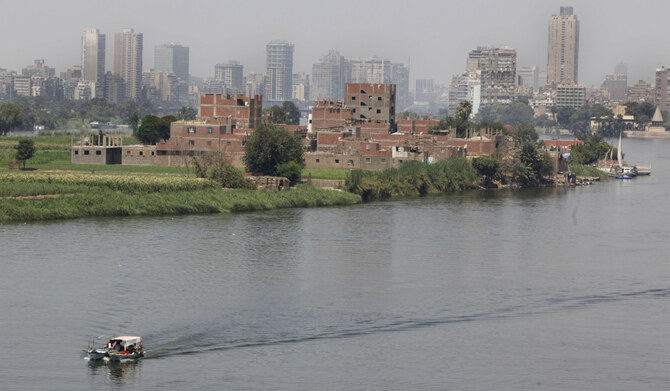

KAMPALA: A regional partnership of 10 countries says an agreement on the equitable use of water resources from the Nile River basin has come into force despite the notable opposition of Egypt.
The legal status of the “cooperative framework” was formally confirmed by the African Union after South Sudan joined the treaty, the Nile Basin Initiative said in a statement Sunday.
Ethiopia, Uganda, Rwanda, Burundi and Tanzania have ratified the accord. Egypt and Sudan declined to sign, while Congo abstained. Kenya has not yet deposited its ratification documents with the African Union.
FASTFACTS
• The accord ‘is a testament to our collective determination to harness the Nile River for the benefit of all, ensuring its equitable and sustainable use for generations to come,’ the Nile Basin Initiative said.
• Tensions in the region have increased, stemming in part from Ethiopia’s construction of a $4 billion dam on the Blue Nile, a key tributary of the Nile River.
The accord, which came into force on Sunday, “is a testament to our collective determination to harness the Nile River for the benefit of all, ensuring its equitable and sustainable use for generations to come,” the Nile Basin Initiative said in its statement. “This is a moment to congratulate the governments and people of the Nile riparian countries, and all partners and stakeholders, for their patience, resolve, and dedication to this cause.”
The lack of ratification by Egypt and Sudan — desert nations that have raised concern over any attempts to diminish their shares of Nile water — means the accord will prove controversial.
Tensions in the region have increased, stemming in part from Ethiopia’s construction of a $4 billion dam on the Blue Nile, a key tributary of the Nile River. Egypt fears the dam will have a devastating effect on water and irrigation supplies downstream unless Ethiopia takes its needs into account. Ethiopia plans to use the dam to generate badly needed electricity.
The accord’s rights clause states that Nile basin states “shall in their respective territories utilize the water resources of the Nile River system in an equitable and reasonable manner.”
Measuring 6,695 kilometers, the Nile is the longest river in the world, with one tributary, the White Nile, starting in South Sudan and the other, the Blue Nile, in Ethiopia.
Amid the dispute with Ethiopia, Egypt has recently appeared to strengthen its position in the Horn of Africa by pledging security cooperation with Somalia, which opposes Ethiopia’s efforts to seek access to the sea via the Somali breakaway territory of Somaliland. Under the terms of an agreement reached last week, Egypt could deploy peacekeeping troops to Somalia when the mandate of AU peacekeepers expires at the end of 2024.
Egypt, a founding member of the Nile Basin Initiative, has long asserted its rights to Nile water according to the terms of an agreement.
The agreement between Egypt and the UK gave downstream Egypt and Sudan rights to the Nile water, with Egypt taking 55.5 billion cubic meters and Sudan 18.5 billion cubic meters of the total of 84 billion cubic meters, with 10 billion lost to evaporation.
That agreement, first signed in 1929, took no account of the other nations along the river basin that have been agitating for a more equitable accord.


