

Medical residents from Pakistan, other states fill critical positions in US, but running into visa issues

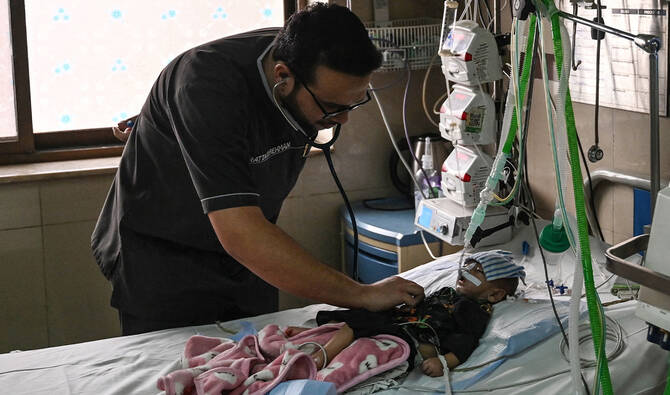
A doctor treats a child suffering from pneumonia, at the ICU ward of the Children's Hospital in Lahore on January 31, 2024. (AFP/File)
Short Url
Updated 04 July 2025
Follow

Medical residents from Pakistan, other states fill critical positions in US, but running into visa issues

  • The US is projected to face a physician shortage in the next 11 years, the Association of American Medical Colleges says
  • Over 6,600 foreign-born international medical residents matched into US programs in 2025, and another 300 filled positions

Some hospitals in the US are without essential staff because international doctors who were set to start their medical training this week were delayed by the Trump administration’s travel and visa restrictions.

It’s unclear exactly how many foreign medical residents were unable to start their assignments, but six medical residents interviewed by The Associated Press say they’ve undergone years of training and work only to be stopped at the finish line by what is usually a procedural step.

“I don’t want to give up,” said a permanent Canadian resident who matched to the University of Pittsburgh Medical Center Harrisburg but had her visa denied because she is a citizen of Afghanistan. She requested to remain anonymous for fear of reprisal. “But the situation also seems so helpless.”

Initially, the medical community was worried that hundreds of positions — many in hospitals in low-income or rural areas of the US — could be affected. The pause on interviews for J-1 visas for approved work or study-related programs was lifted in mid-June.

The national nonprofit that facilitates the residency match process said the visa situation is resolving, but it will take weeks to know with confidence how many medical residents have had the start of their careers derailed because they got their visa too late or were blocked by President Donald Trump’s travel ban on 12 countries, according to people who coordinate the residents’ training.

Four foreign medical residents told the AP that US embassies have been slow to open up interview slots — and some have not opened any.

“You lose out on the time you could have used to treat patients,” said one resident from Pakistan, who matched to an internal medicine program in Massachusetts and requested to remain anonymous for fear of reprisal.

Thousands of foreign medical residents fill gaps in US hospitals.

The US is projected to face a physician shortage in the next 11 years, per the Association of American Medical Colleges, and foreign medical residents fill critical gaps in the health care system. More than 6,600 foreign-born international medical residents matched into US programs in 2025 — the highest on record — and another 300 filled positions that were vacant after the match process was complete.

Not all of those residents were affected by visa issues or the travel ban on foreign nationals from countries including Afghanistan, Haiti and Sudan.

International medical graduates often take jobs in places where US medical trainees tend not to go, said Donna Lamb, president of the National Resident Matching Program.

“It’s not just that they’re coming in and they want to work in big, flashy centers on the coast,” Lamb said. “They’re truly providing health care for all of America.”

Foreign medical residents work in specialties that US applicants aren’t as eager to apply to. For example, international candidates make up almost 40 percent of residents in internal medicine, which specializes in the prevention and treatment of chronic conditions like diabetes and heart disease.

“The residents are the backbone of the entire hospital,” said Dr. Zaid Alrashid from Brookdale University Hospital and Medical Center in New York, which has medical residents from almost every continent. Most received their visas prior to the pause but a few were caught up in delays.

Two residents from India who spoke on condition of anonymity have not been able to get an appointment at any US embassies there despite the J-1 visa pause being lifted.

Another resident from Egypt just secured a visa appointment for mid-August but is worried her program may not be willing to wait for her. She’s already paid her security deposit for an apartment in Texas to live during her residency.

“I don’t know when this situation will be resolved,” said the resident, who spoke on condition of anonymity, adding she hasn’t been eating or sleeping well.

HOSPITALS WAITING FOR RESIDENTS

In California, leaders at two graduate medical education programs said they have a small number of residents caught up in J-1 visa delays. Both spoke on condition of anonymity due to concerns for the doctors who are still trying to get visas.

A residency leader at one large health care system said two doctors in its 150-resident program are delayed, adding they could start late or defer to next year. A 135-person program at a California public health system told the AP that one resident has yet to arrive, though he was finally scheduled for a visa interview.

“We are not going to breathe easy until he’s here in our hospital,” the second leader said.

As of Wednesday, Lamb’s matching program had received fewer than 20 requests to defer or cancel residency contracts.

Worried about losing their spots if they defer, many foreign medical residents may keep trying to get to the US and start their residencies late, said Dr. Sabesan Karuppiah, a past member of the American Medical Association’s International Medical Graduates Governing Council and former director of a large residency program.

Some hospitals may struggle at this point to replace the residents who don’t make it, leaving fewer people to care for the same number of patients, said Kimberly Pierce Burke, executive director of the Alliance of Independent Academic Medical Centers.

Foreign medical trainees who’ve made it into the US remain on edge about their situations, Karuppiah said.

“I can tell you the word on the street is: ‘Do not leave the country,’” he said, adding that people are missing out on important events, seeing sick parents or even getting married. “Everybody’s scared to just leave, not knowing what’s going to happen.”


Pakistan’s Forward Sports, key Adidas supplier, plans to launch Saudi operations this year, says CEO

Updated 9 sec ago
Follow

Pakistan’s Forward Sports, key Adidas supplier, plans to launch Saudi operations this year, says CEO

  • Forward Sports produces 15 million footballs each year which are exported worldwide and used in major tournaments
  • Its CEO Khawaja Masood Akhtar says this is the ‘best time’ for cross-border partnerships between Pakistan, Saudi Arabia

SIALKOT: Forward Sports, one of the world’s largest manufacturer of footballs and a key supplier to global brands, is planning to start operations in Saudi Arabia through a joint venture this year, its chief executive officer (CEO) told Arab News last week.

Headquartered in the northeastern city of Sialkot, the Pakistani sports equipment company has been working with global sports brand Adidas for two decades and was one of the two manufacturers of Adidas’ Al Rihla, the official 2022 World Cup ball.

Forward Sports produces 15 million footballs each year which are exported worldwide and recently replaced a Chinese competitor as Adidas’s largest football supplier, according to Forward Sports CEO Khawaja Masood Akhtar.

In an exclusive interview with Arab News, Akhtar said his company is in early stages of its expansion to Saudi Arabia, where it plans to start with a “minimum headcount” from Pakistan.

“We are going to have a JV (joint venture) with one of the most influential persons in Riyadh in sports goods,” Akhtar said, without disclosing the name of the Saudi partner.

“We want to start, I can say, within this year, and we are just on the beginning stage, and the first stage will be only marketing.”

Akhtar’s statement follows a meeting between Forward Sports’ representatives and Saudi officials during the Future Investment Initiative (FII) summit in Riyadh in Oct. last year. This month, Forward Sports officials also met with the ambassador of Saudi Arabia to Pakistan, Nawaf bin Said Al-Malki, in Islamabad to discuss the company’s operations in the Kingdom.

Pakistan and Saudi Arabia share a long-standing strategic partnership in political, security and economic domains, underpinned by deep religious and cultural ties. Both countries have moved closer to broaden their cooperation in recent months, signing a landmark defense pact in Sept. and agreeing to launch an economic cooperation framework a month later to strengthen bilateral trade and investment relations.

’BEST TIME’ FOR JOINT VENTURES

Akhtar called it the “best time” for cross-border partnerships between Pakistan and Saudi Arabia, adding that his company intends to understand the Saudi market before starting manufacturing operations in the Kingdom.

“Investment is not so much important,” he said, when asked about how much amount his company would be spending on its expansion to Saudi Arabia.

“At the moment, we don’t know how much we are going to put and how much they are going to put. We are just at a very beginning level.”

In the initial phase, he said, Forward Sports plans to operate with a small team, relying largely on the existing infrastructure of its Saudi partner.

“We will want to keep very minimum headcounts there from Pakistan in the beginning, maybe two or three people,” Akhtar said. “We want to hire [people] from Saudi Arabia.”

He said his company’s manufacturing operations in Saudi Arabia would be structured to comply with localization laws, with the bulk of production remaining in Pakistan.

“Either we will do 80:20 or 70:30, means 80 percent or 70 percent job is done in Pakistan. This depends on the article, which article we are going to produce there,” Akhtar told Arab News.

“So only 30 percent or 20 percent will be done in Saudi Arabia. This is a law to put ‘Made-in-KSA [on the balls]... so we have to respect that percentage.”

EXPANSION WON’T HURT PAKISTAN’S EXPORTS

Therefore, manufacturing, finishing, packaging and logistics of Forward Sports would largely remain in Pakistan, according to its CEO. The company’s expansion will not replace Pakistan’s exports or undermine domestic jobs.

“I don’t think so it will be replacing anything from Pakistan,” he said. “It would not hurt (Pakistani exports).”

Commercial opportunities in Saudi Arabia’s sports sector are expected to grow significantly before the Kingdom hosts the 2034 FIFA World Cup.

Akhtar said the move to expand their operations to the Kingdom is aimed at creating new demand, but they have not yet made a decision on whether to make footballs for future FIFA World Cups in Saudi Arabia.

“This, this is again, we don’t know,” he said. “We have to sit with a brand. If they agree, then we can be producing some balls also in Saudi Arabia.”

CAPACITY NOT A CONSTRAINT

Akhtar said Forward Sports already has the ability to scale up production if the demand rises.

“For us to make high volume is no problem. We touched like 75,000 balls per day,” he said, adding that current production has eased to 50,000 balls per day following the recent FIFA World Cup cycle.

REASSURANCES TO COUNTRYMEN

Despite the Saudi expansion, Akhtar said his company’s headquarters would stay in Pakistan, reassuring Pakistani workers and stakeholders that they would not lose anything.

“Don’t think we are going to lose anything in Pakistan,” he said. “We will remain here, and we will be increasing our capacities in Pakistan.”