

Pakistan PM Sharif in Azerbaijan for ECO summit focused on climate, trade

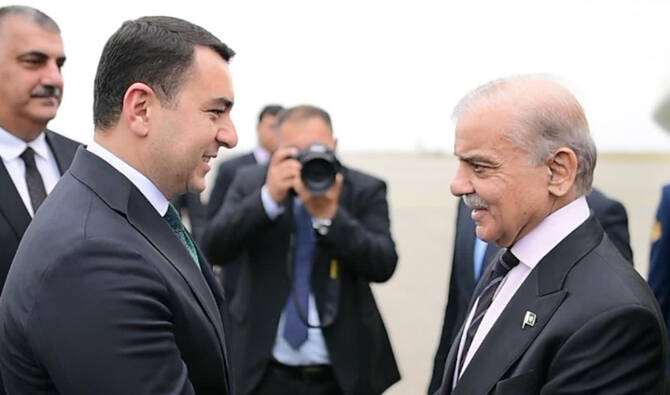
Azerbaijan Minister of Culture Adil Karimli (left) receives Pakistan Prime Minister Shehbaz Sharif upon his arrival at Fuzuli Airport in Shusha, Azerbaijan, on July 3, 2025, for a two-day official visit to attend the 17th ECO Summit. (Handout/PMO)
Short Url
Updated 03 July 2025
Follow

Pakistan PM Sharif in Azerbaijan for ECO summit focused on climate, trade

  • Regional leaders gather in Baku to discuss sustainable development, connectivity
  • PM Sharif expected to reaffirm Pakistan’s commitment to ECO Vision 2025

ISLAMABAD: Pakistani Prime Minister Shehbaz Sharif will be in Azerbaijan from today, Thursday, to attend the two-day 17th Economic Cooperation Organization (ECO) summit in Baku, where regional leaders will meet to discuss sustainable growth, climate resilience and increased intra-regional trade.

The theme of this year’s summit is “New ECO Vision for a Sustainable and Climate Resilient Future.” The ECO is a 10-member regional bloc comprising countries from Central and South Asia, the Caucasus, and the Middle East.

According to a report published in state broadcaster Radio Pakistan, Sharif will lead the Pakistani delegation and “share Pakistan’s perspective on key regional and global challenges.”

The report said he will also “reaffirm Pakistan’s commitment to the ECO Vision 2025 and advocate for enhanced intra-regional trade, transport connectivity, energy cooperation, and sustainable development.”

On the sidelines of the summit, Sharif is scheduled to hold bilateral meetings with other ECO leaders to discuss matters of mutual interest.

This marks Sharif’s second visit to Azerbaijan this year. He last traveled to Baku in May 2025, where he met with Azerbaijani President Ilham Aliyev and discussed deepening bilateral cooperation in energy and trade.

The ECO was established in 1985 by Iran, Turkiye, and Pakistan, and was expanded later to include Afghanistan, Azerbaijan, Kazakhstan, Kyrgyzstan, Tajikistan, Turkmenistan, and Uzbekistan. The organization aims to promote economic, technical, and cultural cooperation among member states.


Justice Amin-Ud-Din Khan appointed Pakistan’s first Constitutional Court chief justice

Updated 13 November 2025
Follow

Justice Amin-Ud-Din Khan appointed Pakistan’s first Constitutional Court chief justice

  • Federal Constitutional Court will now decide cases involving Pakistan’s constitution, instead of the Supreme Court
  • A top court judge since 2019, Justice Khan has decided thousands of civil cases relating to inheritance, property

ISLAMABAD: President Asif Ali Zardari appointed top court judge Justice Amin-Ud-Din Khan as the first chief justice of the Federal Constitutional Court (FCC) on Thursday, a notification from the law ministry said. 

The FCC was formed after the government made sweeping changes to the military and judicial command structure via the 27th constitutional amendment. The new amendment shifts constitutional cases from the Supreme Court to the FCC while it grants expanded powers to Pakistan’s army chief. 

 “The President of the Islamic Republic of Pakistan is pleased to appoint Mr. Justice Amin-Ud-Din Khan as Chief Justice of the Federal Constitutional Court of Pakistan with effect from the date he makes oath of his office,” a notification from the law ministry read. 

According to the Supreme Court’s website, Justice Khan was born on Dec. 1, 1960 in the eastern city of Multan where he received his education from Kindergarten Muslim School. He completed his secondary education from the Government Muslim High School in 1977. 

He secured his bachelor’s degree in Philosophy in 1981 and completed his L.L.B degree from the University Law College in Multan in 1984 and also secured a diploma in Taxation Law.

Justice Khan obtained the license to practice in Pakistan’s lower courts in 1985 before enrolling as an advocate of the Lahore High Court in 1987. He was later enrolled as an advocate of the Supreme Court of Pakistan in 2001.

He was involved there in mostly civil cases relating to property, preemption and matters of inheritance. 

Justice Khan was elevated to the bench in 2011 and during his stint as judge, he decided thousands of civil cases the Bahawalpur Bench and Multan Bench of the Lahore High Court. 

He was elevated as a judge of the Supreme Court in 2019. 

His appointment to the post takes place hours after two Supreme Court judges, Justice Athar Minallah and Justice Mansoor Ali Shah, resigned in protest. 

The judges took exception to the 27th constitutional amendment, with Justice Shah describing it as a “grave assault” on the constitution. 

The FCC was set up after years of clashes between the executive and the judiciary. Verdicts issued by the top courts over the years ousted prime ministers from office and put the judiciary on a confrontational path with the governments at the time.