Indonesian president makes first visit to Saudi Arabia since taking office

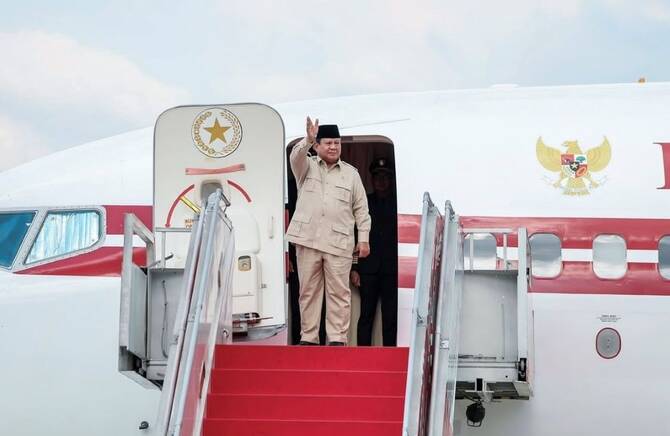
Indonesian President Prabowo Subianto departs from Halim Perdanakusuma airport in Jakarta to Jeddah on July 1, 2025, on his first trip to Saudi Arabia since taking office. (PCO)
Short Url
Updated 01 July 2025
Follow

Indonesian president makes first visit to Saudi Arabia since taking office

  • First meeting of Indonesia-Saudi Supreme Coordination Council scheduled for Wednesday
  • President Prabowo Subianto is accompanied by Religious Affairs Minister Nasaruddin Umar

JAKARTA: Indonesian President Prabowo Subianto will attend the inaugural session of the Indonesia-Saudi Supreme Coordination Council this week, his first official trip to Saudi Arabia since taking office, Indonesia’s Ministry of Foreign Affairs said on Tuesday.

The leader of Southeast Asia’s biggest economy, who became president last October, left Jakarta on Tuesday afternoon for a three-day trip to the Kingdom. He is accompanied by Religious Affairs Minister Nasaruddin Umar. 

Prabowo is scheduled to meet Saudi Crown Prince Mohammed bin Salman in Jeddah on Wednesday, the Indonesian foreign ministry said in a statement.

“This state visit is aimed at strengthening bilateral relations between Indonesia and Saudi Arabia, particularly in strategic sectors, such as cooperation in economy and investment, energy security, and cooperation to serve Indonesia’s Hajj and Umrah pilgrims. The meeting will also be used as an avenue to discuss current regional and global issues, especially developments in the Middle East.” 

The coordination council was established in October 2023 by the crown prince and former Indonesian President Joko Widodo to align the strategic priorities of the two countries. 

From its first meeting, Indonesia is expecting “a number of deliverables in the form of MoU (memorandum of understanding), including between governments and businesses,” the foreign affairs ministry said. 

Jakarta has in recent years sought to enhance trade ties with Riyadh and gain a greater presence in the Middle East. 

Bilateral ties have traditionally focused on Hajj and Umrah as Indonesia, the world’s biggest Muslim-majority nation, sends the largest Hajj contingent of pilgrims every year. 

Indonesian and Saudi officials have been in talks to explore untapped potential in commerce, as trade and investment ties have been on the rise. Non-oil trade was worth about $3.3 billion in 2024, showing a 14.5 percent increase compared to 2020.

As part of the Industry and Mineral Resources Minister Bandar Al-Khorayef’s visit to Jakarta in April, the Saudi Export-Import Bank and its Indonesian counterpart signed an agreement aimed at strengthening economic and trade relations between the two countries. 

Al-Khorayef also signed a memorandum of understanding with Energy and Mineral Resources Minister Bahlil Lahadalia to boost cooperation in the mining and minerals sector. 

Indonesia holds the world’s largest nickel reserves and has rich deposits of other minerals, including copper and bauxite. In 2023, its mining sector accounted for about 11.9 percent of the country’s gross domestic product.


Afghan mothers seek hospital help for malnourished children

Updated 11 sec ago
Follow

Afghan mothers seek hospital help for malnourished children

HERAT: Najiba, 24, keeps a constant watch over her baby, Artiya, one of around four million children at risk of dying from malnutrition this year in Afghanistan.
After suffering a bout of pneumonia at three months old, Artiya’s condition deteriorated and his parents went from hospital to hospital trying to find help.
“I did not get proper rest or good food,” affecting her ability to produce breast milk, Najiba said at Herat Regional Hospital in western Afghanistan.
“These days, I do not have enough milk for my baby.”
The distressed mother, who chose not to give her surname for privacy reasons, said the family earns a living from an electric supplies store run by her husband.
Najiba and her husband spent their meagre savings trying to get care for Artiya, before learning that he has a congenital heart defect.
To her, “no one can understand what I’m going through. No one knows how I feel every day, here with my child in this condition.”
“The only thing I have left is to pray that my child gets better,” she said.
John Aylieff, Afghanistan director at the World Food Programme (WFP), said women are “sacrificing their own health and their own nutrition to feed their children.”
Artiya has gained weight after several weeks at the therapeutic nutrition center in the Herat hospital, where colorful drawings of balloons and flowers adorn the walls.
Mothers such as Najiba, who are grappling with the reality of not being able to feed their children, receive psychological support.
Meanwhile, Artiya’s father is “knocking on every door just to borrow money” which could fund an expensive heart operation on another ward, Najiba said.

- ‘Staggering’ scale -

On average, 315 to 320 malnourished children are admitted each month to the center, which is supported by medical charity Doctors Without Borders (MSF).
The number of cases has steadily increased over the past five years, according to Hamayoun Hemat, MSF’s deputy coordinator in Herat.
Since the Taliban regained power in 2021, low-income families have been hit hard by cuts to international aid, as well as drought and the economic fallout of five million Afghans forced across the border from Iran and Pakistan.
“In 2025, we’d already seen the highest surge in child malnutrition recorded in Afghanistan since the beginning of the 21st century,” Aylieff said in Kabul.
The crisis is only set to worsen this year, he told AFP: “A staggering four million children in this country will be malnourished and will require treatment.”
“These children will die if they’re not treated.”
WFP is seeking $390 million to feed six million Afghans over the next six months, but Aylieff said the chance of getting such funds is “so bleak.”
Pledges of solidarity from around the globe, made after the Taliban government imposed its strict interpretation of Islamic law, have done little to help Afghan women, the WFP director said.
They are now “watching their children succumb to hunger in their arms,” he said.

- ‘No hope’ -

In the country of more than 40 million people, there are relatively few medical centers that can help treat malnutrition.
Some families travel hundreds of kilometers (miles) to reach Herat hospital as they lack health care facilities in their home provinces.
Wranga Niamaty, a nurse team supervisor, said they often receive patients in the “last stage” where there is “no hope” for their survival.
Still, she feels “proud” for those she can rescue from starvation.
In addition to treating the children, the nursing team advises women on breastfeeding, which is a key factor in combating malnutrition.
Single mothers who have to work as cleaners or in agriculture are sometimes unable to produce enough milk, often due to dehydration, nurse Fawzia Azizi said.
The clinic has been a lifesaver for Jamila, a 25-year-old mother who requested her surname not be used out of privacy concerns.
Jamila’s eight-month-old daughter has Down’s syndrome and is also suffering from malnutrition, despite her husband sending money back from Iran where he works.
Wrapped in a floral veil, Jamila said she fears for the future: “If my husband is expelled from Iran, we will die of hunger.”