Law firm that helped ban pro-Palestine protests on UK campus assisting other universities

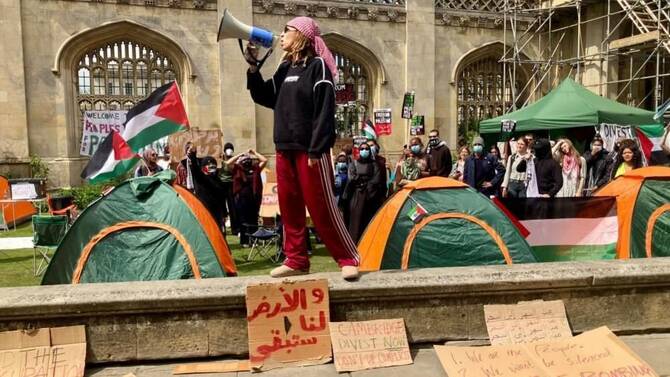
Demonstrations against the Gaza war also took place in Cambridge in May 2024. (BBC)
Short Url
Updated 30 June 2025
Follow

Law firm that helped ban pro-Palestine protests on UK campus assisting other universities

  • Shakespeare Martineau LLP helped Cardiff University obtain 12-month ban on protests
  • Students, staff face unlimited fines, up to 2 years in prison amid ‘chilling precedent for academic institutions’

LONDON: A law firm in the UK that helped a university ban pro-Palestine protests on campus has been assisting other higher education institutions considering legal action against their students.

Shakespeare Martineau LLP represented Cardiff University in a case that resulted in a year-long ban on unauthorized campus protests from June.

The case could result in unlimited fines for staff and students found in breach of the injunction, as well as prison terms of up to two years.

Those wishing to hold protests on Cardiff’s campus will be required to apply for permission up to three weeks in advance.

Earlier this year, similar 12-month injunctions were granted to two colleges at Cambridge University

The Guardian reported on Monday that the law firm promoted the type of injunction, known as a “newcomer injunction” because it can be used “against persons unknown,” to other universities during a webinar held in October.

According to a freedom of information act obtained in conjunction with Liberty Investigates, it was found that representatives of Reading, Exeter, Northumbria, Hertfordshire, Birkbeck, Bath Spa and Liverpool John Moores universities registered for the webinar.

The Guardian reported that lawyers acting in the case against Cardiff warned that the injunction was too broad and could affect industrial action.

A UN watchdog, the newspaper reported, said the move is a “flagrant violation of international human rights law,” while Gina Romero, UN special rapporteur for freedom of assembly, said: “Profiting from the … curtailing of human rights is despicable.”

A spokesperson for Shakespeare Martineau said the injunction relates to “unlawful encampments,” and “lawful” protest would not be affected.

Smita Jamdar, head of education at Shakespeare Martineau, said: “Universities are dealing with complex situations on campus every single day. Understandably, many institutions are seeking guidance on how to manage a whole host of situations effectively and safely, while upholding the law and balancing the rights and freedoms of the whole campus community.”

But the European Legal Support Centre called the use of the injunctions a “chilling precedent for academic institutions,” adding that they are “legally complex and financially impractical for affected students to challenge in court.”

Last week, England’s Office for Students warned universities against “sweeping” limits on protest in a new set of guidelines due to take effect in August.


Power outages hit Ukraine and Moldova as Kyiv struggles against the winter cold

Updated 10 sec ago
Follow

Power outages hit Ukraine and Moldova as Kyiv struggles against the winter cold

  • Outages had been caused by a technical malfunction affecting power lines linking Ukraine and Moldova
  • Blackouts were reported in Kyiv, as well as Zhytomyr and Kharkiv regions

KYIV: Emergency power cuts swept across several Ukrainian cities as well as neighboring Moldova on Saturday, officials said, amid a commitment from the Kremlin to US President Donald Trump to pause strikes on Kyiv as Ukraine battles one of its bleakest winters in years.
Ukraine’s Energy Minister Denys Shmyhal said that the outages had been caused by a technical malfunction affecting power lines linking Ukraine and Moldova.
The failure “caused a cascading outage in Ukraine’s power grid,” triggering automatic protection systems, he said.
Blackouts were reported in Kyiv, as well as Zhytomyr and Kharkiv regions, in the center and northeast of the country respectively. The outage cut water supplies to the Ukrainian capital, officials said, while the city’s subway system was temporarily suspended because of low voltage on the network.
Moldova also experienced major power outages, including in the capital Chisinau, officials said.
“Due to the loss of power lines on the territory of Ukraine, the automatic protection system was triggered, which disconnected the electricity supply,” Moldova’s Energy Minister Dorin Junghietu said in a post on Facebook. “I encourage the population to stay calm until electricity is restored.”
Weaponizing winter
The large-scale outage followed weeks of Russian strikes against Ukraine’s already struggling energy grid, which have triggered long stretches of severe power shortages.
Moscow has sought to deny Ukrainian civilians heat, light and running water over the course of the war, in a strategy that Ukrainian officials describe as “weaponizing winter.”
While Russia has used similar tactics throughout the course of its almost four-year invasion of Ukraine, temperatures throughout this winter have fallen further than usual, bringing widespread hardship to civilians.
Forecasters say Ukraine will experience a brutally cold period stretching into next week. Temperatures in some areas will drop to minus 30 degrees Celsius (minus 22 Fahrenheit), Ukraine’s State Emergency Service said.
Trump said late Thursday that President Vladimir Putin had agreed to a temporary pause in targeting Kyiv and other Ukrainian towns amid the extreme weather.
“I personally asked President Putin not to fire on Kyiv and the cities and towns for a week during this ... extraordinary cold,” Trump said during a Cabinet meeting at the White House. Putin has “agreed to that,” he said, without elaborating on when the request to the Russian leader was made.
The White House didn’t immediately respond to a query seeking clarity about the scope and timing of any limited pause.
Kremlin spokesperson Dmitry Peskov confirmed Friday that Trump “made a personal request” to Putin to stop targeting Kyiv until Sunday “in order to create favorable conditions for negotiations.”
Talks are expected to take place between US, Russian and Ukrainian officials on Feb. 1 in Abu Dhabi. The teams previously met in late January in the first known time that officials from the Trump administration simultaneously met with negotiators from both Ukraine and Russia. However, it’s unclear many obstacles to peace remain. Disagreement over what happens to occupied Ukrainian territory, and Moscow’s demand for possession of territory it hasn’t captured, are a key issue holding up a peace deal, Zelensky said Thursday.
Russian presidential envoy Kirill Dmitriev said on social media Saturday that he was in Miami, where talks between Russian and US negotiators have previously taken place.
Russia struck Ukrainian energy assets in several regions on Thursday but there were no strikes on those facilities overnight, Ukraine’s President Volodymyr Zelensky said Friday.
In a post on social media, Zelensky also noted that Russia has turned its attention to targeting Ukrainian logistics networks, and that Russian drones and missiles hit residential areas of Ukraine overnight, as they have most nights during the war.
Trump has framed Putin’s acceptance of the pause in strikes as a concession. But Zelensky was skeptical as Russia’s invasion approaches its fourth anniversary on Feb. 24 with no sign that Moscow is willing to reach a peace settlement despite a US-led push to end the fighting.
“I do not believe that Russia wants to end the war. There is a great deal of evidence to the contrary,” Zelensky said Thursday.