

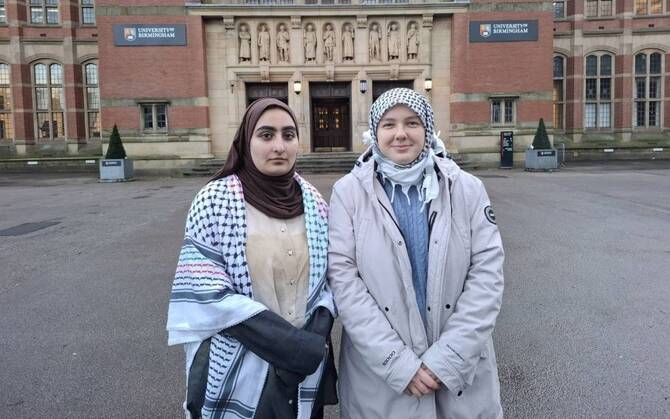

LONDON: Two pro-Palestine students at the UK’s University of Birmingham are facing disciplinary proceedings over their activism, with a major legal rights group sounding the alarm over a “nationwide crackdown” on solidarity with the Palestinian people.
The European Legal Support Centre submitted legal documents to the university’s misconduct panel on behalf of the two students, Mariyah Ali and Antonia Listrat.
Amid the war in Gaza and sweeping pro-Palestine solidarity at institutions across the UK, the two students had demanded that their university divest from arms companies supplying the Israeli military.
Ali and Listrat face a disciplinary hearing on April 7, with the ELSC urging the university to dismiss the proceedings.
Coventry MP Zarah Sultana labeled the university’s move “an assault on democratic rights,” while the decision was questioned by UN Special Rapporteur Gina Romero, who highlighted “harassment, intimidation and reprisals” against the students at the university.
The pair have been supported by the university’s student body, which elected Listrat as guild president and Ali as ethnic minorities officer.
Ali said: “The disciplinary process against Antonia and me is a blatant attempt to suppress dissent and silence the wider student movement.
“This authoritarian crackdown is not just an attack on our right to protest — it is a display of institutional Islamophobia and bureaucratic repression.
“The student movement for Palestine is stronger than ever. Instead of charging students, the University of Birmingham must focus on divesting from companies complicit in genocide and war crimes.”
The student union also passed a motion supporting pro-Palestine solidarity that was subsequently blocked by union trustees.
By taking punitive measures against the students, the university is “contradicting the democratic will of students,” the ELSC said.
Anna Ost, the center’s senior legal officer, added: “We are deeply concerned that the university’s intention and effect in targeting these two students is to dissuade the wider university community from speaking out for Palestine.
“The university needs to change its approach, drop the disciplinaries, and demonstrate that fundamental freedoms are still promoted on its campus.”
The targeting of the students is part a wider crackdown on pro-Palestine activism across the UK in the wake of Israel’s war in Gaza.
Since October 2023, at least 28 universities across the UK have disciplined more than 113 students for activism, a joint investigation by Sky News and Liberty Investigates found.
The ELSC warned that the campus crackdowns, which have involved police and private security, is creating a “chilling effect” that “sets a dangerous precedent for campus democracy.”
British universities are legally bound to protect freedom of expression under the education and human rights acts, it added, warning that the University of Birmingham is “violating these obligations by penalizing students for their political beliefs.”
The center called on the university to dismiss the charges against the students and uphold freedom of speech, expression and assembly on campus.
Listrat said protesting is “an integral part of campus life” that signifies a “healthy and progressive society.”
She added: “As far-right rhetoric rises throughout the world, we need to make a huge effort to protect our rights and uphold international law and morality.
“Enabling genocide and profiting from human rights violations is quite a violent stance that the University of Birmingham has taken. Funding genocide is violent; protesting genocide is peaceful.”
Arab News contacted the University of Birmingham for comment.
In response, a spokesperson for the university said: “The University of Birmingham is a large community representing a wide range of backgrounds and views. We have a strong and longstanding commitment to freedom of speech and academic freedom, supported by our code of practice. Through this we regularly facilitate debates and activities (such as rallies) on sensitive but important topics. This year, that has included signing off many events on a range of issues, including, for example, in relation to Palestine.
“We have never, and would never, act against any member of our community because of the views they lawfully hold or express. However, it is important that the university is a safe and welcoming space for the entire community, so when there is any complaint or allegation of misconduct — for example, threatening, intimidating or offensive behaviour or language, harassment, or bullying — we will take action in line with our regulations. We are unable to comment on matters involving individual students.
“The university is committed to maintaining high environmental, social and governance standards across our investment portfolios, the full details of which can be found transparently on our website which is regularly updated. We are a signatory to the UN Principles for Responsible Investment, incorporating ESG factors in our investments.”


