Most Filipinos in favor of rejoining ICC, study shows

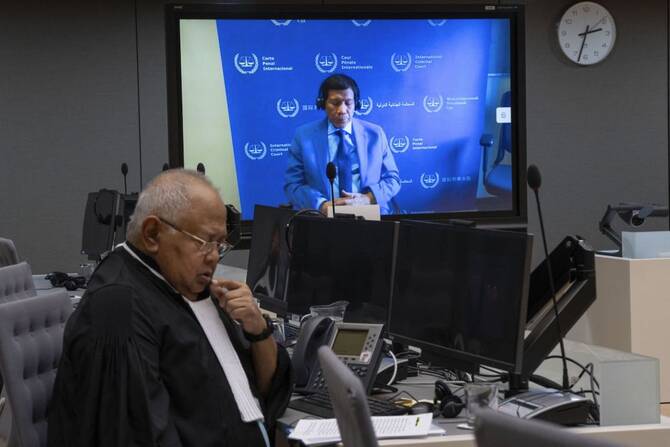
Rodrigo Duterte appears on screen, with his lawyer Salvador Medialdea, in a courtroom during his first appearance before the ICC on charges of crimes against humanity, The Hague, Mar. 14, 2025. (AFP)
Short Url
Updated 30 June 2025
Follow

Most Filipinos in favor of rejoining ICC, study shows

  • Philippines withdrew from the ICC in 2019 under ex-president Rodrigo Duterte
  • 57 percent of respondents support rejoining the court, while 37 percent are against it

MANILA: The majority of Filipinos support the Philippines rejoining the International Criminal Court, the results of a new opinion poll showed on Monday.

The Philippines withdrew from the ICC in 2019 under ex-president Rodrigo Duterte, as the court’s prosecutors began to look into his “war on drugs” campaign in 2016-22, which they estimate has resulted in the extrajudicial killings of 30,000 Filipinos.

Despite the Philippines’ withdrawal, the court has issued an arrest warrant against Duterte, as it keeps jurisdiction over alleged crimes committed while a country was a member.

The current administration of President Ferdinand Marcos Jr. complied with the arrest warrant and Duterte has been in ICC custody since March, awaiting trial. The Marcos’s spokesperson, Claire Castro, said earlier this month that he was also “open to talking about” rejoining the ICC.

The move would be supported by 57 percent of Filipinos, according to the latest survey by OCTA Research.

“A clear 57 percent of Filipinos support the Philippines rejoining the ICC. In contrast, 37 percent are opposed, and 6 percent remain undecided, indicating broad, though not unanimous, public backing for renewed engagement,” the Quezon City-based polling and research firm said in its report.

The study was conducted between April 20 and April 24, on 1,200 respondents in Metro Manila, Balance Luzon, Visayas, and Mindanao.

In Mindanao, where Duterte traces his political roots and despite detention won the mayoral election last month, the support for rejoining the ICC was the lowest.

“In Metro Manila, Balance Luzon, and the Visayas, at least 60 percent of respondents express support,” the OCTA Research report said. “In Mindanao, however, is an exception — with only 30 percent supporting the move and 66 percent expressing opposition, the highest rate of opposition recorded across regions.”

The highest rate of support for reengagement with the ICC was among people aged 25-34, with 62 percent of them in favor of the move, while the lowest support was among those aged 45-54, at 50 percent.

Duterte’s arrest has likely contributed to awareness about the ICC across the Philippines, with 85 percent of adult Filipinos claiming to have seen, read, or heard about the court and only 13 percent reporting being unaware of it.

“This widespread awareness sets the stage for significant national conversations on justice, accountability, and the Philippines’ potential reengagement with the ICC,” OCTA Research said.

“Awareness levels are consistently high nationwide. In Metro Manila, 89 percent of respondents indicated familiarity with the ICC, followed closely by Balance Luzon (86 percent), Mindanao (85 percent), and the Visayas (77 percent).”


Moscow made an offer to France regarding a French citizen imprisoned in Russia, says Kremlin

Updated 5 sec ago
Follow

Moscow made an offer to France regarding a French citizen imprisoned in Russia, says Kremlin

  • Laurent Vinatier, an adviser for Swiss-based adviser Center for Humanitarian Dialogue, Vinatier was arrested in Moscow in June 2024
  • He is accused of failing to register as a “foreign agent” while collecting information about Russia’s “military and military-technical activities” 

The Kremlin on Thursday said it was in contact with the French authorities over the fate of a French political scholar serving a three-year sentence in Russia and reportedly facing new charges of espionage.
Kremlin spokesman Dmitry Peskov told reporters that Russia has made “an offer to the French” regarding Laurent Vinatier, arrested in Moscow last year and convicted of collecting military information, and that “the ball is now in France’s court.” He refused to provide details, citing the sensitivity of the matter.
French President Emmanuel Macron is following Vinatier’s situation closely, his office said in a statement. French Foreign Ministry spokesperson Pascal Confavreux said Thursday that all government services are fully mobilized to pay provide consular support to Vinatier and push for his liberation as soon as possible.
Peskov’s remarks come after journalist Jérôme Garro of the French TF1 TV channel asked President Vladimir Putin during his annual news conference on Dec. 19 whether Vinatier’s family could hope for a presidential pardon or his release in a prisoner exchange. Putin said he knew “nothing” about the case, but promised to look into it.
Vinatier was arrested in Moscow in June 2024. Russian authorities accused him of failing to register as a “foreign agent” while collecting information about Russia’s “military and military-technical activities” that could be used to the detriment of national security. The charges carry a maximum penalty of five years in prison.
The arrest came as tensions flared between Moscow and Paris following French President Emmanuel Macron’s comments about the possibility of deploying French troops in Ukraine.
Vinatier’s lawyers asked the court to sentence him to a fine, but the judge in October 2024 handed him a three-year prison term — a sentence described as “extremely severe” by France’s Foreign Ministry, which called for the scholar’s immediate release.
Detentions on charges of spying and collecting sensitive data have become increasingly frequent in Russia and its heavily politicized legal system since Moscow invaded Ukraine in February 2022.
In addition to criticizing his sentence, the French Foreign Ministry urged the abolition of Russia’s laws on foreign agents, which subject those carrying the label to additional government scrutiny and numerous restrictions. Violations can result in criminal prosecution. The ministry said the legislation “contributes to a systematic violation of fundamental freedoms in Russia, like the freedom of association, the freedom of opinion and the freedom of expression.”
Vinatier is an adviser for the Center for Humanitarian Dialogue, a Switzerland-based nongovernmental organization, which said in June 2024 that it was doing “everything possible to assist” him.
While asking the judge for clemency ahead of the verdict, Vinatier pointed to his two children and his elderly parents he has to take care of.
The charges against Vinatier relate to a law that requires anyone collecting information on military issues to register with authorities as a foreign agent.
Human rights activists have criticized the law and other recent legislation as part of a Kremlin crackdown on independent media and political activists intended to stifle criticism of the war in Ukraine.
In August 2025, Russian state news agency Tass reported that Vinatier was also charged with espionage, citing court records but giving no details. Those convicted of espionage in Russia face between 10 and 20 years in prison.
Russia in recent years has arrested a number of foreigners — mainly US citizens — on various criminal charges and then released them in prisoner swaps with the United States and other Western nations. The largest exchange since the Cold War took place in August 2024, when Moscow freed journalists Evan Gershkovich and Alsu Kurmasheva, fellow American Paul Whelan, and Russian dissidents in a multinational deal that set two dozen people free.