

Philippines’ former leader Duterte seeks interim release from ICC

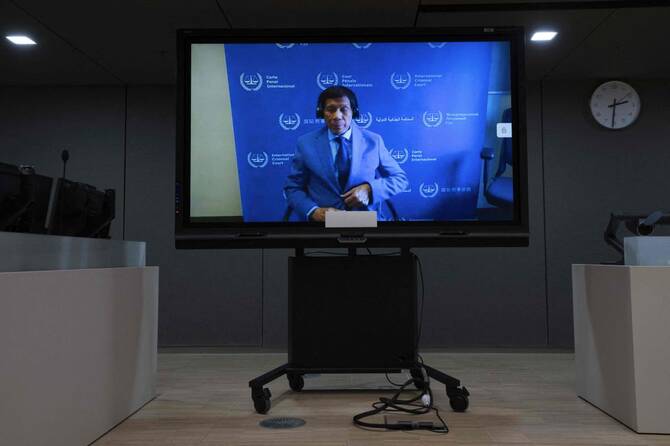
Former Philippine president Rodrigo Duterte is seen on a screen in the courtroom during his first appearance before the International Criminal Court on charge of crimes against humanity over his deadly crackdown on narcotics on March 14, 2025. (AFP)
Short Url
Updated 13 June 2025
Follow

Philippines’ former leader Duterte seeks interim release from ICC

  • Duterte stands accused of crimes against humanity over his years-long campaign against drug users and dealers
  • International Criminal Court prosecutors have agreed not to oppose the request, according to the filing

MANILA: Former Philippine president Rodrigo Duterte’s defense team at the International Criminal Court has filed a motion for his interim release to an unnamed country, stating the prosecution would not object.

The 80-year-old stands accused of crimes against humanity over his years-long campaign against drug users and dealers that rights groups say killed thousands.

In a filing posted to the court’s website late Thursday, defense lawyers said the involved country – the name of which was redacted – had expressed its “principled agreement to receive Mr. Duterte onto its territory.”

ICC prosecutors have agreed not to oppose the request, according to the filing, which said discussions about an interim release had been under way since Duterte’s first court appearance at The Hague on March 14.

“The Prosecution has confirmed its non-opposition to interim release to (REDACTED) (REDACTED) State Party” as long as certain conditions were met, the filing reads.

An annex spelling out the conditions for Duterte’s release was not publicly available, but the defense team’s filing noted that the octogenarian posed no flight risk and cited humanitarian concerns around his age.

Lawyers representing relatives of those killed in Duterte’s drug war condemned the application for release, citing threats made against victims’ families, and saying they had legal avenues to oppose it.

“There is still a procedure within the ICC that requires the prosecution to comment and the ICC Pre Trial Chamber (PTC) to decide on the application for provisional release,” lawyer Neri Colmenares said in a statement.

In an interview with local radio, lawyer Kristina Conti said she believed it was “50-50” the former president would be released.

“I hope the (drug war) victims can weigh in but that would be difficult if (the release is based on) humanitarian grounds, and he is reportedly sick,” she said.

Duterte was arrested in Manila on March 11, flown to the Netherlands that same night and has been held at the ICC’s detention unit at Scheveningen Prison since.

ICC deputy prosecutor Mame Mandiaye Niang is currently overseeing the case against Duterte after Karim Khan stepped aside during an investigation into alleged sexual misconduct.

Requests for comment sent to the ICC prosecutor’s office were not immediately returned.


Afghanistan launches retaliatory attacks on Pakistan as tensions escalate

Updated 28 February 2026
Follow

Afghanistan launches retaliatory attacks on Pakistan as tensions escalate

  • At least 66 Afghans have been killed by Pakistan’s strikes, Afghan authorities say
  • Afghanistan has called for dialogue while Pakistan ruled out any talks with Kabul 

KABUL: Afghanistan has launched new attacks on Pakistan’s military bases, the Afghan defense ministry said on Saturday, as cross-border clashes escalated between the neighbors after months of tension. 

The latest flare-up erupted after Pakistan’s airstrikes on Afghan territory last weekend triggered a retaliatory offensive from Afghanistan along the border on Thursday. 

The two countries have engaged in tit-for-tat attacks since, marking the most serious development in ongoing tensions between the two countries, which agreed to a ceasefire last October following a week of deadly clashes. 

Afghanistan’s Air Force has “once again launched airstrikes on Pakistani military bases” in Miranshah and Spinwam, the Afghan Ministry of National Defense said on X on Saturday, claiming that the strikes caused “severe damage and heavy casualties.”

“These successful operations were conducted in response to repeated aerial aggressions by the Pakistani military regime,” the ministry said. 

Afghan forces also launched similar strikes against military targets in Islamabad and Abbottabad on Friday, which the ministry said was in retaliation of aerial attacks by Pakistani forces in Kabul, Kandahar and Paktia.

At least 66 Afghan civilians, mostly women and children, have been killed in Pakistani strikes, with another 59 others wounded, according to Hamdullah Fitrat, deputy spokesman for the Afghan government. 

Pakistan has maintained that it is targeting only military targets to avoid any civilian casualties, in compliance with international law. 

Pakistani officials said its forces have killed more than 330 Afghan fighters and targeted 37 military locations across Afghanistan.

Zabihullah Mujahid, chief spokesperson for the Afghan government, earlier called for talks to resolve the crisis. 

“We have always emphasized peaceful resolution, and now too we want the issue to be resolved through dialogue,” he said on Friday. 

However, Pakistan has ruled out any talks with Kabul. 

“There won’t be any talks, there is nothing to talk about. There’s no negotiation. Terrorism from Afghanistan has to end,” Mosharraf Zaidi, spokesperson for Pakistan’s prime minister, said on Friday. 

Pakistan is accusing the Afghan Taliban of sheltering fighters from the banned Tehreek-e-Taliban Pakistan and allowing them to stage cross-border attacks — a charge Afghanistan denies, saying it does not allow its territory to be used against other countries. 

As international calls for mediation grow amid the escalating hostility, Afghans across the country are growing fearful of the violence. 

“Everyone heard the jets. This is the first time since the withdrawal of US invaders that we have heard such a horrible noise and news of damage. It is not good for us,” said Kandahar resident Shahid Zamari. 

“We had forgotten the US war and its bad impact on us, on our families, on our children. And now this has come upon us again — by Pakistan, and in the holy month of Ramadan.” 

When the strikes hit Kabul at around 1:30 a.m. on Friday, Saleema Wardak moved quickly to wake up her six children and escape outside, assuming the strong jolt that shook her house was an earthquake. 

“While standing in the yard, my husband told me it was not an earthquake but an explosion. Then we heard the crazy sounds of planes, and shooting from the mountains against the planes,” she told Arab News. 

“We hid inside, worried another bomb would fall on us. People say Pakistan is targeting civilians on purpose to increase pressure on the Taliban. So we hid … The world is unjust … They do not value the blood of the poor.” 

For Sabawoon, a 23-year-old student from eastern Kunar province’s Asadabad city, the coming days are filled with uncertainties. 

“What to do? Where to go? We have to stay and find our way to survive,” he told Arab News. “God willing, nothing bad will happen to us. If they are bombing us, what can we do?”