


Saudi-led initiative restores Yemen’s iconic Seiyun Palace

1 / 5
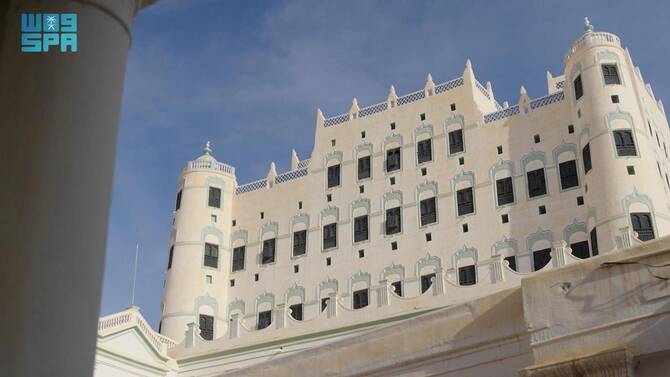
Seiyun Palace in Hadramout is regaining its original form through restoration led by the Saudi Development and Reconstruction Program for Yemen. (SPA)
2 / 5
Seiyun Palace in Hadramout is regaining its original form through restoration led by the Saudi Development and Reconstruction Program for Yemen. (SPA)
3 / 5
Seiyun Palace in Hadramout is regaining its original form through restoration led by the Saudi Development and Reconstruction Program for Yemen. (SPA)
4 / 5
Seiyun Palace in Hadramout is regaining its original form through restoration led by the Saudi Development and Reconstruction Program for Yemen. (SPA)
5 / 5
Seiyun Palace in Hadramout is regaining its original form through restoration led by the Saudi Development and Reconstruction Program for Yemen. (SPA)
Short Url
Updated 30 June 2025
Follow

Saudi-led initiative restores Yemen’s iconic Seiyun Palace

  • Kingdom’s program, UNESCO collaborate to preserve heritage, boost cultural tourism in Hadramout

RIYADH: After years of deterioration that threatened its survival as a historical and cultural symbol, Seiyun Palace in Hadramout, eastern Yemen, is regaining its original form through restoration led by the Saudi Development and Reconstruction Program for Yemen. 

Seiyun Palace was once featured on Yemen’s national currency due to its importance, the Saudi Press Agency reported.

Originally built as a fortified stronghold to protect Seiyun, the palace later became the residence of the sultans of the Kathiri state, who ruled Wadi Hadramout. 

Despite its significance, the palace suffered damage over time, reaching a critical point in 2022 when a large part of its outer wall collapsed, raising concerns about its future. This led to calls for restoration, according to the SPA. 

At the Yemeni government’s request, the Saudi development program launched a project to restore the palace. 

Funded by the program and implemented by UNESCO, the effort involved Saudi Arabia’s Ministry of Culture and Yemen’s General Organization of Antiquities and Museums, with support from Yemen’s Social Fund for Development.

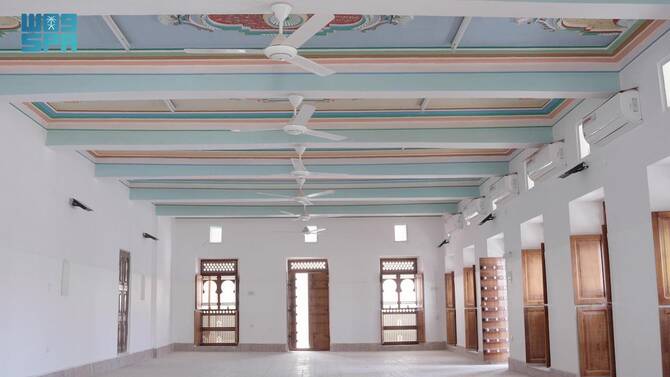
Restoration included repairing the outer wall and mudbrick structures. Attention was given to restoring wooden ceilings, carved doors, and windows that showcase Yemeni craftsmanship. 

The project also preserved the palace’s architectural features, including traditional decorations and wall inscriptions. Local engineers and technicians were trained in restoration techniques for ongoing maintenance. 

This project supports development in Hadramout and the preservation of Yemen’s heritage. The palace can now receive visitors and host events, enhancing its role as a cultural and tourism site, the SPA reported.

The Seiyun Palace restoration is one of 264 projects by the Saudi development program across Yemen, covering education, health, transportation, energy, water, agriculture, fisheries, and institutional capacity building.


‘Stability can’t be bought’: Saudi ministers extol benefits of long-term reform in a fragmented world

Updated 56 min 54 sec ago
Follow

‘Stability can’t be bought’: Saudi ministers extol benefits of long-term reform in a fragmented world

  • They outline during discussion at the World Economic Forum in Davos the ways in which the Kingdom is capitalizing on stability as a competitive advantage
  • They highlight in particular the use of predictable policymaking, disciplined public finances, and long-term planning under Saudi Vision 2030

DAVOS: Stability is the crucial ingredient for long-term economic growth, especially in an increasingly fragmented global economy, Saudi ministers said on Thursday at the World Economic Forum in Davos.

It is not something that can be purchased or improvised, said Faisal Alibrahim, the minister of economy and planning, it must be developed patiently.

“You have to build it, accumulate it over time, for it to be the right kind of stability,” he said. “We treat it as a discipline,” he added.

Speaking during a panel discussion on the Saudi economy, Alibrahim and Finance Minister Mohammed Al-Jadaan outlined the ways in which the Kingdom has sought to capitalize on stability as a competitive advantage.

They highlighted in particular the use of predictable policymaking, disciplined public finances, and long-term planning under the Kingdom’s Vision 2030 plan for national development and diversification.

Al-Jadaan said governments and businesses alike are operating in a world where uncertainty has become the norm, which places a greater burden on policymakers to reduce ambiguity wherever possible.

“Businesses can price tariffs, they can price taxes,” he said. “What they find very difficult to price is ambiguity. We are trying to ensure that we build that resilience within our economy and give the private sector that predictability that they need.”

This focus on predictability, he added, has been central to Saudi Arabia’s economic transformation, by helping the private sector to plan for the long term while the government undertakes deep structural reform.

Alibrahim noted that trust has become a big factor in global trade and investment, particularly as geopolitical tensions and economic fragmentation intensify.

In a fragmenting world, one of the rarest things now is the idea that a “commitment made today will be honored tomorrow,” he said. Yet trust shapes how the world trades and how markets remain active, because it means participants can predict what will happen, he added. Stability therefore becomes a “rare currency, and even a competitive edge.”

He also said that reform on paper was not enough; it must be coupled with streamlined regulation and continuous engagement, so that businesses can develop long-term thinking and navigate uncertainty with more confidence.

Al-Jadaan framed Saudi Vision 2030 as a multiphase journey that began with structural reforms, followed by an execution-heavy phase, and is now entering a third stage focused on the maximization of impact.

He said the Kingdom was in a phase of “learning, reprioritizing and staying the course,” would make bold decisions, and had the “courage to continue through difficulties.” A key anchor of all this, he added, was discipline in relation to public finance.

“You cannot compromise public finance for the sake of growth,” Al-Jadaan said. “If you spend without restraint, you lose your anchor while the economy is still diversifying.”

This discipline underpins what he described as Saudi Arabia’s “deficit by design” — in other words, borrowing strategically to fund capital expenditure that supports long-term growth, rather than consumption.

“If you borrow to spend on growth-enhancing investment, you are safe,” he said. “If you borrow to consume today, you are leaving the burden to your children.”

Alibrahim said the focus in the next phase of Vision 2030 will be on the optimal deployment of capital, ensuring the momentum continues while costs are tightly managed.

Looking ahead, both ministers emphasized the importance of long-term planning, which can be a challenge for some countries constrained by short election cycles.

“If you cannot take a long-term view in a turbulent world, it becomes very difficult,” Al-Jadaan said.

“Success stories like Singapore, South Korea and China were built on decades-long plans, pursued through good times and bad.”

The ministers’ discussion points were echoed by international participants. Noubar Afeyan, founder and CEO of life sciences venture capital firm Flagship Pioneering, said that by utilizing technology, including artificial intelligence, alongside a strategic vision in the form of Vision 2030, the Kingdom had been able to turn vulnerabilities into strengths, becoming not only self-sufficient but a potential exporter of innovation and intellectual property.

“Uncertainty opens up opportunities for countries that might otherwise be overlooked,” he added.

“Saudi Arabia, with Vision 2030, is positioning itself to not only address its own challenges but also become a net exporter of innovation and expertise.”

Ajay Banga, the president of the World Bank, said Vision 2030 had helped create “physical and human infrastructure” that allows Saudi Arabia to capitalize on its demographic dividend.

Jennifer Johnson, CEO of investment management firm Franklin Templeton, said Saudi policymakers stood out for their openness and curiosity.

“I have spoken to Saudi ministers and they ask what they need to do — that doesn’t happen often,” she said.