

JIAT clears coalition of alleged rights violations in Yemen

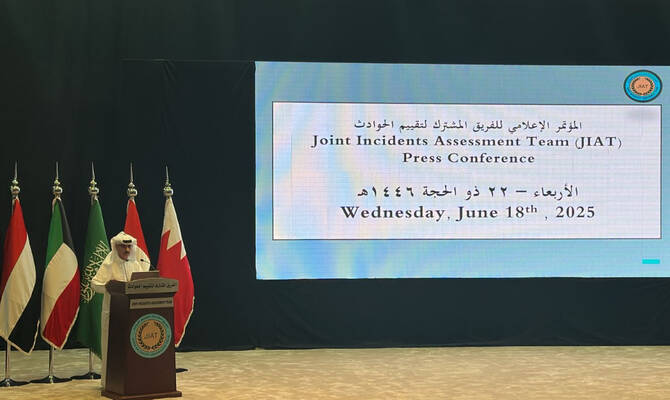
Spokesman of the Joint Incidents Assessment Team (JIAT) Mansour Bin Ahmed Al-Mansour speaks at a press conference in Riyadh on Wednesday, June 18th 2025. (AN photo)
Short Url
Updated 18 June 2025
Follow

JIAT clears coalition of alleged rights violations in Yemen

  • Coalition forces identified four locations and carried out an air mission on what was considered a legitimate military target and in line with international humanitarian law

RIYADH: The Joint Incidents Assessment Team on Wednesday issued a statement in response to allegations of human rights violations in Yemen over the targeting of Sarwah Rural Hospital in Harib directorate, Marib governorate on April 24, 2015.

After examining various documents, including air tasking orders, daily mission schedules, mission execution procedures, after-mission reports and satellite images, the JIAT concluded that the hospital is located in Sarwah village and included on the coalition forces’ no-strike list.

Specialists studied satellite images of the hospital and found no trace of damage to its structures caused by aerial targeting.

Analyzing coalition air missions on April 24, 2015, the JIAT found no evidence of operations in Sarwah village. Similarly, missions on April 23 and April 25 showed no activity in the area.

In a press conference in Riyadh, JIAT spokesman Mansour Al-Mansour addressed an allegation that coalition forces targeted a mosque in Al-Sawad in Yemen’s Amran governorate on Sept. 23, 2019.

After reviewing air missions, the JIAT found that no coalition operations were carried out in Amran on that date.

By studying missions conducted the day before, the JIAT reported that intelligence indicated Houthi militia fighters were gathering at mobilization sites in Harf Sufyan in Amran in preparation for a major attack.

Coalition forces identified four locations and carried out an air mission on what was considered a legitimate military target and in line with international humanitarian law.

“The coalition forces have taken all possible precautions to avoid accidental loss or damage to civilians and civilian objects, or in any case, to minimize it to the lowest possible level, during the planning and execution of the military operation,” Al-Mansour said.

The precautions included the use of “guided bombs proportionate to the size of the military targets and ensuring that there were no civilians present before or during the targeting,” he said.

The JIAT concluded that the strike was lawful. It noted that while the targeted structure was claimed to be a mosque, no indications such as a minaret were found.

It also addressed an allegation that a coalition airstrike hit a pickup truck in Al-Jarr village, Hajjah governorate, followed by a second strike 10 minutes later that destroyed a house on June 16, 2019.

After reviewing air mission data, satellite images and visiting operational centers, the JIAT found no evidence of coalition activity on that date, nor on the days before or after. Satellite imagery also showed no signs of aerial targeting.

The JIAT concluded that coalition forces did not target Al-Jarr village, as claimed.

It also addressed an allegation that coalition forces targeted houses in Al-Hijrah village, Markhah Al-Sofla directorate in Shabwah on Jan. 4, 2019.

After reviewing air tasking orders, mission schedules, post-mission reports and satellite images, it found that no coalition air missions were conducted in Shabwah.

The JIAT also confirmed that no air missions were carried out in the governorate on Jan. 3 or Jan. 5, 2019, and concluded that coalition forces did not target houses in Al-Hijrah village as claimed.


Minzal brings Saudi traditions to life in Diriyah

Updated 07 January 2026
Follow

Minzal brings Saudi traditions to life in Diriyah

  • From leather crafts and archery to Saudi coffee, Minzal offers a lesson in ‘Sloum Al-Arab’

RIYADH: This season of Minzal places social norms and traditional etiquette at its center, with tents set up to teach what is locally known as “Sloum Al-Arab” alongside gatherings for coffee, dinner and stargazing around campfires.

“Sloum Al-Arab” refers to the unwritten customers and values that have shaped Arab and Bedouin society for centuries, including generosity, coffee preparation, courage and archery. 

In Saudi Arabia, these traditions are closely ties to cultural identity and religious belief. 

Leather products and the making of leather goods is one of the crafts featured at Minzal this year and is one of the oldest crafts still practiced in the kingdom.

“The most difficult thing I faced to work on was camel leather because it is a little tough,” Nada Samman, a leather trainer and craftsman at Minzal, told Arab News. 

Minzal continues to evolve with each season, offering activities that highlight Bedouin values, traditional skills and sports. (AN photo by Haifa Alshammari)

“The work on leather is wonderful whether it is goat leather, cow leather, Sawakni sheep, and of course, camel leather. At Minzal, we are offering multiple handicraft workshops, most specifically the leather handicrafts. We want visitors to spend time at something useful and fun."

Samman explained the workshops allowed participants to preserve heritage while engaging in meaning, hands on activities. 

Faisal Al-Khaled, a visual artist and craftsman specializing in Saudi designs at Minzal, shared a similar goal: “I want people to have, by the end of this experience, a unique and traditional art piece created by them, and that I know I helped them to preserve this craft.”

Minzal, which has been organized for several years now, continues to evolve with each season, offering activities that highlight Bedouin values, traditional skills and sports. Archery is a key feature, reflecting its deep roots in Arab and Islamic history.

Mohammed Al-Sharif, a certified archery player and coach with the Saudi Archery Federation since 2028, said the sport was closely connected to Saudi culture. It was encouraged by the Prophet Muhammad, which led people to learn and teach it through generations.

“Our traditional bow is considered one of the most important and widely used bows in Arab culture,” Al-Sharif said. “We have several styles, and professional archers specializing in traditional bow shooting … There are various types of archery, such as horseback archery and standing archery, where bow sizes vary according to specific needs, such as types used for hunting and others used during warfare.”

He explained that archery was historically part of daily life, used for protection and hunting. 

Saudi coffee also plays a significant role in the Minzal experience, with live demonstrations. One of the most frequently consumed beverages in the Kingdom, it is a symbol of hospitality and generosity.

Ahmed Al-Shuaibi explained how it was prepared at the Sloum tent, first by roasting the beans and then allowing them to cool. The beans are ground with spices in a Nigr.

“Coffee is passed from our grandparents,” he added. “In significant majlis, you see them offering our local coffee and not other types of coffee. We organized this corner so that young generations can visit and learn this.”