


TOKYO: From the only country ever targeted by atomic bombs, a senior Iranian diplomat has called for a return to diplomacy over destruction amid simmering nuclear tensions in the Middle East.
Peiman Seadat, Tehran’s ambassador to Japan, says his country remains open to dialogue but cautions that “peace by force is not peace” following recent attacks on its nuclear sites and failed negotiations.
In an exclusive interview with Arab News on Saturday, Seadat described genuine diplomacy as requiring “mutual respect, even on points of disagreement, equal footing, and a willingness to achieve a satisfactory outcome for parties involved.”
Iranian authorities are “now assessing the situation” and weighing options, he said.

Peiman Seadat, Iran’s ambassador to Japan. (AN photo)
Seadat’s remarks come amid simmering tensions following a 12-day conflict between Iran and Israel, which ended with a ceasefire on June 24.
Accusing both the US and Israel of choosing aggression over diplomacy, he said the attacks on Iran’s nuclear facilities were carried out two days before planned talks with the US, and thus have deepened a “legacy of distrust.”
“Rather than condemning the party that disrupted the negotiations, the Americans sided with the aggressor,” he said. “They, therefore, betrayed the very negotiation to which they were a party.
“Accordingly, the conclusion is that they were complicit in the aggression, a fact they further proved when they launched attacks against our peaceful nuclear sites, thus joining the Israelis in gross violation of every tenet of international law.”
In his first public remarks after the truce, Iran’s Supreme Leader Ayatollah Ali Khamenei declared victory, claiming Iran “slapped America in the face” by striking the Al-Udeid base in Qatar in retaliation for the US bombing of Iranian nuclear facilities.

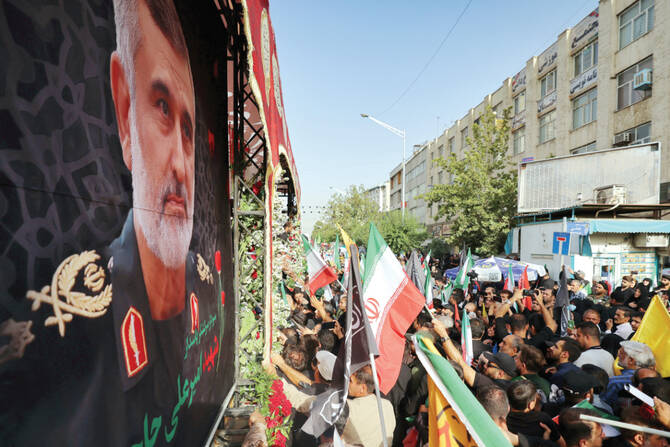
An Iranian woman marches with a poster of Supreme Leader Ayatollah Ali Khamenei in Tehran on June 28, 2025, during the funeral of Iranian armed forces generals and nuclear scientists killed in Israeli strikes. (AP Photo)
Warning that any future attacks would prompt further strikes on American targets, he asserted Iran’s regional capabilities and rejected calls for concessions.
Khamenei also downplayed the impact of the strikes on Iran’s nuclear facilities, claiming that the US acted mainly to protect Israel after Iranian missiles penetrated Israeli defenses.
US President Donald Trump ridiculed Khamenei’s victory claims, insisting Iran had been “decimated” and its nuclear sites “obliterated” during the conflict.
Trump said he had considered but ultimately rejected plans to assassinate Khamenei, claiming he “saved him from a very ugly and ignominious death” by stopping direct attacks from the US or Israel.
He also said he halted plans to lift sanctions on Iran following Khamenei’s “blatant and foolish” statements and warned he would “absolutely” consider bombing Iran again if Tehran resumed nuclear enrichment at threatening levels.
Trump further claimed to have pressured Israel to avoid delivering a “final knockout” blow, suggesting Israeli strikes could have targeted Tehran directly if not for US intervention.
On Saturday, Iranian Foreign Minister Abbas Araghchi condemned Trump’s comments, saying a potential nuclear deal hinges on the US ending its “disrespectful tone” toward the supreme leader.

Iran's Foreign Minister Abbas Araghchi mourns next to the coffin of Iranian Revolutionary Guards commander Hossein Salami, who was killed during Israeli strikes, during a state funeral procession at Enghelab (Revolution) Square in the capital Tehran on June 28, 2025. (AFP)
“If President Trump is genuine about wanting a deal, he should put aside the disrespectful and unacceptable tone towards Iran’s Supreme Leader, Grand Ayatollah Khamenei, and stop hurting his millions of heartfelt supporters,” Araghchi posted on the social platform X.
Seadat said that Iran remained committed to diplomacy, citing his country’s continued adherence to the 2015 nuclear deal and participation in talks until Israeli strikes derailed the process.
“Iran has always been a party to genuine diplomacy, but peace by force is not peace; it is, rather, coercion,” he said. “What we wanted was a cessation of aggression, and we achieved it at this stage, with resolve. So, while we remain highly vigilant, we will see how the situation unfolds.”
As diplomatic strains persist, Israeli officials have signaled a readiness to escalate. On June 26, Israeli Defense Minister Israel Katz told local media that Israel has a “green light” from Trump to strike Iran again if it appears to be advancing its nuclear program.
He added that Israel would not have needed US permission to target Khamenei directly.
That same day, Israeli Prime Minister Benjamin Netanyahu claimed victory and framed the conflict as a strategic opportunity to expand diplomatic ties with Arab states.
“We have fought with determination against Iran and achieved a great victory. This victory opens the path to dramatically enlarge the peace accords,” Netanyahu said in a video address, referencing the Abraham Accords, which normalized relations between Israel and several Arab countries in 2020.

This satellite image provided by Maxar Technologies shows excavators at tunnel entrances at the Fordo facility in Iran on Friday, June 27, 2025. (Maxar Technologies via AP)
However, Gulf states have condemned both Iran’s missile strike on Qatar and Israel’s attacks on Iranian facilities, citing concerns over regional stability and national sovereignty.
In a joint statement on June 16, Arab countries rejected and condemned Israel’s military aggression against Iran, calling instead for a return to negotiations.
Seadat insisted that Iran’s nuclear program remains peaceful and said Iran’s parliament moved to limit cooperation with the International Atomic Energy Agency (IAEA) only after repeated, ignored reassurances from Tehran.
“Up to the moment our sites were attacked in contravention of the NPT rules, the IAEA Statute, and two resolutions by its General Conference that prohibit any attack on IAEA-safeguarded peaceful nuclear sites, 130 IAEA inspectors were in place, meaning one-fifth of all inspections conducted by the IAEA in the world,” Seadat said.
He added: “Regardless of disagreements, the IAEA continued its most robust verification regime in the world in Iran.”

This photo taken on January, 20, 2014, shows an IAEA inspector at the Iranian nuclear research center of Natanz as an interim deal with world powers on Iran's nuclear program came into force. (AFP)
Even after the attacks, Seadat said, both the IAEA and US intelligence confirmed there were no signs of nuclear weapons activity — despite early claims, which he attributed to a “very irresponsible” IAEA report.
He said the 2015 nuclear agreement created “a balance: a cap on our peaceful nuclear program in return for full removal of sanctions.” That arrangement, he added, was especially reassuring as it was backed by UN Security Council Resolution 2231.
“This is a model that Japan and some others have. They also enrich uranium for peaceful purposes. I do not know what to say, unless the meaning of reassuring has changed, perhaps because of the aggressions by the Israeli regime and the Americans on Iran,” Seadat said.
Tensions had started escalating after a May 31 IAEA report revealed that Iran had increased uranium enrichment to 60 percent — the only non-nuclear weapons state to do so — and expanded its stockpile of near-weapons-grade material by 50 percent in three months. Iran dismissed the report as “politically motivated” and “baseless accusations.”

Members of the United Nations Security Council listen as IAEA Director General Rafael Grossi speaks via video during a meeting on threats to international peace and security at the United Nations headquarters on June 22, 2025 in New York City. (Getty Images via AFP)
On Wednesday, Rafael Grossi, IAEA director general, said his top priority is resuming inspections in Iran to determine the impact of the recent strikes. The extent of any damage remains unclear.
While Grossi suggested Iran may have relocated parts of its stockpile ahead of the attacks, US Defense Secretary Pete Hegseth said on Thursday he had seen no intelligence supporting that claim.
Looking ahead, Seadat noted that Japan could play a significant diplomatic role, referencing its unique moral standing as the only country to have experienced atomic bombings.
“The Hibakusha, the first generation of survivors of Hiroshima and Nagasaki, still walk among us in Japan,” he said. “Because of this, Japan possesses a profound moral authority, having known the depths of suffering like few others.”
He added that Japan is well-positioned to support peace through “inclusive” regional development, particularly efforts that enhance energy security for all.
Seadat also said there is growing alignment between Iran and Arab and Islamic states, which he described as a “positive and constructive path” toward regional peace.
However, he cautioned that maintaining momentum would require active, sustained support from all sides.
Although East Asia lies far from Iran, Seadat emphasized cultural similarities and the potential for cooperation — especially through Japan’s technological expertise and diplomatic engagement.
“We need this new paradigm in our region, and I believe Japan, through the dynamism of its diplomacy, can contribute to it,” he said.


