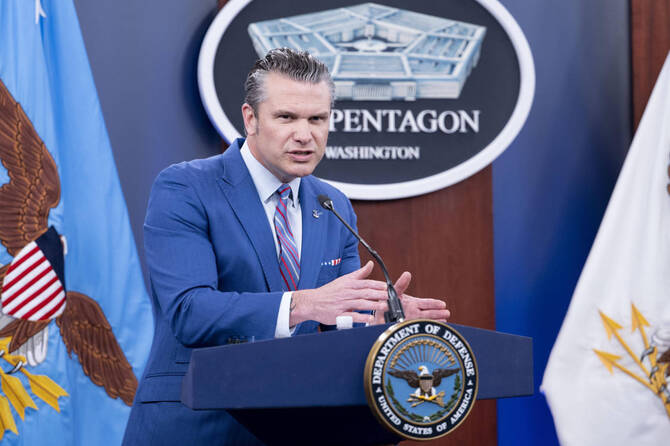
WASHINGTON: US Defense Secretary Pete Hegseth on Thursday said he was unaware of any intelligence suggesting Iran had moved any of its highly enriched uranium to shield it from US strikes on Iran’s nuclear program during the weekend. US military bombers carried out strikes against three Iranian nuclear facilities early Sunday local time using more than a dozen 30,000-pound bunker-buster bombs.
The results of the strikes are being closely watched to see how far they may have set back Iran’s nuclear program.
“I’m not aware of any intelligence that I’ve reviewed that says things were not where they were supposed to be, moved or otherwise,” Hegseth told an often fiery news conference.
US President Donald Trump, who watched the exchange with reporters, echoed his defense secretary, saying it would have taken too long to remove anything.
“The cars and small trucks at the site were those of concrete workers trying to cover up the top of the shafts. Nothing was taken out of (the) facility,” Trump wrote on his social media platform, without providing evidence.
Several experts have cautioned that Iran likely moved a stockpile of near weapons-grade highly enriched uranium out of the deeply buried Fordow site before the strikes, and could be hiding it in locations unknown to Israel, the US and UN nuclear inspectors. They noted satellite imagery from Maxar Technologies showing “unusual activity” at Fordow on Thursday and Friday, with a long line of vehicles waiting outside an entrance to the facility. A senior Iranian source told Reuters on Sunday most of the 60 percent highly enriched uranium had been moved to an undisclosed location before the attack.
The Financial Times, citing European intelligence assessments, reported that Iran’s highly enriched uranium stockpile remains largely intact since it was not concentrated at Fordow. Hegseth’s comments denying such claims came at the news briefing where he also accused journalists of downplaying the success of the US strikes following a leaked preliminary assessment from the Defense Intelligence Agency suggesting they may have only set back Iran by months.
He said the assessment was low confidence, and, citing comments from CIA Director John Ratcliffe, said it had been overtaken by intelligence showing Iran’s nuclear program was severely damaged and would take years to rebuild.
Ratcliffe, Hegseth, Secretary of State Marco Rubio and General Dan Caine, the chairman of the Joint Chiefs of Staff, held a classified briefing on the strikes on Thursday for all 100 members of the US Senate. Tulsi Gabbard, who normally would conduct such briefings as director of national intelligence, was not scheduled to participate. Trump said last week that she was wrong in suggesting there was no evidence Iran was building a nuclear weapon. The Senate briefing had been scheduled for Tuesday, but was postponed. Senators are expected to vote this week on a resolution that would require congressional approval for strikes against Iran, although the measure is not expected to be enacted. At the Pentagon news conference, Hegseth described the strikes as “historically successful.”
During the press conference, Caine, the top US general largely stuck to technical details, outlining the history of the bunker-busting bombs used. Caine showed a video testing the bombs on a bunker like the ones struck on Sunday.
Caine declined to provide his own assessment of the strike and deferred to the intelligence community. He denied being under any pressure to change his assessment to present a more optimistic view of the US strikes.
He also said he would not change his assessment due to politics. Uniformed military officials are supposed to remain apolitical and provide their best military advice.
“I’ve never been pressured by the president or the secretary to do anything other than tell them exactly what I’m thinking, and that’s exactly what I’ve done,” he said.

No known intelligence that Iran moved uranium, US defense chief says
https://arab.news/8dzuc
No known intelligence that Iran moved uranium, US defense chief says
- Several experts cautioned that Iran likely moved a stockpile of highly enriched uranium out of the Fordow plant before US strikes
- US President Donald Trump echoes his defense secretary, saying it would have taken too long to remove anything before the attack
Saad Hariri pledges to contest May election
- Beirut rally draws large crowds on anniversary of his father’s assassination
BEIRUT: Lebanon’s former Prime Minister Saad Hariri announced on Saturday that his movement, which represents the majority of Lebanon’s Sunni community, would take part in upcoming parliamentary elections scheduled for May.
The Future Movement had suspended its political activities in 2022.
Hariri was addressing a large gathering of Future Movement supporters as Lebanon marked the 21st anniversary of the assassination of his father and former Prime Minister Rafik Hariri, at Martyrs’ Square in front of his tomb.
He said his movement remained committed to the approach of “moderation.”
A minute’s silence was observed by the crowd in Martyrs’ Square at the exact time when, in 2005, a suicide truck carrying about 1,000 kg of explosives detonated along Beirut’s seaside road as Rafik Hariri’s motorcade passed, killing him along with 21 others, including members of his security guards and civilians, and injuring 200 people.
Four members of Hezbollah were accused of carrying out the assassination and were tried in absentia by the Special Tribunal for Lebanon.
The crowd waved Lebanese flags and banners of the Future Movement as they awaited Saad Hariri, who had returned to Beirut from the UAE, where he resides, specifically to commemorate the anniversary, as has been an annual tradition.
Hariri said that “after 21 years, the supporters of Hariri’s approach are still many,” denouncing the “rumors and intimidation” directed at him.
He added: “Moderation is not hesitation … and patience is not weakness. Rafik Hariri’s project is not a dream that will fade. He was the model of a statesman who believed, until martyrdom, that ‘no one is greater than their country.’ The proof is his enduring place in the minds, hearts and consciences of the Lebanese people.”
Hariri said he chose to withdraw from political life after “it became required that we cover up failure and compromise the state, so we said no and chose to step aside — because politics at the expense of the country’s dignity and the project of the state has no meaning.”
He said: “The Lebanese are weary, and after years of wars, divisions, alignments and armed bastions, they deserve a normal country with one constitution, one army, and one legitimate authority over weapons — because Lebanon is one and will remain one. Notions of division have collapsed in the face of reality, history and geography, and the illusions of annexation and hegemony have fallen with those who pursued them, who ultimately fled.”
Hariri said the Future Movement’s project is “One Lebanon, Lebanon first — a Lebanon that will neither slide back into sectarian strife or internal fighting, nor be allowed to do so.”
He added that the Taif Agreement is “the solution and must be implemented in full,” arguing that “political factions have treated it selectively by demanding only what suits them — leaving the agreement unfulfilled and the country’s crises unresolved.”
He said: “When we call for the full implementation of the Taif Agreement, we mean: weapons exclusively in the hands of the state, administrative decentralization, the abolition of political sectarianism, the establishment of a senate and full implementation of the truce agreement. All of this must be implemented — fully and immediately — so we can overcome our chronic problems and crises together.
“Harirism will continue to support any Arab rapprochement, and reject any Arab discord. Those who seek to sow discord between the Gulf and Arab countries will harm only themselves and their reputation.
“We want to maintain the best possible relations with all Arab countries, starting with our closest neighbor, Syria — the new Syria, the free Syria that has rid itself of the criminal and tyrannical regime that devastated it and Lebanon, and spread its poison in the Arab world.”
Hariri said he saluted “the efforts of unification, stabilization and reconstruction led by Syrian President Ahmad Al-Sharaa.”
When asked about the Future Movement’s participation in parliamentary elections following his withdrawal from politics, he said: “Tell me when parliamentary elections will be held, and I will tell you what the Future Movement will do. I promise you that, when the elections take place, they will hear our voices, and they will count our votes.”
The US Embassy in Lebanon shared a post announcing that Ambassador Michel Issa laid a wreath at the grave of Rafik Hariri.
Hariri’s legacy “to forge peace and prosperity continues to resonate years later with renewed significance,” the embassy said.


