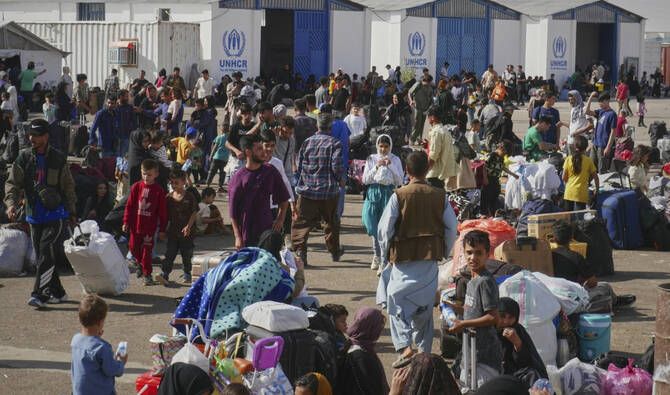

ISLAMABAD: At least 1.2 million Afghans have been forced to return from Iran and Pakistan this year, the UN refugee agency said Saturday, warning that repatriations on a massive scale have the potential to destabilize the fragile situation in Afghanistan.
Iran and Pakistan in 2023 launched separate campaigns to expel foreigners they said were living in the country illegally. They set deadlines and threatened them with deportation if they didn’t leave. The two governments deny targeting Afghans, who have fled their homeland to escape war, poverty or Taliban rule.
The UN high commissioner for refugees said that of the 1.2 million returning Afghans, more than half had come from Iran following a March 20 government deadline for them to leave voluntarily or face expulsion.
Iran has deported more than 366,000 Afghans this year, including refugees and people in refugee-like situations, according to the agency.
Iran’s 12-day war with Israel also has driven departures. The highest number of returns was on June 26, when 36,100 Afghans crossed the border in one day.
“Afghan families are being uprooted once again, arriving with scant belongings, exhausted, hungry, scared about what awaits them in a country many of them have never even set foot in,” said Arafat Jamal, the UNHCR representative in the Afghan capital, Kabul.
He said women and girls are particularly worried, as they fear the restrictions on freedom of movement and basic rights such as education and employment.
More than half Afghanistan relies on humanitarian assistance. But opposition to Taliban policies and widespread funding cuts are worsening the situation, with aid agencies and nongovernmental organizations cutting back on basic services like education and health care.
IRAN URGES FOREIGNERS TO LEAVE QUICKLY
Iran’s attorney general, Mohammad Movahedi Azad, said Saturday that foreigners in the country illegally should leave as soon as possible or face prosecution, state media reported.
“Foreign nationals, especially brothers and sisters from Afghanistan whom we have hosted for years, help us [so] that illegal individuals leave Iran in the shortest period,” the official IRNA news agency quoted Azad as saying.
Iranian authorities said in April that out of more than 6 million Afghans, up to 2.5 million were in the country illegally.
Iran’s top diplomat in Kabul, Ali Reza Bikdeli, visited the Dogharoun border crossing with Afghanistan and promised to facilitate the repatriation of Afghans, state TV reported.
Iranians have complained about the increasing presence of Afghans in recent months, with some accusing them of spying for Israel since the outbreak of the war.
TALIBAN PLEDGE AMNESTY
Earlier this month, on the religious festival of Eid Al-Adha, the Taliban prime minister said all Afghans who fled the country after the collapse of the former Western-backed government were free to return, promising they would be safe.
“Afghans who have left the country should return to their homeland,” Mohammad Hassan Akhund said in a message on X. “Nobody will harm them. Come back to your ancestral land and live in an atmosphere of peace.”
On Saturday, a high-ranking ministerial delegation traveled to western Herat province to meet some of the Afghans returning from Iran.
The officials pledged “swift action to address the urgent needs of the returnees and ensure that essential services and support are provided to ease their reintegration,” according to a statement from the Taliban deputy spokesman Hamdullah Fitrat on X.
People get food, temporary accommodation and access to health care upon their return, said Ahmadullah Muttaqi, the director of information and culture in Herat. Everyone receives 2,000 Afghanis, or $28.50, in cash and is taken free of charge to their home provinces.
“Upon arrival, they are housed in designated camps until permanent housing is arranged, as residential townships are currently under construction in every province for them,” he told The Associated Press.
Meanwhile, Pakistani authorities have set a June 30 deadline for some 1.3 million Afghans to leave. Pakistan aims to expel a total of 3 million Afghans this year.