

Pakistan plans digital wheat tracking system, steps up Ramadan price monitoring

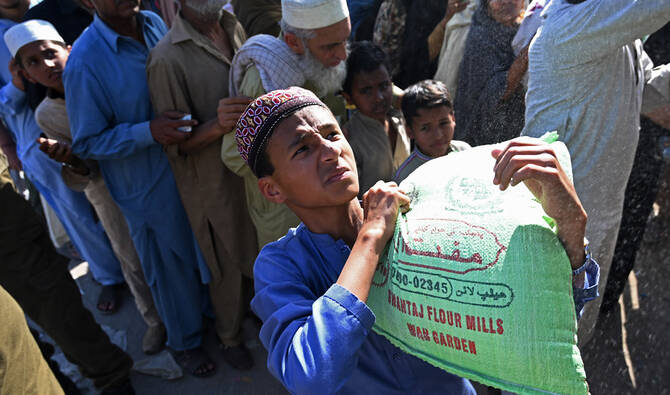
A boy receives free wheat flour at a distribution point in Rawalpindi on March 28, 2023. (AFP/File)
Short Url
Updated 21 February 2026
Follow

Pakistan plans digital wheat tracking system, steps up Ramadan price monitoring

  • Government says adequate stocks available ahead of the upcoming harvesting season
  • It instructs provinces to prevent flour price spikes during the holy month of Ramadan

ISLAMABAD: Pakistan plans to introduce digital traceability and tighter supply chain monitoring in its wheat procurement system under a new long-term policy, the food security ministry said on Saturday, as authorities move to curb price volatility during Ramadan.

The announcement followed a meeting of the National Wheat Oversight Committee chaired by Federal Minister for National Food Security and Research Rana Tanveer Hussain to review procurement arrangements, stock availability and price stability measures ahead of the upcoming harvesting season.

The review comes after riverine floods during last year’s monsoon season damaged farmlands in parts of eastern Punjab, the country’s main wheat-producing region, raising concerns about crop output. Officials at the meeting, however, expressed satisfaction over existing wheat stocks, saying sufficient supplies were available across provinces to meet national consumption needs until the arrival of the new crop.

“The Federal Minister emphasized that the current procurement framework will remain applicable for one year,” the statement said. “He stated that the Federal Government is working on a comprehensive long-term wheat policy for the period 2026–2030, aimed at strengthening national food security through modern reforms.”

“He highlighted that the upcoming policy will focus on digital traceability mechanisms, improved supply chain monitoring, enhanced transparency, and sustained price stability, enabling better coordination between the federal and provincial governments,” the statement added.

The committee was informed that the illustrative wheat procurement price has been fixed at 3,500 rupees ($12.55) per 40 kilograms, and provinces have been asked to ensure smooth implementation of procurement operations.

Special emphasis was also placed on consumer protection during Ramadan.

“The Federal Minister directed all provinces to ensure strict market monitoring and take effective administrative measures to prevent any unnecessary increase in flour prices,” the statement continued.


Pakistan says responding to Afghan ‘offensive operations’ after border fire as tensions escalate

Updated 26 February 2026
Follow

Pakistan says responding to Afghan ‘offensive operations’ after border fire as tensions escalate

  • Afghan Taliban spokesperson says “large-scale offensive operations” launched against Pakistani military bases
  • Pakistan says Afghan forces opened “unprovoked” fire across multiple sectors along shared border

ISLAMABAD: Afghanistan’s Taliban authorities said on Thursday they had launched “large-scale offensive operations” against Pakistani military bases and installations, prompting Pakistan to say its forces were responding to what it described as unprovoked fire along the shared border.

The escalation follows Islamabad’s weekend airstrikes targeting what it said were Tehreek-e-Taliban Pakistan (TTP) and Daesh militant camps inside Afghanistan in response to a wave of recent bombings and attacks in Pakistan. Islamabad said the strikes killed over 100 militants, while Kabul said dozens of civilians were killed and condemned the attacks as a violation of its sovereignty.

In a post on social media platform X, Afghan government spokesperson Zabihullah Mujahid said Afghanistan had launched “large-scale offensive operations” in response to repeated violations by the Pakistani military.


Pakistan’s Ministry of Information said Afghan forces had initiated hostilities along multiple points of the frontier.

“Afghan Taliban regime unprovoked action along the Pakistan–Afghanistan border given an immediate, and effective response,” the ministry said in a statement.

The statement said Pakistani forces were targeting Taliban positions in the Chitral, Khyber, Mohmand, Kurram and Bajaur sectors, claiming heavy Afghan casualties and the destruction of multiple posts and equipment. It added that Pakistan would take all necessary measures to safeguard its territorial integrity and the security of its citizens.


Separately, security officials said Pakistani forces had carried out counterattacks in several border sectors.

“Pakistan’s security forces are giving a befitting reply to the unprovoked Afghan aggression with full force,” a security official said, declining to be named. 

“The Pakistani security forces’ counter-attack destroyed Taliban’s hideouts and the Khawarij fled,” they added, referring to TTP militants. 

The claims from both sides could not be independently verified.

Cross-border violence has intensified in recent weeks, with Pakistan blaming a surge in suicide bombings and militant attacks on militants it says are based in Afghanistan. Kabul denies providing safe havens to anti-Pakistan militant groups.

The clashes mark the third major escalation between the neighbors in less than a year. Similar Pakistani strikes last year triggered weeklong clashes before Qatar, Türkiye and other regional actors mediated a ceasefire in October.

The 2,600-kilometer (1,600-mile) frontier, a key trade and transit corridor linking Pakistan to landlocked Afghanistan and onward to Central Asia, has faced repeated closures amid tensions, disrupting commerce and humanitarian movement. Trade between the two nations has remained closed since October 2025.