What’s next for birthright citizenship after the Supreme Court’s ruling

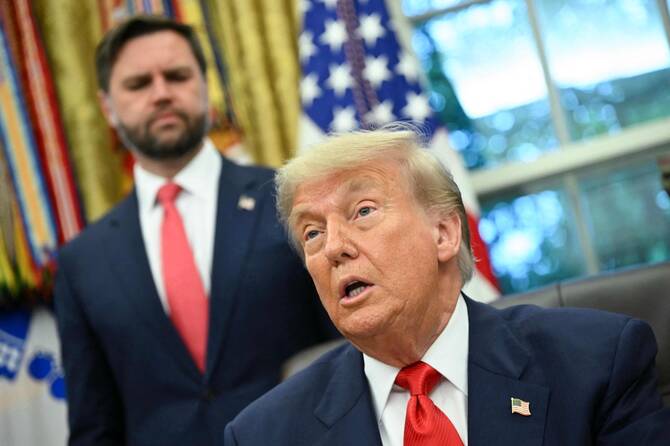
American President Donald Trump and Vice President JD Vance in the Oval Office of The White House in Washington, US. (AFP)
Short Url
Updated 28 June 2025
Follow

What’s next for birthright citizenship after the Supreme Court’s ruling

  • US President Trump’s executive order, signed in January, seeks to deny citizenship to children who are born to people who are living in the US illegally or temporarily

WASHINGTON: The legal battle over President Donald Trump’s move to end birthright citizenship is far from over despite the Republican administration’s major victory Friday limiting nationwide injunctions.
Immigrant advocates are vowing to fight to ensure birthright citizenship remains the law as the Republican president tries to do away with more than a century of precedent.
The high court’s ruling sends cases challenging the president’s birthright citizenship executive order back to the lower courts. But the ultimate fate of the president’s policy remains uncertain.
Here’s what to know about birthright citizenship, the Supreme Court’s ruling and what happens next.
What does birthright citizenship mean?
Birthright citizenship makes anyone born in the United States an American citizen, including children born to mothers in the country illegally.
The practice goes back to soon after the Civil War, when Congress ratified the Constitution’s 14th Amendment, in part to ensure that Black people, including former slaves, had citizenship.
“All persons born or naturalized in the United States and subject to the jurisdiction thereof, are citizens of the United States,” the amendment states.
Thirty years later, Wong Kim Ark, a man born in the US to Chinese parents, was refused re-entry into the US after traveling overseas. His suit led to the Supreme Court explicitly ruling that the amendment gives citizenship to anyone born in the US, no matter their parents’ legal status.
It has been seen since then as an intrinsic part of US law, with only a handful of exceptions, such as for children born in the US to foreign diplomats.
Trump has long said he wants to do away with birthright citizenship
Trump’s executive order, signed in January, seeks to deny citizenship to children who are born to people who are living in the US illegally or temporarily. It’s part of the hard-line immigration agenda of the president, who has called birthright citizenship a “magnet for illegal immigration.”
Trump and his supporters focus on one phrase in the amendment — “subject to the jurisdiction thereof” – saying it means the US can deny citizenship to babies born to women in the country illegally.
A series of federal judges have said that’s not true, and issued nationwide injunctions stopping his order from taking effect.
“I’ve been on the bench for over four decades. I can’t remember another case where the question presented was as clear as this one is. This is a blatantly unconstitutional order,” US District Judge John Coughenour said at a hearing earlier this year in his Seattle courtroom.
In Greenbelt, Maryland, a Washington suburb, US District Judge Deborah Boardman wrote that “the Supreme Court has resoundingly rejected and no court in the country has ever endorsed” Trump’s interpretation of birthright citizenship.
Is Trump’s order constitutional? The justices didn’t say
The high court’s ruling was a major victory for the Trump administration in that it limited an individual judge’s authority in granting nationwide injunctions. The administration hailed the ruling as a monumental check on the powers of individual district court judges, whom Trump supporters have argued want to usurp the president’s authority with rulings blocking his priorities around immigration and other matters.
But the Supreme Court did not address the merits of Trump’s bid to enforce his birthright citizenship executive order.
“The Trump administration made a strategic decision, which I think quite clearly paid off, that they were going to challenge not the judges’ decisions on the merits, but on the scope of relief,” said Jessica Levinson, a Loyola Law School professor.
Attorney General Pam Bondi told reporters at the White House that the administration is “very confident” that the high court will ultimately side with the administration on the merits of the case.
Questions and uncertainty swirl around next steps
The justices kicked the cases challenging the birthright citizenship policy back down to the lower courts, where judges will have to decide how to tailor their orders to comply with the new ruling. The executive order remains blocked for at least 30 days, giving lower courts and the parties time to sort out the next steps.
The Supreme Court’s ruling leaves open the possibility that groups challenging the policy could still get nationwide relief through class-action lawsuits and seek certification as a nationwide class. Within hours after the ruling, two class-action suits had been filed in Maryland and New Hampshire seeking to block Trump’s order.
But obtaining nationwide relief through a class action is difficult as courts have put up hurdles to doing so over the years, said Suzette Malveaux, a Washington and Lee University law school professor.
“It’s not the case that a class action is a sort of easy, breezy way of getting around this problem of not having nationwide relief,” said Malveaux, who had urged the high court not to eliminate the nationwide injunctions.
Justice Sonia Sotomayor, who penned the court’s dissenting opinion, urged the lower courts to “act swiftly on such requests for relief and to adjudicate the cases as quickly as they can so as to enable this Court’s prompt review” in cases “challenging policies as blatantly unlawful and harmful as the Citizenship Order.”
Opponents of Trump’s order warned there would be a patchwork of polices across the states, leading to chaos and confusion without nationwide relief.
“Birthright citizenship has been settled constitutional law for more than a century,” said Krish O’Mara Vignarajah, president and CEO of Global Refuge, a nonprofit that supports refugees and migrants. “By denying lower courts the ability to enforce that right uniformly, the Court has invited chaos, inequality, and fear.”


US signs new health deals with 9 African countries that mirror Trump’s priorities

A pharmacist counts HIV medicine inside a clinic in Ha Lejone, Lesotho, July 16, 2025. (AP)
Updated 4 sec ago
Follow

US signs new health deals with 9 African countries that mirror Trump’s priorities

  • US aid cuts have crippled health systems across the developing world, including in Africa, where many countries relied on the funding for crucial programs, including those responding to outbreaks of disease
  • The agreements signed so far, with Kenya, Nigeria and Rwanda among others, are the first under the new global health framework, which makes aid dependent on negotiations between the recipient country and the US

JOHANNESBURG: The US government has signed health deals with at least nine African countries, part of its new approach to global health funding, with agreements that reflect the Trump administration’s interests and priorities and are geared toward providing less aid and more mutual benefits.
The agreements signed so far, with Kenya, Nigeria and Rwanda among others, are the first under the new global health framework, which makes aid dependent on negotiations between the recipient country and the US.
Some of the countries that have signed deals either have been hit by US aid cuts or have separate agreements with the Trump administration to accept and host third-country deportees, although officials have denied any linkage.
The Trump administration says the new “America First” global health funding agreements are meant to increase self-sufficiency and eliminate what it says are ideology and waste from international assistance. The deals replace a patchwork of previous health agreements under the now-dismantled United States Agency for International Development.
US aid cuts have crippled health systems across the developing world, including in Africa, where many countries relied on the funding for crucial programs, including those responding to outbreaks of disease.
The new approach to global health aligns with President Donald Trump’s pattern of dealing with other nations transactionally, using direct talks with foreign governments to promote his agenda abroad. It builds on his sharp turn from traditional US foreign assistance, which supporters say furthered American interests by stabilizing other countries and economies and building alliances.
A different strategy
The deals mark a sharp departure from how the US has provided health care funding over the years and mirrors the Trump administration’s interests.
South Africa, which has lost most of its US funding — including $400 million in annual support — due in part to its disputes with the US, has not signed a health deal, despite having one of the world’s highest HIV prevalence rates.
Nigeria, Africa’s most populous country, reached a deal but with an emphasis on Christian-based health facilities, although it has a slight majority Muslim population. Rwanda and Uganda, which each have deportation deals with the US, have announced the health pacts.
Cameroon, Eswatini, Lesotho, Liberia and Mozambique also are among those that have signed health deals with the US
According to the Center for Global Development, a Washington think tank, the deals “combine US funding reductions, ambitious co-financing expectations, and a shift toward direct government-to-government assistance.”
The deals represent a reduction in total US health spending for each country, the center said, with annual US financial support down 49 percent compared with 2024.
A faith-based deal in Nigeria, a lifeline for several others

Under its deal, Nigeria, a major beneficiary of USAID funds, would get support that has a “strong emphasis” on Christian faith-based health care providers.
The US provided approximately $2.3 billion in health assistance to Nigeria between 2021 and 2025, mostly through USAID, official data shows. The new five-year agreement will see US support at over $2 billion, while Nigeria is expected to raise $2.9 billion to boost its health care programs.
The agreement “was negotiated in connection with reforms the Nigerian government has made to prioritize protecting Christian populations from violence and includes significant dedicated funding to support Christian health care facilities,” the State Department said in a statement.
The department said “the president and secretary of state retain the right to pause or terminate any programs which do not align with the national interest,” urging Nigeria to ensure “that it combats extremist religious violence against vulnerable Christian populations.”
For several other countries, the new deals could be a lifeline after US aid cuts crippled their health care systems and left them racing to fill the gaps.
Under its deal, Mozambique will get US support of over $1.8 billion for HIV and malaria programs. Lesotho, one of the poorest countries in the world, clinched a deal worth over $232 million.
In the tiny kingdom of Eswatini, the US committed to provide up to $205 million to support public health data systems, disease surveillance and outbreak response, while the country agreed to increase domestic health expenditures by $37 million.
No deal for South Africa after disputes
South Africa is noticeably absent from the list of signatories following tensions with the Trump administration.
Trump has said he will cut all financial assistance to South Africa over his widely rejected claims that it is violently persecuting its Afrikaner white minority.
The dismantling of USAID resulted in the loss of over $436 million in yearly financing for HIV treatment and prevention in South Africa, putting the program and thousands of jobs in the health care industry at risk.
Health compacts with countries that signed deportation deals
At least four of the countries that have reached deals previously agreed to receive third-country deportees from the US, a controversial immigration policy that has been a trademark of the Trump administration.
The State Department has denied any linkage between the health care compacts and agreements regarding accepting third-country asylum seekers or third-country deportees from the United States. However, officials have said that political considerations unrelated to health issues may be part of the negotiations.
Rwanda, one of the countries with a deportation deal with the US, signed a $228 million health pact requiring the US to support it with $158 million.
Uganda, another such country, signed a health deal worth nearly $2.3 billion in which the US will provide up to $1.7 billion. Also Eswatini, which has started receiving flights with deported prisoners from the US