USAID cuts may cause over 14 million additional deaths by 2030, study says

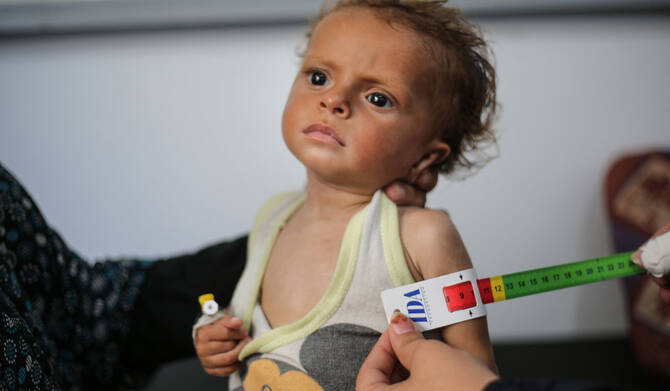
A malnourished Palestinian child is examined at Al-Awda hospital in the Nuseirat refugee camp in the central Gaza Strip on June 30, 2025. (AFP)
Short Url
Updated 01 July 2025
Follow

USAID cuts may cause over 14 million additional deaths by 2030, study says

  • Projections suggest that ongoing deep funding cuts - combined with the potential dismantling of the agency - could result in more than 14 million additional deaths by 2030, including 4.5 million deaths among children younger than 5 years

PARIS: More than 14 million of the world’s most vulnerable people, a third of them small children, could die because of the Trump administration’s dismantling of US foreign aid, a study in the Lancet journal projected Tuesday.
“For many low- and middle-income countries, the resulting shock would be comparable in scale to a global pandemic or a major armed conflict,” study co-author Davide Rasella, a researcher at the Barcelona Institute for Global Health, said in a statement.

WHY IT'S IMPORTANT
President Donald Trump's administration, since taking office in January, has made funding cuts to USAID and its aid programs worldwide in what the U.S. government says is part of its broader plan to remove wasteful spending.
Human rights experts and advocates have warned against the cuts. USAID funding has had a crucial role in improving global health, primarily directed toward low and middle-income countries, particularly African nations, according to the study.

BY THE NUMBERS
The study estimated that over the past two decades, USAID-funded programs have prevented more than 91 million deaths globally, including 30 million deaths among children.
Projections suggest that ongoing deep funding cuts - combined with the potential dismantling of the agency - could result in more than 14 million additional deaths by 2030, including 4.5 million deaths among children younger than 5 years, the study in The Lancet said.
Washington is the world's largest humanitarian aid donor, amounting to at least 38% of all contributions recorded by the United Nations. It disbursed $61 billion in foreign assistance last year, just over half of it via USAID, according to government data.

KEY QUOTE
"Our estimates show that, unless the abrupt funding cuts announced and implemented in the first half of 2025 are reversed, a staggering number of avoidable deaths could occur by 2030," the study said.

CONTEXT
U.S. Secretary of State Marco Rubio said in March the Trump administration canceled over 80% of all programs at USAID following a six-week review.
The remaining approximately 1,000 programs, he said, would now be administered "more effectively" under the U.S. State Department and in consultation with Congress.


Ukraine’s Zelensky: We have backed US peace proposals to get a deal done

Updated 4 sec ago
Follow

Ukraine’s Zelensky: We have backed US peace proposals to get a deal done

  • “The tactic we chose is for the Americans not to think that we want to continue the war,” Zelensky ‌told The Atlantic

Ukrainian President Volodymyr Zelensky said Kyiv ‌had sought to back US peace proposals to end the war with Russia as President Donald Trump seeks to resolve the conflict before ​November mid-term elections.
Zelensky, in an interview published by The Atlantic on Thursday, said Kyiv was willing to hold both a presidential election and a referendum on a deal, but would not settle for an accord that was detrimental to Ukraine’s interests.
“The tactic we chose is for the Americans not to think that we want to continue the war,” Zelensky ‌told the ‌US-based publication. “That’s why we started supporting their ​proposals in ‌any ⁠format ​that speeds ⁠things along.”
He said Ukraine was “not afraid of anything. Are we ready for elections? We’re ready. Are we ready for a referendum? We’re ready.”
Zelensky has sought to build good relations with Washington since an Oval Office meeting in February 2025 descended into a shouting match with Trump and US Vice President JD ⁠Vance.
But he said he had rejected a ‌proposal, reported this week by the ‌Financial Times, to announce the votes ​on February 24, the fourth ‌anniversary of Russia’s invasion. A ceasefire and proposed US security ‌guarantees against a future invasion had not yet been settled, he said.
“No one is clinging to power,” The Atlantic quoted him as saying. “I am ready for elections. But for that we need security, guarantees ‌of security, a ceasefire.”
And he added: “I don’t think we should put a bad deal ⁠up for a ⁠referendum.”
Russian President Vladimir Putin has said Zelensky is not a legitimate negotiating partner because he has not faced election since coming to power in 2019.
Zelensky has said in recent weeks that a document on security guarantees for Ukraine is all but ready to be signed.
But, in his remarks, he acknowledged that details remained unresolved, including whether the US would be willing to shoot down incoming missiles over Ukraine if Russia were to violate the peace.
“This hasn’t been fixed ​yet,” Zelensky said. “We have raised ​it, and we will continue to raise these questions...We need all of this to be written out.”