

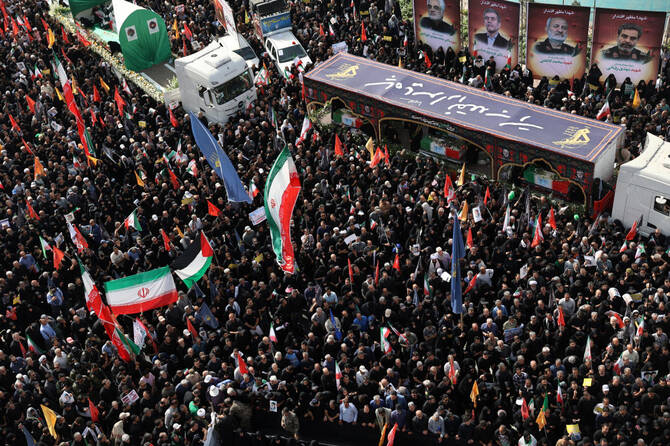
Thousands mourn top Iranian military commanders and scientists killed in Israeli strikes

People attend the funeral procession of Iranian military commanders, nuclear scientists and others killed in Israeli strikes, in Tehran on June 28, 2025. (West Asia News Agency via Reuters)
Short Url
Updated 28 June 2025
Follow

Thousands mourn top Iranian military commanders and scientists killed in Israeli strikes

  • Caskets of Guard chief Gen. Hossein Salami and Gen. Amir Ali Hajjizadeh and others were driven on trucks along the capital
  • Saturday’s ceremonies were the first public funerals for top commanders since the ceasefir

DUBAI: Thousands of mourners lined the streets of downtown Tehran on Saturday for the funeral of the head of the Revolutionary Guard and other top commanders and nuclear scientists killed during a 12-day war with Israel.

The caskets of Guard’s chief Gen. Hossein Salami, the head of the Guard’s ballistic missile program, Gen. Amir Ali Hajjizadeh and others were driven on trucks along the capital’s Azadi Street.

Salami and Hajjizadeh were both killed on the first day of the war, June 13, as Israel launched a war it said meant to destroy Iran’s nuclear program, specifically targeting military commanders, scientists and nuclear facilities.

Over 12 days before a ceasefire was declared on Tuesday, Israel claimed it killed around 30 Iranian commanders and 11 nuclear scientists, while hitting eight nuclear-related facilities and more than 720 military infrastructure sites. More than 1,000 people were killed, including at least 417 civilians, according to the Washington-based Human Rights Activists group.

Iran fired more than 550 ballistic missiles at Israel, most of which were intercepted, but those that got through caused damage in many areas and killed 28 people.

Saturday’s ceremonies were the first public funerals for top commanders since the ceasefire, and Iranian state television reported that they were for 60 people in total, including four women and four children.

Authorities closed government offices to allow public servants to attend the ceremonies.

Iran has always insisted its nuclear program is only for peaceful purposes. But Israel views it as an existential threat and said its military campaign was necessary to prevent Iran from building an atomic weapon.


Editorial: The threat of Yemen’s fragmentation is far reaching

President of Yemen’s Presidential Leadership Council Rashad Mohammed Al-Alimi. (SABA Net)
Updated 7 sec ago
Follow

Editorial: The threat of Yemen’s fragmentation is far reaching

  • The southern issue is a just cause — one that must be addressed in any future political settlement and not reduced to the ambitions of any single individual, including the likes of Aidarous Al-Zubaidi

RIYADH: As Yemen’s political landscape continues to shift at a dizzying pace, it is worth pausing to reflect on the official Saudi position — and the commentary of some of our leading Saudi columnists — regarding the recent unilateral moves by the Southern Transitional Council (STC) in the governorates of Hadramout and Al-Mahrah. These actions, taken without the consent of the Presidential Leadership Council (PLC) or coordination with the Arab Coalition, represent a dangerous gamble with the future of a fragile nation — one that Saudi Arabia, like its Arab neighbors, wishes only peace, stability, and prosperity.
There is no ambiguity in the Kingdom’s stance: it has worked tirelessly to preserve calm in Hadramout and Al-Mahrah, steering both regions away from military escalation and toward peaceful solutions. In a bid to contain the situation, Saudi Arabia, in coordination with its brothers and partners in the United Arab Emirates and the PLC, dispatched a joint team to negotiate with the STC. The goal was clear — facilitate the withdrawal of STC forces and hand over military sites to the National Shield Forces.
Yet despite Riyadh’s call for de-escalation and its appeal to the STC to prioritize national interest and social cohesion, the Council has persisted in its confrontational posture, seemingly indifferent to the grave consequences of its actions.
Observers in Riyadh will note that the Kingdom remains steadfast in its support for the PLC and Yemen’s internationally recognized government. Its commitment to Yemen’s stability is not rhetorical — it is political, economic, and developmental. Saudi Arabia’s vision is to shepherd Yemen from the shadows of conflict into an era of peace, prosperity, and regional integration. This is not merely a function of geography or shared borders; it is a reflection of the Kingdom’s religious, political, and economic responsibilities in the Arab and Islamic world.
From this vantage point, the newspaper firmly believes that the STC’s unilateral actions in Hadramout constitute a blatant violation of Yemen’s transitional framework. They undermine the legitimacy of the recognized government, threaten the fragile peace, and jeopardize the political process. Worse still, they echo the very tactics employed by the Houthi militias — an alarming parallel that should not be ignored.
It is therefore essential to reiterate the Kingdom’s position: the STC must withdraw its forces from Hadramout and Al-Mahrah, restoring the status quo ante. This is not a punitive demand, but a necessary step to safeguard national security and prevent further military flare-ups.
At the same time, Saudi Arabia has consistently affirmed that the southern issue is a just cause — one that must be addressed in any future political settlement. It is enshrined in the outcomes of Yemen’s National Dialogue and must be resolved inclusively, reflecting the aspirations of all southern Yemenis — not reduced to the ambitions of any single individual, including the likes of Aidarous Al-Zubaidi or other STC figures.
Ultimately, we urge the separatists to choose reason over recklessness. Partitioning Yemen will not bring peace — it will sow the seeds of future wars, embolden extremist actors, and pose a threat not only to Yemen’s internal cohesion but to regional and international stability. As Western and American policymakers know all too well: what happens in Yemen never stays in Yemen.