

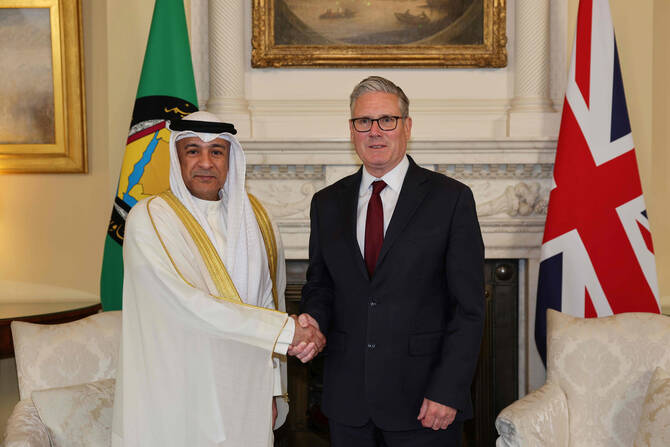

RIYADH: The UK-Gulf Cooperation Council free trade deal is set to be worth far more than the anticipated $5 billion boost to Britain’s economy, Arab News has been told, as the two economies become increasingly interlinked.
The deal, signed on May 20, is the first such agreement between a G7 nation and the GCC, and is seen as a structural bet on Gulf economic transformation and a precedent-setter for how the bloc will engage with major economies for decades to come.
Combined with the India FTA signed by the UK in July, the deals are expected to add more than £8 billion ($10.7 billion) annually to British GDP relative to 2040 forecasts, marking a significant shift in the country’s post-EU trade architecture.
Beirut-based economist and academic Jassem Ajaka told Arab News that the asymmetry of need works in the deal’s favor, saying: “For the UK, the pact opens a vital gateway to GCC markets — a strategic priority following its departure from the EU.
“For the Gulf states, securing a deal with one of the world’s largest economies promises to deepen bilateral investment and accelerate capital flows in both directions.”
In a note sent to the media following the deal, Georges Elhedery, group CEO of HSBC, said the opportunity was visible from both sides.
“We see first-hand the opportunity this agreement can unlock and stand ready to help deepen economic ties and support businesses to connect, invest and grow,” he noted.
Timed for Gulf transformation
The deal’s economic logic is closely tied to the GCC’s own transformation. Saudi Arabia’s Vision 2030, the UAE’s push to become a global finance and technology hub, Qatar’s post-World Cup infrastructure drive, and similar modernization plans across the bloc have created strong demand for the very services in which Britain excels — from finance and engineering to cybersecurity and fintech.
Ajaka said that the deal “carries transformative potential for GCC economies seeking to diversify beyond oil.”
He added: “The UK brings financial expertise and advanced services that Gulf nations need for their modernization agendas, while the GCC offers a dynamic, high-growth market the UK urgently needs.”
David Landsman, executive chair of British Expertise International, a membership network connecting UK professional and technical services firms with global opportunities, told Arab News that British firms are already embedded in that transformation.
“BEI members and other British firms are already playing a significant role in the ambitious transformation programs across the Gulf, as the governments of the region seek to strengthen both their physical and human capital,” he said, adding: “This deal, the first the GCC has concluded with any G7 member, strengthens the potential yet further.”
Tariffs are not the most important part
The tariff reductions will generate the most attention. Cars, biscuits, salmon, and medical equipment will all move toward duty-free entry, eliminating an estimated £580 million in annual costs for UK exporters. Around two-thirds of UK goods will enter the GCC tariff-free on day one, rising to 93 percent after 10 years.
Ajaka noted that improved access to UK food markets “directly addresses one of the GCC’s most pressing strategic vulnerabilities: food security” — a point of particular significance for a bloc that imports over 80 percent of what it consumes.
He argued the deal reflects a broader shift in the Gulf’s negotiating posture, saying: “GCC nations have transformed from rule-takers to rule-makers. The Gulf is setting new guidelines driven by the need to achieve food security, given that it imports most of its consumption, and negotiating this with the UK demonstrates their strong negotiating position.”
The more structurally significant provisions, however, lie in services, digital trade, and data. Services account for around 80 percent of the British economy and roughly half of UK exports to the GCC.
For the first time in any GCC trade agreement, the bloc has agreed to prohibit unjustified data localization requirements, meaning UK technology and financial firms can store and process data outside the Gulf without establishing costly local data centers. That single provision removes a barrier that has long disadvantaged smaller British firms and added operational complexity for larger ones.
The business mobility commitments are similarly consequential.
The GCC has agreed to its most ambitious visa transparency provisions ever granted to a trading partner.
For UK lawyers, engineers, architects, and consultants who need to be physically present in the region to win and deliver contracts, the opacity of Gulf visa processes has been a genuine commercial deterrent.
Commitments to publish requirements in English and process them consistently change the practical economics of professional services market entry.
Landsman said the mobility and data provisions were where the deal would be most felt by his members.
“This is very much a modern FTA with an extensive focus on services as well as goods and so plays well to the UK’s strengths in the professional and technical services sectors,” he said.
The British Expertise International official added: “Modern services are delivered by a combination of people and technology, so the mobility provisions — making it easier for consultants and other experts to travel, work, and operate from offices in GCC countries, while allowing for mutual recognition of qualifications — will significantly ease doing business, as will innovative data movement measures.”
The precedent that matters most
This is the GCC’s first-ever agreement with a G7 nation. The commitments on data flows, business mobility, services access, and digital trade now set the bloc’s established negotiating floor for future agreements with other major economies.
For the Gulf states, the deal signals to global markets that their economies are commercially sophisticated and capable of structuring modern trade relationships, itself a form of economic diplomacy with value beyond the bilateral.
Ajaka sees the GCC’s position only strengthening from here.
“Looking ahead, GCC nations will have the upper hand for several reasons, including their unity,” he said, adding: “The conflict with Iran showed that GCC nations are a cornerstone of the region, beyond being just oil hubs. Plans like Saudi Arabia’s Vision 2030 also signal to foreign investors that these nations are following a clear roadmap and exceeding targets across multiple sectors.”
On the deal’s projected 19.8 percent increase in bilateral trade, he was skeptical that the figure captures the full picture. “The real figure will likely be much larger. In terms of capital deployment and investment, Gulf sovereign wealth funds play a very significant role, particularly in diversifying into sustainable sectors.”
Ajaka added that the agreement has proven that the GCC possesses strong negotiating capabilities and has mastered the art of geopolitical and economic alliance-building.
He concluded: “GCC nations are now a prominent global economic hub.”
Gains that will take time to materialize
Thomas Kuruvilla, managing partner for the Middle East and India at Arthur D. Little, welcomed the deal but struck a note of caution. “The UK-GCC trade agreement creates real opportunity, particularly in technology, capital, and clean energy, but only for those prepared to compete at the pace the Gulf now expects,” he told Arab News, adding: “What’s more, its long-term success will depend less on headline tariff reductions and more on practical execution.”
The agreement is not an overnight economic transformation. Its gains will be gradual and contingent on implementation quality and a regional security environment that remains fragile.


