
DUBAI: Israel claimed Tuesday to have killed a top Iranian general as it traded more strikes with its longtime foe, and US President Donald Trump warned residents of Tehran to evacuate while demanding that Iran surrender without conditions.
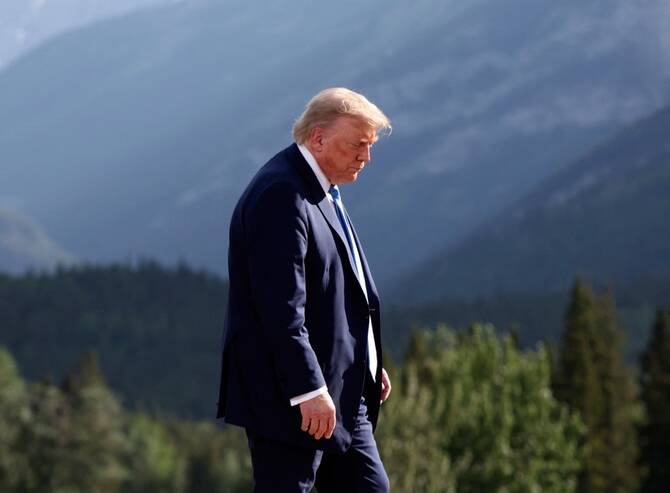
Trump left the Group of Seven summit in Canada a day early to deal with the conflict between Israel and Iran, telling reporters on Air Force One during the flight back to Washington: “I’m not looking at a ceasefire. We’re looking at better than a ceasefire.”
When asked to explain, he said the US wanted to see “a real end” to the conflict that could involve Iran “giving up entirely.” He added: “I’m not too much in the mood to negotiate.”
Later on social media, he warned Supreme Leader Ayatollah Ali Khamenei that the US knows where he is hiding and called for Iran’s “UNCONDITIONAL SURRENDER.”
It was not clear what Trump meant by urging Iran to surrender or if he was suggesting that the country give up its nuclear ambitions.
No immediate response from Iran, but military leaders vowed Israel would soon see more attacks
“The operations carried out so far have been solely for the purpose of warning and deterrence,” Gen. Abdul Rahim Mousavi, the commander in chief of Iran’s army, said in a video. “The punishment operation will be carried out soon.”
Trump’s hard line added to the uncertainty roiling the region on the fifth day of Israel’s air campaign aimed at Iran’s military and nuclear program.
Residents of Tehran fled their homes in droves, and the UN nuclear watchdog for the first time said Israeli strikes on Iran’s main uranium-enrichment facility at Natanz had also damaged its main underground section, not just an above-ground facility, as previously acknowledged.
Israel says its sweeping assault is necessary to prevent its adversary from getting any closer to building an atomic weapon. The strikes have killed at least 224 people in Iran.
Iran has retaliated by launching some 400 missiles and hundreds of drones at Israel. So far, 24 people have been killed in Israel.
EU foreign ministers all agreed on need for urgent de-escalation in Middle East, says Kallas
European Union foreign policy chief Kaja Kallas on Tuesday reaffirmed the need for an urgent de-escalation in the Middle East, where Iran and Israel have been firing missiles at each other since Friday, while also saying Tehran should not develop a nuclear bomb.
“We all agreed the urgent need for de-escalation, Iran cannot have a nuclear bomb and diplomacy is the solution to prevent this and the EU will play its part,” she told reporters after a meeting with EU foreign ministers.
“We cannot be lenient when Iran accelerates its nuclear program.”
Israel says killed top Iran commander and aide to supreme leader
The Israeli military said Tuesday it killed Iran’s top military commander, Ali Shadmani, in an overnight strike, calling him the closest figure to supreme leader Ayatollah Ali Khamenei.

Ali Shadmani was apparently killed over Monday night. (Internet)
In a statement, the military said following “a sudden opportunity overnight, the (Israeli air force) struck a staffed command center in the heart of Tehran and eliminated Ali Shadmani, the war-time Chief of Staff, the most senior military commander, and the closest figure to Iranian Supreme Leader Ali Khamenei.”
The Israeli military said Shadmani had commanded both the Islamic Revolutionary Guard Corps and the Iranian armed forces.
Trump team proposes Iran talks this week on nuclear deal, ceasefire
The US is discussing with Iran the possibility of a meeting this week between US envoy Steve Witkoff and Iranian Foreign Minister Abbas Araghchi to discuss a nuclear deal and an end to the war between Israel and Iran, Axios reported on Monday citing four sources briefed on the issue.
Trump to depart the G7 early as conflict between Israel and Iran shows signs of intensifying
President Donald Trump is abruptly leaving the Group of Seven summit, departing a day early Monday as the conflict between Israel and Iran intensifies and the US leader has declared that Tehran should be evacuated “immediately.”
World leaders had gathered in Canada with the specific goal of helping to defuse a series of global pressure points, only to be disrupted by a showdown over Iran’s nuclear program that could escalate in dangerous and uncontrollable ways.
Israel launched an aerial bombardment campaign against Iran four days ago.

At the summit, Trump warned that Tehran needs to curb its nuclear program before it’s “too late.” He said Iranian leaders would “like to talk” but they had already had 60 days to reach an agreement on their nuclear ambitions and failed to do so before the Israeli aerial assault began. “They have to make a deal,” he said.
Asked what it would take for the US to get involved in the conflict militarily, Trump said Monday morning, “I don’t want to talk about that.”
White House says US forces remain in ‘defensive posture’ in Middle East
US forces in the Middle East remain in a “defensive posture, and that has not changed,” the White House said Monday as Israel and Iran traded heavy strikes for a fourth day.
“We will defend American interests,” White House spokesperson Alex Pfeiffer added in a post on social media.
China tells citizens in Israel to leave ‘as soon as possible’
China’s embassy in Israel on Tuesday urged its citizens to leave the country “as soon as possible,” after Israel and Iran traded heavy strikes.
“The Chinese mission in Israel reminds Chinese nationals to leave the country as soon as possible via land border crossings, on the precondition that they can guarantee their personal safety,” the embassy said in a statement on WeChat.
“It is recommended to depart in the direction of Jordan,” it added.
Airports close across the Mideast as the Israel-Iran conflict shutters the region’s airspace
Israel has closed its main international Ben Gurion Airport “until further notice,” leaving more than 50,000 Israeli travelers stranded abroad. The jets of the country’s three airlines have been moved to Larnaca.
In Israel, Mahala Finkleman was stuck in a Tel Aviv hotel after her Air Canada flight was canceled, trying to reassure her worried family back home while she shelters in the hotel’s underground bunker during waves of overnight Iranian attacks.
“We hear the booms. Sometimes there’s shaking,” she said. “The truth, I think it’s even scarier … to see from TV what happened above our heads while we were underneath in a bomb shelter.”

Israeli Prime Minister Benjamin Netanyahu’s office warned Israelis not to flee the country through any of the three crossings with Jordan and Egypt that are open to the Israeli public. Despite having diplomatic ties with Israel, the statement said those countries are considered a “high risk of threat” to Israeli travelers.
Iran on Friday suspended flights to and from the country’s main Khomeini International Airport on the outskirts of Tehran. Israel said Saturday that it bombed Mehrabad Airport in an early attack, a facility in Tehran for Iran’s air force and domestic commercial flights.
Israel says strikes have set back nuclear program
Prime Minister Benjamin Netanyahu said the Israeli strikes have set Iran’s nuclear program back a “very, very long time,” and told reporters he is in daily touch with Trump.
“The regime is very weak,” he added.
Israel says its sweeping assault on Iran’s top military leaders, uranium enrichment sites and nuclear scientists, is necessary to prevent its longtime adversary from getting any closer to building an atomic weapon. The strikes have killed at least 224 people since Friday.
Iran maintains that its nuclear program is peaceful, and the US and others have assessed that Tehran has not had an organized effort to pursue a nuclear weapon since 2003. The head of the International Atomic Energy Agency has repeatedly warned that the country has enough enriched uranium to make several nuclear bombs should it choose to do so.
Iran has retaliated by launching more than 370 missiles and hundreds of drones at Israel. So far, 24 people have been killed in Israel and more than 500 injured.
The back-and-forth has raised concerns about all-out war between the countries and propelled the region, already on edge, into even greater upheaval.
Israel’s military issues evacuation warning affecting up to 330,000 people
Earlier Monday, Israel’s military issued an evacuation warning to 330,000 people in a part of central Tehran that houses the country’s state TV and police headquarters, as well as three large hospitals, including one owned by Iran’s paramilitary Revolutionary Guard. The city, one of the region’s largest, is home to around 9.5 million people.
Israel’s military has issued similar evacuation warnings for civilians in parts of Gaza and Lebanon ahead of strikes.
State-run television abruptly stopped a live broadcast after the station was hit, according to Iran’s state-run news agency. While on the air, an Iranian state television reporter said the studio was filling with dust after “the sound of aggression against the homeland.” Suddenly, an explosion occurred, cutting the screen behind her as she hurried off camera.

Heavy traffic on the Karaj-Chalus road as vehicles move westwards in a direction leading out of Tehran, Iran. (Reuters)
The broadcast quickly switched to prerecorded programs. The station later said its building was hit by four bombs.
An anchor said on air that a few colleagues had been hurt, but their families should not be worried. The network said its live programs were transferred to another studio.
Israel claims ‘full aerial superiority’ over Tehran
Israeli military spokesperson Brig. Gen. Effie Defrin said Monday that his country’s forces had “achieved full aerial superiority over Tehran’s skies.”
The military said it destroyed more than 120 surface-to-surface missile launchers in central Iran, a third of Iran’s total, as well as two F-14 planes that Iran used to target Israeli aircraft and multiple launchers just before they launched ballistic missiles toward Israel.
Israeli military officials also said fighter jets had struck 10 command centers in Tehran belonging to Iran’s Quds Force, an elite arm of its Revolutionary Guard that conducts military and intelligence operations outside Iran.

Smoke and fire rise at an impacted facility site following missile attack from Iran on Israel, at Haifa, Israel. (Reuters)
The Israeli strikes “amount to a deep and comprehensive blow to the Iranian threat,” Defrin said.
One missile fell near the American consulate in Tel Aviv, with its blast waves causing minor damage, US Ambassador Mike Huckabee said on X. He added that no American personnel were injured.
Explosions rock Tel Aviv, Petah Tikva and Haifa oil refinery
Powerful explosions rocked Tel Aviv shortly before dawn Monday, sending plumes of black smoke into the sky over the coastal city.
Authorities in the central Israeli city of Petah Tikva said Iranian missiles hit a residential building there, charring concrete walls, shattering windows and ripping the walls off multiple apartments.
Iranian missiles also hit an oil refinery in the northern city of Haifa for the second night in a row. The early morning strike killed three workers, ignited a significant fire and damaged a building, Israel’s fire and rescue services said. The workers were sheltering in the building’s safe room when the impact caused a stairwell to collapse, trapping them inside.
Firefighters rushed to extinguish the fire and rescue them, but the three died before rescuers could reach them.
No sign of conflict letting up
Iran’s foreign minister, Abbas Araghchi, appeared to make a veiled outreach Monday for the US to step in and negotiate an end to hostilities between Israel and Iran.
In a post on X, Araghchi wrote that if Trump is “genuine about diplomacy and interested in stopping this war, next steps are consequential.”
“It takes one phone call from Washington to muzzle someone like Netanyahu,” Iran’s top diplomat wrote. “That may pave the way for a return to diplomacy.”
The message to Washington was sent as the latest talks between the US and Iran were canceled over the weekend after Israel targeted key military and political officials in Tehran.
On Sunday, Araghchi said that Iran will stop its strikes if Israel does the same.
The conflict has also forced most countries in the Middle East to close their airspace. Dozens of airports have stopped all flights or severely reduced operations, leaving tens of thousands of passengers stranded and others unable to flee the conflict or travel home.
Health authorities reported that 1,277 people were wounded in Iran. Iranians also reported fuel rationing.
Rights groups such as the Washington-based Iranian advocacy group Human Rights Activists have suggested that the Iranian government’s death toll is a significant undercount. The group says it has documented more than 400 people killed, among them 197 civilians.
Ahead of Israel’s initial attack, its Mossad spy agency positioned explosive drones and precision weapons inside Iran. Since then, Iran has reportedly detained several people and hanged one on suspicion of espionage.