

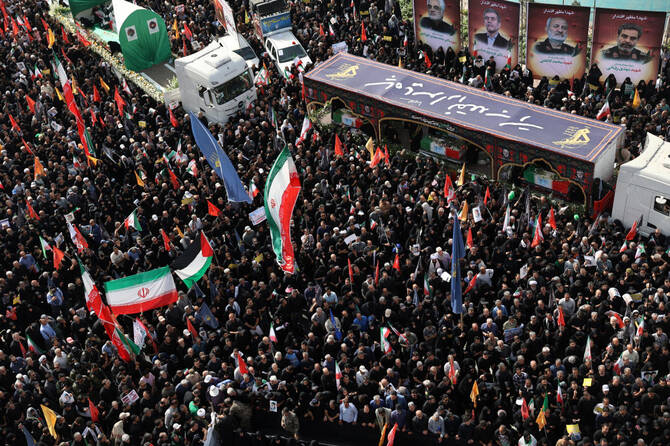
Thousands mourn top Iranian military commanders and scientists killed in Israeli strikes

People attend the funeral procession of Iranian military commanders, nuclear scientists and others killed in Israeli strikes, in Tehran on June 28, 2025. (West Asia News Agency via Reuters)
Short Url
Updated 28 June 2025
Follow

Thousands mourn top Iranian military commanders and scientists killed in Israeli strikes

  • Caskets of Guard chief Gen. Hossein Salami and Gen. Amir Ali Hajjizadeh and others were driven on trucks along the capital
  • Saturday’s ceremonies were the first public funerals for top commanders since the ceasefir

DUBAI: Thousands of mourners lined the streets of downtown Tehran on Saturday for the funeral of the head of the Revolutionary Guard and other top commanders and nuclear scientists killed during a 12-day war with Israel.

The caskets of Guard’s chief Gen. Hossein Salami, the head of the Guard’s ballistic missile program, Gen. Amir Ali Hajjizadeh and others were driven on trucks along the capital’s Azadi Street.

Salami and Hajjizadeh were both killed on the first day of the war, June 13, as Israel launched a war it said meant to destroy Iran’s nuclear program, specifically targeting military commanders, scientists and nuclear facilities.

Over 12 days before a ceasefire was declared on Tuesday, Israel claimed it killed around 30 Iranian commanders and 11 nuclear scientists, while hitting eight nuclear-related facilities and more than 720 military infrastructure sites. More than 1,000 people were killed, including at least 417 civilians, according to the Washington-based Human Rights Activists group.

Iran fired more than 550 ballistic missiles at Israel, most of which were intercepted, but those that got through caused damage in many areas and killed 28 people.

Saturday’s ceremonies were the first public funerals for top commanders since the ceasefire, and Iranian state television reported that they were for 60 people in total, including four women and four children.

Authorities closed government offices to allow public servants to attend the ceremonies.

Iran has always insisted its nuclear program is only for peaceful purposes. But Israel views it as an existential threat and said its military campaign was necessary to prevent Iran from building an atomic weapon.


Italy wants military to stay in Lebanon after peacekeepers leave

Updated 2 sec ago
Follow

Italy wants military to stay in Lebanon after peacekeepers leave

  • Defense Minister Guido Crosetto says Italy will continue to 'do its part' even after UNIFIL mission ends next year
ROME: Italy said Monday it intends to keep a military presence in Lebanon even after the UN peacekeeping force it belongs to leaves as planned from December 31, 2026.
“Even after (the peacekeeping force) UNIFIL, Italy will continue to do its part, supporting with conviction the international presence and supporting the capacity development of the Lebanese armed forces,” Defense Minister Guido Crosetto said during a visit to Lebanon, according to a statement.
Asked by AFP if this meant Italy wanted to maintain a military presence in the country, a ministry spokesman confirmed that this was the case.
The United Nations Interim Force in Lebanon (UNIFIL) has acted as a buffer between Israel and Lebanon since 1978, remaining after Israel ended an occupation of southern Lebanon in 2000.
Lebanon had wanted UNIFIL to stay.
But the UN Security Council voted in August to allow only one final extension for UNIFIL after pressure from Israel and its US ally to end the mandate.
UNIFIL is currently led by Italian Major General Diodato Abagnara and numbers 9,923 troops from 49 countries, according to the force’s website.
Italy is the second biggest contributing country with 1,099 soldiers deployed after Indonesia which has 1,232 soldiers.
Israel has hailed the termination of UNIFIL and urged the Beirut government to exert its authority after an Israeli military campaign which devastated Iranian-backed militia Hezbollah.
Under a truce between Israel and Hezbollah, the long-fledgling Lebanese national army has been deploying in southern Lebanon and dismantling Hezbollah’s infrastructure.
“Support is needed to strengthen the Lebanese armed forces, so that they are in the best possible position to defend the country, ensuring security and respect for its borders,” Crosetto said in Monday’s statement.
“We will guarantee our presence in multilateral and bilateral contexts,” he said.