GENEVA: Medical charity Doctors Without Borders (MSF) called on Friday for a controversial Israel- and US-backed relief effort in Gaza to be halted, branding it “slaughter masquerading as humanitarian aid.”
The Gaza Humanitarian Foundation, which began operating last month, “is degrading Palestinians by design, forcing them to choose between starvation or risking their lives for minimal supplies,” MSF said in a statement.
It said more than 500 people have been killed in the Gaza Strip while seeking food in recent weeks.
Starting in March, Israel blocked deliveries of food and other crucial supplies into Gaza for more than two months, leading to warnings of that the entire population of the occupied Palestinian territory is at risk of famine.
The United Nations says Israel’s occupation of the West Bank and Gaza is illegal under international law.
The densely populated Gaza Strip has been largely flattened by Israeli bombing since the October 7, 2023, attack on Israel by Hamas.
Israel began allowing food supplies to trickle in at the end of May, using GHF — backed by armed US contractors, with Israeli troops on the perimeter — to run operations.
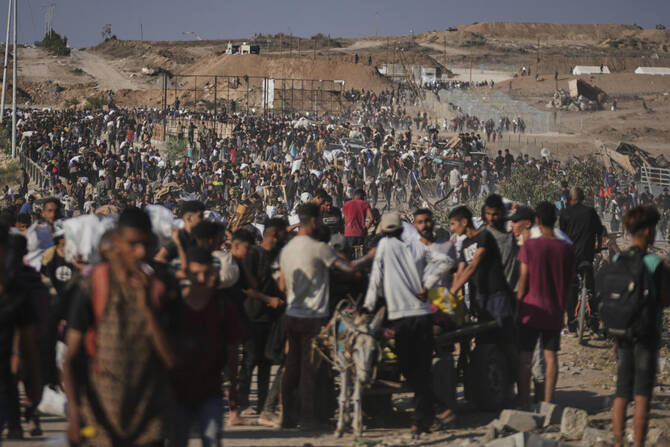
The latter have been marred by chaotic scenes and near-daily reports of Israeli forces firing on people desperate to get food.
There are also concerns about the neutrality of GHF, officially a private group with opaque funding.
The UN and major aid groups have refused to work with it, citing concerns it serves Israeli military goals and that it violates basic humanitarian principles.
The Gaza health ministry says that since late May, nearly 550 people have been killed near aid centers while seeking scarce food supplies.
“With over 500 people killed and nearly 4,000 wounded while seeking food, this scheme is slaughter masquerading as humanitarian aid and must be immediately dismantled,” MSF said.
GHF has denied that fatal shootings have occurred in the immediate vicinity of its aid points.
On Tuesday, the United Nations condemned what it said was Israel’s “weaponization of food” in Gaza and called it a war crime.
MSF said the way GHF distributes food aid supplies “forces thousands of Palestinians, who have been starved by an over 100 day-long Israeli siege, to walk long distances to reach the four distribution sites and fight for scraps of food supplies.”
“These sites hinder women, children, the elderly and people with disabilities from accessing aid, and people are killed and wounded in the chaotic process,” it said.
Aitor Zabalgogeazkoa, MSF’s emergency coordinator in Gaza, said the four sites were all under the full control of Israeli forces, surrounded by watch points and barbed wire.
“If people arrive early and approach the checkpoints, they get shot. If they arrive on time but there is an overflow and they jump over the mounds and the wires, they get shot,” he said in the statement.
“If they arrive late, they shouldn’t be there because it is an ‘evacuated zone’ — they get shot.”
MSF said that its teams in Gaza were seeing patients every day who had been killed or wounded trying to get food at one of the sites.
It pointed to “a stark increase in the number of patients with gunshot wounds.”
MSF urged “the Israeli authorities and their allies to lift the siege on food, fuel, medical and humanitarian supplies and to revert to the pre-existing principled humanitarian system coordinated by the UN.”


![]()

MSF slams Gaza aid scheme as ‘slaughter masquerading’ as aid
Short Url
https://arab.news/28fmt
MSF slams Gaza aid scheme as ‘slaughter masquerading’ as aid
- MSF says more than 500 people have been killed in the Gaza Strip while seeking food in recent weeks
- Charity says US-backed Gaza Humanitarian Foundation forces Palestinians to choose between starvation or risk their lives for minimal supplies


Latest updates





© 2026 SAUDI RESEARCH & PUBLISHING COMPANY, All Rights Reserved And subject to Terms of Use Agreement.