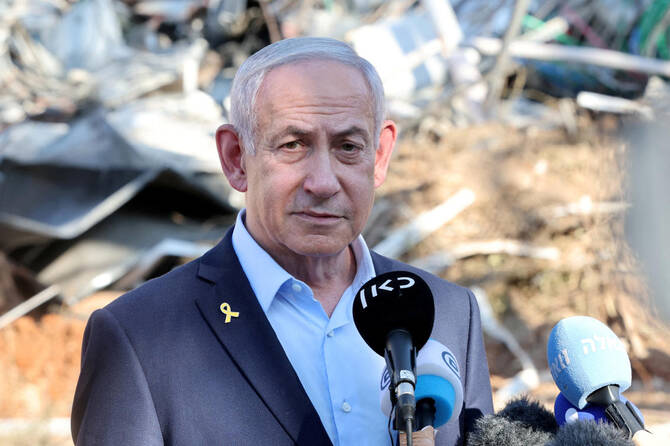
Israeli court rejects Netanyahu’s call to postpone graft trial hearings

Israel’s Prime Minister Benjamin Netanyahu has requested multiple postponements in the trial since it began in May 2020. (Reuters)
Short Url
Updated 28 June 2025
Follow

Israeli court rejects Netanyahu’s call to postpone graft trial hearings

  • Netanyahu has denied any wrongdoing and his supporters have described the long-running trial as politically motivated

JERUSALEM: An Israeli court on Friday rejected Prime Minister Benjamin Netanyahu’s request to postpone giving testimony in his corruption trial, after US President Donald Trump said the case should be canceled.

Netanyahu’s lawyer on Thursday asked the court to excuse the leader from hearings over the next two weeks, saying he needed to concentrate on “security issues” after Israel’s 12-day war with Iran.

The Jerusalem district court said in a judgment published online that “in its current form (his request) does not provide a basis or detailed justification for the cancelation of the hearings.”

Trump on Wednesday described the case against Netanyahu as a “witch hunt,” saying the trial “should be CANCELLED, IMMEDIATELY, or a Pardon given to a Great Hero.”

Netanyahu has thanked Trump for his support in Israel’s brief war against Iran, which ended with a ceasefire on June 24.

Netanyahu has denied any wrongdoing and his supporters have described the long-running trial as politically motivated.

In a first case, he and his wife, Sara, are accused of accepting more than $260,000 worth of luxury goods such as cigars, jewelry and champagne from billionaires in exchange for political favors.

In two other cases, Netanyahu is accused of attempting to negotiate more favorable coverage from two Israeli media outlets.

During his current term since late 2022, Netanyahu’s government has proposed a series of far-reaching judicial reforms that critics say were designed to weaken the courts.

Netanyahu has requested multiple postponements in the trial since it began in May 2020, citing the war in Gaza which started in 2023, later fighting in Lebanon and this month the conflict with Iran.


Ankara city hall says water cuts due to ‘record drought’

Updated 10 January 2026
Follow

Ankara city hall says water cuts due to ‘record drought’

  • Dam reservoir levels have dropped to 1.12 percent and taps are being shut off for several hours a day in certain districts on a rotating schedule in Ankara

ANKARA: Water cuts for the past several weeks in Turkiye’s capital were due to the worst drought in 50 years and an exploding population, a municipal official told AFP, rejecting accusations of mismanagement.
Dam reservoir levels have dropped to 1.12 percent and taps are being shut off for several hours a day in certain districts on a rotating schedule in Ankara, forcing many residents to line up at public fountains to fill pitchers.
“2025 was a record year in terms of drought. The amount of water feeding the dams fell to historically low levels, to 182 million cubic meters in 2025, compared with 400 to 600 million cubic meters in previous years. This is the driest period in the last 50 years,” said Memduh Akcay, director general of the Ankara municipal water authority.
Turkish President Recep Tayyip Erdogan has called the Ankara municipal authorities, led by the main opposition party, “incompetent.”
Rejecting this criticism, the city hall says Ankara is suffering from the effects of climate change and a growing population, which has doubled since the 1990s to nearly six million inhabitants.
“In addition to reduced precipitation, the irregularity of rainfall patterns, the decline in snowfall, and the rapid conversion of precipitation into runoff (due to urbanization) prevent the dams from refilling effectively,” Akcay said.
A new pumping system drawing water from below the required level in dams will ensure no water cuts this weekend, Ankara’s city hall said, but added that the problem would persist in the absence of sufficient rainfall.
Much of Turkiye experienced a historic drought in 2025. The municipality of Izmir, the country’s third-largest city on the Aegean coast, has imposed daily water cuts since last summer.